
Hardwood Floor Water Damage Repair: Minor Fixes to Full Replacement
Tyler McClelland leads mitigation operations for Advanced DRI across New York's Hudson Valley, directing water, mold, and large-loss response in the field. He holds IICRC Water Restoration Technician (WRT) and Applied Microbial Remediation Technician (AMRT) certifications and a New York State Mold Supervisor certification, and is trained in IRCA hospital safe construction practices recognized by The Joint Commission.

White ring, dark stain or cupped boards? How to fix minor water damage on hardwood, when to sand, and when the floor or subfloor must come up.
On solid hardwood, most minor water damage from clean water dries out and can be refinished, as long as it is dried slowly and checked with a moisture meter instead of by eye. The real question is how far the water got: into the finish, into the boards, or down into the subfloor.
Quick answer: On solid hardwood wet by clean water, photograph the damage, wipe up the water, clear rugs and furniture, check the ceiling or basement below, and dry with fans and a dehumidifier, not direct heat. White haze is moisture in the finish; dark stains mean water reached the wood. Never sand cupped boards until readings are stable. If the water came from a toilet or sewer line, sat overnight, or the boards feel soft, get the floor moisture-mapped: call (845) 294-8919.
Minor Water Damage You Can Usually Fix Yourself
How to Fix Minor Water Damage on Hardwood Floors, Step by Step
- Stop the source, then blot or extract. Use towels or a wet vac. Don't push water across the floor; every seam it crosses drinks.
- Clear the area. Pull rugs and furniture off the wet boards. Where water reached a wall, pry off the shoe molding so the board edges can breathe.
- Dry with air, not heat. Fans across the floor, a dehumidifier in the closed room. No space heaters or hair dryers: they dry the top of a board before the bottom and can make cupping worse.
- Take readings daily. Meter the wet area and a dry area of the same floor and write both down. Our guide on how restorers read moisture meters explains the numbers.
- Treat by symptom once readings match and stop changing, or call a pro if anything on the "no longer minor" list below applies.
The National Wood Flooring Association notes that minor damage often fades or disappears completely as the flooring dries out (NWFA Wood Flooring Installation Guidelines, p. 160). Patience beats sandpaper.
White or cloudy marks: moisture trapped in the finish
A milky ring means water is sitting in the finish, not the wood, often under a plant pot or a damp rug. Give it airflow and time; many marks clear on their own. If haze stays, buff gently with a cleaner approved for your finish. On polyurethane that stays cloudy, a flooring contractor can screen and recoat: abrade the top coat and add a fresh one without sanding to bare wood.
Skip the warm-iron and mayonnaise tricks from furniture care, and skip steam mops: the NWFA warns that water vapor penetrates wood fibers and can cause irreversible damage to the floor and finish (p. 152).
Gray or black stains: water reached the wood
Dark marks mean water got into the wood itself. In oak, iron is often involved. The USDA Forest Products Laboratory explains that woods rich in tannin-like extractives, oak among them, react with iron from nails and other steel to form a blue-black or gray stain, and that a saturated oxalic acid solution removes it when iron is the cause (USDA FPL, "Iron Stain on Wood"). If oxalic acid does nothing and bleach lifts the stain, the same paper says it was probably mildew.
So check for mold first. A dark stain that spreads, smells musty or sits over a soft spot can be mold or decay. Don't sand it; confirmed growth calls for mold remediation. Oxalic acid is toxic: wear gloves and eye protection, test a hidden spot, and rinse thoroughly with warm water afterward; on oak, don't leave it on too long or it can leave a pink stain. A stain through the full board means replacing that board, and a new board can stand out against aged finish.
Slight cupping after a spill or leak
Cupped boards have raised edges because the underside took on more moisture. As the wood dries, the cup often relaxes. Sand it flat while wet and the edges later shrink below the center: a crowned floor. Don't sand until the affected boards read the same as unaffected boards and stay steady.
It is no longer minor if:
- Standing water reached the seams or ran under the baseboards.
- The floor stayed wet more than a day or two. The EPA advises drying water-damaged areas within 24 to 48 hours to prevent mold growth (EPA, A Brief Guide to Mold, Moisture and Your Home).
- Water came through a ceiling or light fixture.
- Boards feel soft or spongy.
- There is a musty odor.
- Stains are appearing on the ceiling below.
- Engineered planks are bubbling or separating.
- The water came from a dishwasher or washing machine overflow (Category 2 under the IICRC S500 standard) or from a toilet backup, sewer line or outdoor flooding (Category 3, grossly contaminated). Clean water also degrades the longer it sits and the more dirty material it touches. See the first steps after any water leak.
What the Damage Looks Like and What It Means
Picture one board seen from the end. Its shape tells you where the moisture is.
| Shape | End view | What it tells you |
|---|---|---|
| Cupping | Edges up, center low (a shallow U) | The underside is wetter than the top |
| Crowning | Center up, edges low (an upside-down U) | Usually a cupped floor sanded too early, or repeated moisture from above |
| Buckling | Boards lifted off the subfloor | Heavy saturation, no room to expand; fasteners have let go |
Then match what you see to the likely cause:
| What you see | Likely cause | Usual next step |
|---|---|---|
| White ring or haze | Moisture in the finish | DIY: dry, buff; recoat if it stays |
| Gray or black stain | Water in the wood (iron and tannin in oak), or mold if musty | Spot-treat a small mark; pro and mold check for anything larger |
| Cupping | Wetter underside | Pro drying and monitoring, then sand once stable |
| Crowning | Sanded while cupped | Pro: stabilize, then re-sand |
| Buckling | Saturation | Replace the buckled section, check the subfloor |
| Soft spot, musty smell | Wet subfloor, possible decay or mold | Pro: open the floor |
| Bubbling engineered plank | Delamination | Replace the planks |
Buckling is the shape that doesn't come back. The NWFA says a buckled wood floor needs replacement wherever the buckling occurred, because the fasteners or adhesive no longer hold (p. 160). For everything else, decide from meter readings over several days, not from how the floor looks on day one.
Solid, Engineered, Laminate or LVP: Why the Floor Type Changes the Answer
Engineered hardwood handles everyday humidity swings better than solid wood but is less forgiving once soaked: solid boards swell and shrink back, delaminated engineered planks do not.
- Solid strip or plank: the most forgiving. Solid floors can be sanded and refinished numerous times (NWFA, p. 19), which leaves room to sand out cupping or stains.
- Engineered: depending on wear-layer thickness, it may be sanded and refinished once or more, or not at all if the wear layer is thin. Core swelling and delamination are what end it. Unlike most solid wood, engineered flooring can go below grade (pp. 19–20), so it's common in basements.
- Laminate: the fiberboard core swells at the edges and rarely recovers. Usually replaced.
- Luxury vinyl plank (LVP): the vinyl survives; the water gets trapped underneath, against the slab, out of sight.
- Floating floors in basements: laminate, LVP or engineered over concrete. Water under one edge can spread under the whole room.
- Parquet and glue-down: harder to dry in place, and the adhesive can fail.
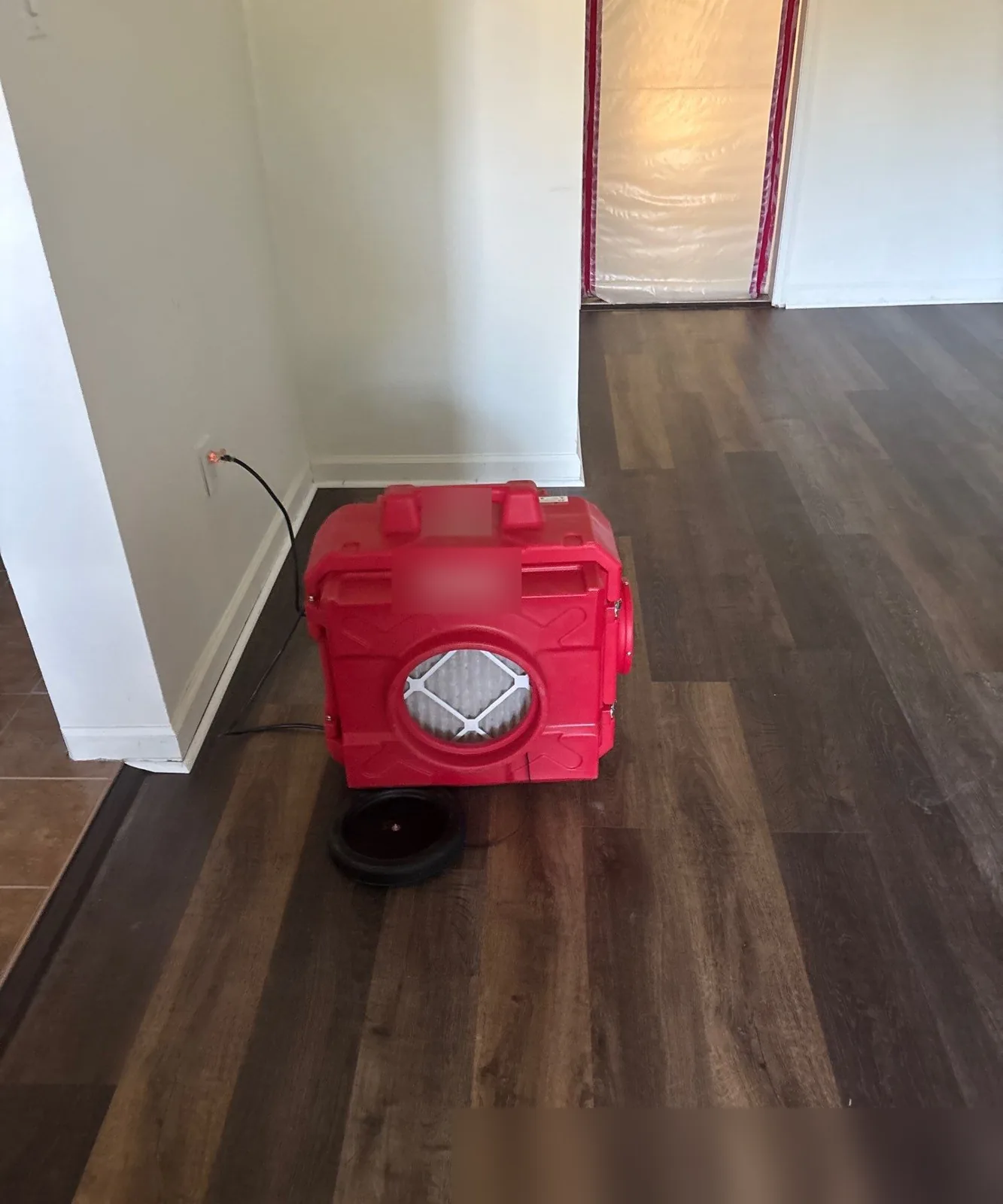
The vinyl in this 2026 West Point, NY photo looks untouched, and that is typical of LVP: the surface rarely shows damage, so whether water got underneath has to be settled with a meter or by lifting a plank. The red unit is an air scrubber, and the plastic in the doorway keeps tear-out dust inside the work area.
Safety before tear-out. Older resilient flooring and underlayment can contain asbestos (NWFA, pp. 105 and 160). The EPA says not to sand asbestos flooring or its backing and to leave sampling to an accredited professional (EPA). Painted baseboards in homes built before 1978 fall under the EPA's lead Renovation, Repair and Painting rule when a paid contractor disturbs them.
In older New York City apartments, crews often find solid oak strip or parquet. Whether it can take another sanding depends on how much wood is left above the tongue, which a flooring contractor checks before anyone quotes a refinish.
How Long Wet Hardwood Takes to Dry, and How Pros Dry It
There is no fixed number of days. The IICRC S500 standard treats water absorbed into low-evaporation materials such as hardwood, plaster and concrete as Class 4, which can call for specialty drying methods and longer drying times (see IICRC standards explained). Drying runs until readings match unaffected wood in the same home.
Moisture content decides when you can sand
Wood settles at a moisture level set by the room's humidity, so the target is what dry wood in your own house reads. The NWFA's water damage section lays out the method: insulated pin meters at multiple depths of flooring and subfloor, pinless meters to map the surface, a reference reading on unaffected wood, and a target within 2% of the expected in-use moisture content (p. 160). Pin meters need the right species setting and pinless meters are affected by density, which is why the reference reading comes first.
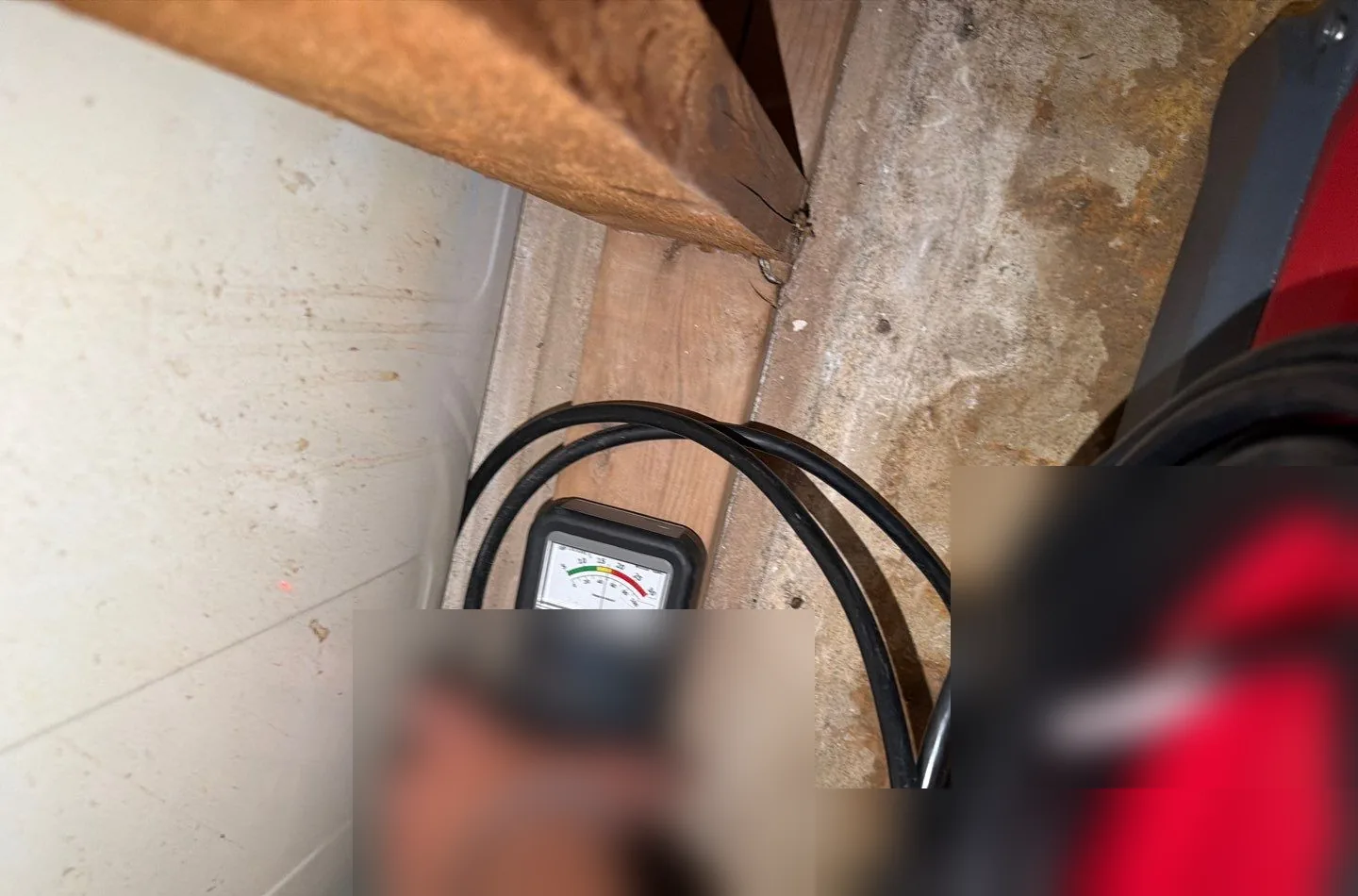
In this 2026 photo from Edison, NJ, a pin meter reads wet wood framing beside the drying hoses; the same meters and logging routine are used on floor boards and subfloor. Crews log readings at the same spots every visit; the day-to-day trend matters more than any single number.
Before anyone sands: the readiness check
- Readings taken in several spots on affected boards and on unaffected wood.
- Affected boards match unaffected wood and have stopped dropping over consecutive days.
- Replacement boards laced in: no more than a 2% moisture difference from the existing floor (NWFA, p. 154).
- New floor over a wood subfloor: no more than a 4% moisture-content difference between subfloor and flooring for solid strip under 3 inches wide, and 2% for plank 3 inches and wider (NWFA, p. 34). The product's installation instructions win if stricter.
How restoration crews dry wood floors
- Extraction first, then baseboards or shoe molding off so edges breathe.
- Floor drying mats or panels connected to suction pull water from the flooring surface (NWFA, p. 160).
- Tenting or pressure systems force dry air beneath and within the floor.
- Drying from below: the NWFA recommends dehumidifiers under the floor where possible, opening basements and crawlspaces to heat and airflow, and removing insulation from the underside of the joists.
- Controlled heat only, inside a closed system, with care not to damage other wood in the room. Not a space heater aimed at a wet board.
See how dehumidifiers dry a building. Mats, tents and drying from below take professional gear and daily monitoring, the core of water damage restoration.
A realistic timeline
Extraction, active drying, stabilization, then sanding. Wood floors usually take longer than drywall or carpet in the same room; the structural drying process covers Class 4 drying in depth.
When the Water Got Into the Subfloor
Water runs down. The NWFA notes that water migrates below the wood floor system any time there is a flood, and that the hidden subfloor may be in worse shape than the wood above it (p. 159).
Signs: soft spots, a musty smell that outlasts the surface drying, popping fasteners, stains or drips on the ceiling below, and boards that cup again after seeming dry.
Plywood vs OSB. Plywood can swell, distort and delaminate. OSB swells and loses density and strength, which weakens how well fasteners hold the floor down. The NWFA's guidance for both: replace when damage is evident, and confirm new panels are within acceptable moisture ranges before flooring goes back (p. 159).
Mold under the floor. The same EPA guide says homeowners can usually clean an area under about 10 square feet; for more, or after heavy water damage, it points to professional remediation guidance. Professional work follows IICRC S520 containment.
Our crews dry subfloors and crawlspaces across the region, from our Toms River water damage team to water damage restoration in Hartford. If the subfloor is wet or decayed, refinishing the top is cosmetic. The floor comes up.
Repair or Replace?
Whether hardwood floor water damage can be repaired comes down to floor type and how far the water went. Solid hardwood often can be; laminate and soaked engineered planks usually cannot. Solid boards wet by clean water and dried promptly can usually be dried in place and sanded flat once stable. Replacement is likely when engineered planks delaminate, boards buckle, or the subfloor is soft or moldy. Floors soaked by sewage or floodwater are usually removed.
The S500 standard's Category 3 includes sewage, toilet backflows from beyond the trap, seawater and rising river or stream water. Wood flooring is judged case by case, but sewage- or flood-soaked strip floors and the subfloor beneath usually come out, because contamination settles into seams and the underside. That call belongs on site, after the sewage cleanup.
Replacing Wood Floors After a Flood or Sewer Backup in NYC
Replacement starts with removal down to a clean, dried and verified subfloor. In apartment buildings the water often comes from the unit above. Co-op and condo flooring work usually needs board approval, and who pays depends on the bylaws, the building's master policy and your HO-6 policy. See water damage restoration in New York City and sewer backup cleanup in NYC.
Restoration Company or Flooring Contractor?
Often both, in that order. The restoration company stops the loss, dries, documents readings for the insurer and removes contaminated materials. The flooring contractor sands, refinishes, laces in boards and installs. The costly mistake is the second trade starting early.
Pro tip: if boards come out, keep a few undamaged ones for future patches.
What Water-Damaged Hardwood Costs to Repair
National figures from HomeAdvisor's hardwood floor repair cost guide (updated June 17, 2026; accessed October 2026). Local labor rates differ.
| Item | National range | Basis |
|---|---|---|
| Water damage repair | $8–$100 | Per sq ft |
| Cupping repair | $1–$8 | Per sq ft |
| Mold or mildew repair | $10–$25 | Per sq ft |
| Rot repair | $50–$250 | Per sq ft |
| Replacing a hardwood floor | $2,500–$7,100 | Depends on floor type |
| All hardwood floor repairs (not water-specific) | $482–$1,706 | Typical project |
The water damage range is wide because refinishing a few dried boards costs a fraction of tearing out flooring and subfloor; blending a repair across a room and the water category also move the price. For regional figures, see our Northeast water damage restoration cost index.
Insurance: Sudden Leaks vs Floods
Washington State's insurance regulator summarizes the usual split: policies often cover sudden, accidental water damage like a burst pipe, while most exclude gradual leaks as maintenance problems (Washington OIC). Wording varies by insurer and state, so check your own policy.
Flood is separate: FEMA and the Insurance Information Institute both note that standard homeowners and renters policies do not cover flood damage. In a basement, the NFIP's Standard Flood Insurance Policy covers only a listed set of items, and finished flooring isn't on it; the policy defines a basement as an area with its floor below ground level on all sides (44 CFR Part 61, App. A(1)).
Whether a policy pays to refinish the whole floor so a repair matches depends on its wording and your state's rules; ask your adjuster in writing. Older floors may be paid at depreciated value, explained in how burst-pipe claims are paid.
Frequently Asked Questions
Will a wet wood floor go back to normal?
Often, if it was slight cupping from clean water. As the boards dry back to the moisture level of the rest of the house, the edges usually settle. Buckled boards, delaminated engineered planks and swollen laminate do not recover. Judge by meter readings over several days.
How long does it take for water to damage hardwood floors?
There is no fixed clock. A worn finish, open seams and a lot of water speed things up; a tight, fresh finish buys time. The EPA advises drying wet materials within 24 to 48 hours to prevent mold, so start right away rather than waiting for the boards to cup.
What pulls moisture out of wood floors?
Dry, moving air. Desiccant or low-grain refrigerant dehumidifiers lower the humidity, air movers carry moisture off the surface, and floor drying mats and air-pressure (tenting) systems pull it from the boards; the NWFA lists all of these. Household fans handle surface water but rarely reach moisture deep in the wood or subfloor.
How much does it cost to repair a water-damaged wood floor?
HomeAdvisor's national data (updated June 2026) puts water damage repair at $8 to $100 per square foot and cupping repair at $1 to $8 per square foot. The spread depends on whether damage stops at the finish or reaches the boards and subfloor, whether the whole room must be refinished to match, and the water category.
Is it cheaper to repair or replace hardwood floors?
Repair is cheaper when damage is limited to the finish or a few boards and the subfloor is sound. Replacement becomes the better value once the whole room needs sanding anyway, the subfloor is involved, or the water was sewage or floodwater. HomeAdvisor lists replacing a hardwood floor at $2,500 to $7,100 depending on floor type.
Will homeowners insurance pay for water-damaged hardwood?
Usually yes for sudden, accidental water such as a burst pipe, and usually no for a slow leak that went on for weeks. Flood damage needs a flood policy, and NFIP coverage doesn't include finished flooring in a basement. Photograph the damage and keep the moisture readings.
How can I tell if water got under my hardwood floor?
Look for soft spots, a musty smell, boards that cup again after drying, and stains on the ceiling below. A pin meter reading through a seam, or from a basement or crawlspace, tells you more than the surface. If the subfloor reads wet, surface drying alone won't fix the floor.
Dry First, Decide Later
Crowned or re-cupped floors usually got that way because someone sanded or installed before the wood was dry. Let the readings decide.
Preventing the Next Leak
- Put leak sensors by appliances; dishwasher leaks often run all night unnoticed.
- Check under sinks, the dishwasher and the washer monthly (our appliance leaks guide shows what to look for).
- No steam mops; breathable mats at entry doors.
- Keep indoor humidity in the range your flooring manufacturer specifies, year-round. Northeast heating seasons open gaps; humid summers swell boards.
If water is on your floor now, call our 24/7 line at (845) 294-8919. We typically respond within 90 minutes in nearby service areas and follow IICRC S500 procedures to dry, measure and document the floor before anyone decides what has to go. We serve NY, NJ, PA and CT from 11 offices, including our New York City office at 776A 6th Avenue, 2nd Floor, New York, NY 10001.
Categories
Need Restoration Services?
Our team is available 24/7 for emergency response. Call us today for a free phone consultation.

Questions About Restoration?
Our experts are ready to help. Contact us for a free consultation.