
Tyler McClelland leads mitigation operations for Advanced DRI across New York's Hudson Valley, directing water, mold, and large-loss response in the field. He holds IICRC Water Restoration Technician (WRT) and Applied Microbial Remediation Technician (AMRT) certifications and a New York State Mold Supervisor certification, and is trained in IRCA hospital safe construction practices recognized by The Joint Commission.
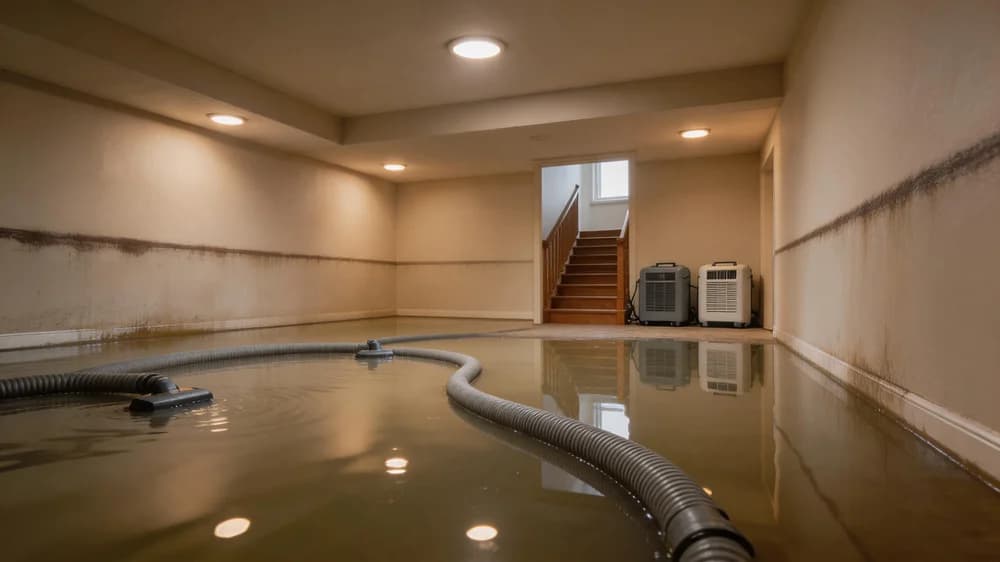
Basement flood cleanup costs in 2026 broken down by extraction, drying, mold prevention and reconstruction, with what insurance typically covers.
How Much Does Basement Flood Cleanup Cost?
Basement flooding is the most common water damage event homeowners face, affecting an estimated 98% of homes with basements at some point. Whether caused by heavy rain, a failed sump pump, a burst pipe, or a sewer backup, the costs of cleanup depend on several critical factors that this guide breaks down in detail.
At Advanced Disaster Recovery Inc. (ADRI), basement flood cleanup is one of our most frequent services. Here's exactly what you can expect to pay in 2026.
Basement Flood Cleanup Cost by Scenario
| Service | Low Estimate | Average | High Estimate |
|---|---|---|---|
| Minor Seepage (unfinished basement) | $500 | $1,200 | $2,500 |
| Moderate Flooding (unfinished, clean water) | $1,000 | $2,500 | $4,500 |
| Moderate Flooding (finished basement, clean water) | $2,500 | $5,500 | $9,000 |
| Severe Flooding (finished, contaminated water) | $5,000 | $10,000 | $20,000+ |
| Sewer Backup Cleanup (any basement) | $3,500 | $8,000 | $15,000 |
Cost Breakdown by Cleanup Phase
| Service | Low Estimate | Average | High Estimate |
|---|---|---|---|
| Water Extraction (per sq ft) | $3 | $5 | $8 |
| Structural Drying (per day, equipment) | $200 | $400 | $800 |
| Carpet & Pad Removal (per sq ft) | $1 | $2 | $4 |
| Drywall Removal (per linear ft, 2 ft cut) | $3 | $6 | $10 |
| Antimicrobial Treatment | $300 | $600 | $1,200 |
| Drywall Replacement (per sheet installed) | $250 | $400 | $650 |
| New Flooring Installation (per sq ft) | $3 | $7 | $15 |
| Contents Cleaning & Restoration | $500 | $2,000 | $5,000 |
Data reflects 2026 pricing in the Northeast US. Actual costs depend on basement size, flood severity, water category, and finish level.
Finished vs. Unfinished Basement: Cost Difference
The finish level of your basement dramatically affects cleanup and restoration costs:
Unfinished Basement
- Typical cleanup cost: $500-$4,500
- What's involved: Water extraction, concrete floor drying, antimicrobial treatment, possible stored contents cleaning
- Key advantage: No drywall, carpet, or built-ins to remove and replace. Concrete and block walls can be cleaned and dried.
- Common extra costs: Stored personal property damage, water heater or furnace damage, electrical panel inspection
Finished Basement
- Typical cleanup cost: $2,500-$20,000+
- What's involved: Everything above, plus demolition and replacement of drywall (minimum 12-24 inches above water line), carpet and pad removal, insulation removal, potential ceiling tile replacement
- Key cost driver: Reconstruction costs often exceed the cost of the actual water damage cleanup and drying
- Common extra costs: Custom finishes, entertainment systems, home office equipment, bar/kitchen areas
Factors That Affect Basement Flood Cleanup Cost
1. Source and Category of Water
- Category 1 (Clean): Burst supply line, water heater failure, rainwater through foundation crack. Least expensive to clean.
- Category 2 (Gray): Washing machine overflow, sump pump failure discharging ground water. Moderate cost; sanitization required.
- Category 3 (Black): Sewer backup, river/stream flooding, standing water over 48 hours (any category becomes Cat 3). Most expensive; all porous materials must be removed.
2. Depth of Flooding
Water depth directly correlates with damage extent:
- Under 1 inch: May affect only flooring. Drywall often salvageable.
- 1-6 inches: Saturates drywall, baseboards, lower portion of furnishings.
- 6-24 inches: Damages electrical outlets, furniture, storage, and may reach HVAC equipment.
- Over 24 inches: Major damage to all systems and finishes. Potential structural concerns with hydrostatic pressure.
3. Basement Size
Costs scale roughly linearly with square footage for extraction and drying:
- Small basement (200-400 sq ft): $1,000-$5,000 typical
- Medium basement (400-800 sq ft): $2,500-$10,000 typical
- Large basement (800-1,500 sq ft): $5,000-$18,000 typical
4. Response Time
This factor cannot be overstated. Costs increase dramatically with delay:
- Within 4 hours: Best chance of saving materials, lowest total cost
- 4-24 hours: Moderate damage escalation, some materials may still be saved
- 24-48 hours: Significant material damage, mold risk begins
- 48-72 hours: Active mold growth likely, extensive material removal required
- Over 72 hours: Mold remediation adds $2,000-$8,000+ to cleanup costs
Does Insurance Cover Basement Flooding?
This is where many homeowners get an unwelcome surprise:
- Covered: Sudden, accidental water damage from internal sources (burst pipe, water heater failure, appliance malfunction). Most policies cover this after your deductible.
- Often NOT Covered:
- Groundwater seepage through foundation (considered a maintenance issue)
- Sewer backups (requires a separate endorsement, usually $40-$100/year)
- Flood water from storms, rivers, or rising water (requires NFIP or private flood insurance)
- Sump pump failure (requires specific sump pump failure endorsement)
- Gradual leaks you "should have known about"
Critical endorsements for basements:
- Sewer/drain backup: $40-$100/year. Covers sewer backup damage up to $5,000-$25,000.
- Sump pump failure: Often bundled with sewer backup or available for $25-$50/year additional.
- Flood insurance: $400-$2,000+/year depending on flood zone. The only coverage for rising water events.
ADRI helps homeowners identify which coverage applies to their specific situation and documents the damage accordingly. Contact us for a free assessment.
Preventing Future Basement Floods
- Battery backup sump pump: $500-$1,200 installed. Protects during power outages when flooding is most likely.
- Backwater valve: $300-$800 installed. Prevents sewer backups from entering your home.
- Foundation waterproofing: $3,000-$12,000 for interior drainage systems. Addresses chronic seepage.
- Gutter extensions: $50-$200. Direct water away from the foundation.
- Smart water sensors: $20-$50 each. Alert you to water before it becomes a flood.
- Annual sump pump testing: Free (DIY). Pour a bucket of water in the pit before every storm season.
Frequently Asked Questions
How much does it cost to pump water out of a basement?
Professional water extraction from a basement typically costs $500-$2,500 depending on the volume of water, basement size, and time of service. This includes pump operation, initial moisture assessment, and setup of drying equipment. DIY pumping with a rented pump ($50-$100/day) is possible for clean water but does not address the critical drying and antimicrobial treatment needed to prevent mold.
Should I file an insurance claim for a flooded basement?
If the damage exceeds $2,000-$3,000 and results from a covered cause, filing a claim generally makes financial sense. For smaller incidents near your deductible, paying out of pocket avoids a claim record that could affect future premiums. ADRI provides free estimates to help you decide. Financing is available if you choose to pay out of pocket.
How long does it take to dry out a flooded basement?
Professional drying with industrial equipment takes 3-5 days for most basements. Factors that extend drying time include concrete floors (hold moisture longer than other materials), humidity levels, and airflow. Attempting to dry a basement without professional equipment often takes 2-3 weeks and frequently results in mold growth.
Can I save my basement carpet after a flood?
Carpet may be salvageable if the water was clean (Category 1) and professional drying began within 24-48 hours. However, carpet pad must almost always be replaced regardless of water category. If the water was contaminated (Category 2 or 3) or sat for more than 48 hours, both carpet and pad must be replaced. The cost of professional carpet cleaning after flooding ($1-$2/sq ft) is often close to the cost of replacement ($3-$7/sq ft), making replacement the better long-term value.
Get Your Free Basement Flood Cleanup Estimate
A flooded basement requires immediate professional attention to minimize damage and costs. Contact Advanced DRI now for 24/7 emergency response. We extract the water, dry the structure, handle your insurance claim, and restore your basement to pre-loss condition.
Categories
Need Restoration Services?
Our team is available 24/7 for emergency response. Call us today for a free phone consultation.

Questions About Restoration?
Our experts are ready to help. Contact us for a free consultation.