Tyler McClelland leads mitigation operations for Advanced DRI across New York's Hudson Valley, directing water, mold, and large-loss response in the field. He holds IICRC Water Restoration Technician (WRT) and Applied Microbial Remediation Technician (AMRT) certifications and a New York State Mold Supervisor certification, and is trained in IRCA hospital safe construction practices recognized by The Joint Commission.
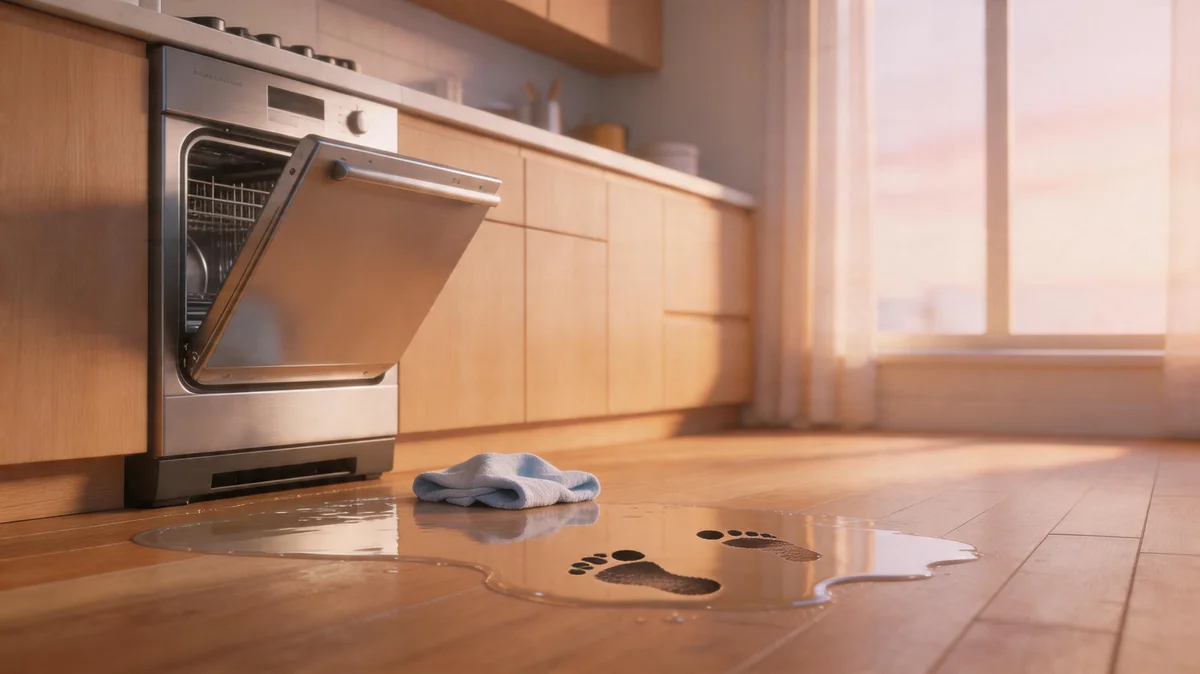
Woke up to a wet kitchen floor? Advanced DRI walks you through the exact steps to take in the first hour after a dishwasher leak to minimize damage.
Few things ruin a morning like walking barefoot into a wet kitchen. A dishwasher that leaks overnight can quietly soak cabinets, subfloor, and even the ceiling of the room below before you even finish your coffee. At Advanced DRI, overnight dishwasher leaks are one of the most common calls we get on weekday mornings — and the homeowners who act fast in the first hour almost always save themselves thousands in repairs.
This guide walks through exactly what to do, in order, starting the moment you realize something is wrong.
Step 1: Stop the Water — Don’t Open the Door Yet
Your first instinct will be to open the dishwasher. Resist it. If the unit is still cycling or has standing water inside, opening the door too fast will dump a gallon or more straight onto your floor. Instead:
- Turn off power at the breaker. Most dishwashers share a circuit with the garbage disposal. Flipping the breaker is safer than reaching behind a wet appliance.
- Shut the water supply valve. It’s usually under the kitchen sink, a small angle stop with a red or blue handle connected to a braided supply line.
- Then open the dishwasher door slowly and let any standing water drain into towels.
Step 2: Find the Source
Dishwasher leaks come from a short list of usual suspects. Knowing which one you’re dealing with tells you how bad the damage underneath might be.
Door Gasket or Latch
If water is only on the floor in front of the machine, the rubber door seal is probably compromised. Damage tends to be limited to the floor directly in front.
Supply Line
A burst or leaking supply line under the sink is a high-volume leak. Expect water under the sink cabinet and potentially traveling along the subfloor to adjacent rooms.
Drain Hose
A cracked drain hose leaks dirty water with food particles. You’ll smell it. This type of leak often runs down behind the dishwasher, soaking the back wall and the floor joists underneath.
Tub or Pump
A crack in the stainless or plastic tub, or a failed pump, leaks from underneath every cycle. This is usually the most destructive because the water has been dripping unnoticed for days or weeks.
Step 3: Extract What You Can
For a small puddle, towels and a wet/dry vacuum handle it. For anything larger — water under cabinets, through floorboards, or dripping from the ceiling below — stop trying to DIY and call a professional.
Why? Water under cabinets is almost impossible to reach without pulling the toe kick and boring access holes. Subfloor drying requires commercial air movers and dehumidifiers, not box fans. Our water damage restoration crews carry thermal imaging cameras and moisture meters that show us exactly where the water traveled — often several feet beyond what you can see.
Step 4: Document Everything
Before you clean up too thoroughly, take photos. Lots of them. Wide shots of the kitchen, close-ups of the floor, the inside of the cabinets, the dishwasher itself, and any water stains on the ceiling below. Your insurance carrier will ask for this, and memories fade fast once the stress wears off.
- Photograph the damage from multiple angles.
- Save any food or items that got wet as evidence of contents loss.
- Note the time you discovered the leak and when you stopped the water.
- Keep receipts for any emergency supplies (towels, fans you rented, plumber visits).
Step 5: Don’t Just Fan-Dry and Hope
This is where we see homeowners make the most expensive mistake. They mop up visible water, point a household fan at the floor for a day, and assume they’re fine. Two weeks later, they call us with a musty smell, buckled hardwood, or black spots along the baseboards.
Water wicks up into drywall and cabinets, and sideways along wood subfloors. Mold begins colonizing damp materials in 24 to 48 hours. By the time you can smell it, it’s already established. If your leak reached cabinetry, flooring, or a wall, get a moisture reading from a certified professional within a day or two.
Step 6: Repair or Replace the Dishwasher
Once the water is stopped and drying is underway, decide whether to repair the unit. A door gasket is a $30 part. A failed pump on a 12-year-old dishwasher usually isn’t worth fixing. Whatever you decide, do not reuse a dishwasher that leaked from the tub or a cracked housing — it will leak again.
When to Call Advanced DRI
Call us immediately if:
- Water reached adjacent cabinets or flooring beyond the footprint of the dishwasher
- There is any staining on the ceiling of the room below
- The leak was ongoing for more than a few hours
- You notice a musty smell a few days after cleanup
- Your flooring is buckling, cupping, or lifting
Our team responds 24/7 and will arrive with commercial extraction equipment, air movers, and dehumidifiers. We also coordinate directly with most insurance carriers so you’re not stuck playing middleman during an already stressful morning.
Ready for Help?
Contact Advanced DRI today if you’ve had a dishwasher leak — or any other sudden water intrusion. The sooner we start drying, the better your chances of avoiding mold, subfloor damage, and cabinet replacement.
Frequently Asked Questions
Will my homeowners insurance cover a dishwasher leak?
Most standard policies cover sudden and accidental water damage, which includes a dishwasher failure. However, long-term slow leaks that show evidence of neglect are often excluded. This is why documentation and a prompt response matter so much.
How do I know if the subfloor is damaged?
Obvious signs include soft spots underfoot, buckling or cupping hardwood, tile that sounds hollow when tapped, and staining on the ceiling below. A moisture meter reading above 16% in wood subfloor usually means professional drying is needed.
Can I run the dishwasher again after a minor leak?
Only after you’ve identified and fixed the exact source. A door gasket replacement is usually safe to run right away. Anything involving the tub, pump, or supply line should be tested with the kick plate off and towels underneath while you watch a full cycle.
Categories
Need Restoration Services?
Our team is available 24/7 for emergency response. Call us today for a free phone consultation.


Questions About Restoration?
Our experts are ready to help. Contact us for a free consultation.