DIY Water Extraction and Drying: What You Can Do Before the Pros Arrive
Tyler McClelland leads mitigation operations for Advanced DRI across New York's Hudson Valley, directing water, mold, and large-loss response in the field. He holds IICRC Water Restoration Technician (WRT) and Applied Microbial Remediation Technician (AMRT) certifications and a New York State Mold Supervisor certification, and is trained in IRCA hospital safe construction practices recognized by The Joint Commission.

Water extraction removes standing water; drying removes what soaked in. Safe shop-vac steps, mistakes to avoid, and when DIY should stop.
There's water on the floor. Maybe a crew is on the way, or maybe you're still deciding whether this is a call-someone problem or a grab-the-shop-vac problem. Either way, the short answer is the same: stop the source, keep power off in the wet area, photograph everything, and pull up clean water with a wet/dry vac. Leave sewage, outdoor flood water and anything inside walls or ceilings to a crew.
Below: what a wet/dry vac can safely handle, how to start drying, and where DIY stops, from the crews who run our water mitigation jobs across New York, New Jersey, Pennsylvania and Connecticut. If the source or power is still on, start with our first steps after discovering water damage.
Before you touch the water: three yes/no checks.
- Can you shut off power to the wet area without stepping in water? If the electrical panel is in the wet area, the answer is no.
- Did the water come from a clean supply line, a sink or tub overflow, or an appliance supply hose? Sewage, a toilet backflow from beyond the trap (whatever it looks like) or flood water from outside counts as a no.
- Is the water limited to one room, on the floor only, with nothing coming through walls or ceilings, and can a wet/dry vac keep up with it?
Three yeses: keep reading. Any "no": stop here and call 24/7 at (845) 294-8919, or request a water damage restoration team online. Sewage or outdoor water goes straight to sewage or flood water cleanup.
What Is Water Extraction, and How Is It Different From Drying?
Water extraction is the first hands-on step of water damage mitigation once the source is stopped: physically removing standing water, and the water held in carpet and pad, with pumps, wet/dry vacuums or truck-mounted extractors. It comes before drying because pulling liquid water out is far faster than evaporating it.
Drying is the slower second half, and it is where most of the job's days go. Every gallon left behind has to be evaporated and then pulled out of the air by a dehumidifier, which is why crews extract first. EPA's mold remediation guidance puts it bluntly: wet vacuums alone will not dry carpets.
Crews work to ANSI/IICRC S500 (5th edition, 2021), the industry standard for water damage restoration. Besides the contamination category, S500 rates each loss by Class, from how much surface is wet and how absorbent it is; Class 4 means water held deep in hardwood, plaster or concrete. Good extraction shrinks that load.
| Question | Extraction | Drying |
|---|---|---|
| What it removes | Liquid water | Moisture held in materials and air |
| Tools | Pumps, wet/dry vacs, extractors | Air movers, dehumidifiers |
| How you know it's done | No more water comes up | Readings reach the drying goal for each material |
| Can a homeowner do it? | Partly | Only the surface |
In short: extraction removes the liquid water you can see or squeeze out. Drying removes the moisture left inside drywall, wood, subfloors and concrete, using air movers and dehumidifiers, until meter readings match the drying goal set from a dry, unaffected sample of the same material.
Safety First: When DIY Is Off the Table
Electricity, gas and carbon monoxide
Never stand in water to reach the breaker panel. If the panel sits in the wet area, call the utility or an electrician and wait. Plug the vac into a GFCI-protected outlet in a dry room with an outdoor-rated cord, away from any outlet or cord in the water. Smell gas? Leave and call from outside.
Gas-powered pumps, pressure washers and generators belong outdoors only. EPA's flooded-home guidance says to place a portable generator outside and at least 20 feet from any building, and the CDC says to keep it at least 20 feet from doors, windows and vents.
Water categories in one minute
S500 categories describe how contaminated the water is (and that can get worse with time):
- Category 1: clean source, such as a broken supply line or a sink overflow.
- Category 2: significant contamination, such as washing machine or dishwasher discharge, or a toilet overflow with urine but no feces.
- Category 3: grossly contaminated, such as sewage, toilet backflow from beyond the trap, rising flood water or seawater.
A roof leak is often Category 2 once it has run through insulation and ceiling materials, and wind-driven storm water can be Category 3. Clean water also gets worse as it sits, warms and touches dirty materials. Category 3 means no DIY at all; our Category 3 protocols explain why.
Older homes: lead paint and asbestos
EPA warns that removing materials with lead-based paint can raise lead dust in the air, and that older homes may contain asbestos. Its Renovation, Repair and Painting rule covers firms disturbing paint in homes built before 1978. In an older house, get the water up and leave the cutting to certified renovators. We offer lead and asbestos testing and abatement, plus notes on pre-1980 homes in New Jersey.
Step by Step: Removing the Water Yourself
Match the tool to the amount of water
| Amount of water | Fastest homeowner tool | When to stop |
|---|---|---|
| Damp floor or a thin film | Towels, squeegee | It keeps coming back (source not stopped) |
| Puddles on a hard floor | Wet/dry vac | It's spreading under baseboards or flooring |
| Wet carpet | Wet/dry vac (won't dry the pad) | The pad stays soaked after vacuuming |
| Deep clean water across a room | Rented utility or submersible pump | The pump or vac can't keep up |
| Any Category 3 water | None | Stop and call |
A basic kit: a wet/dry vac, squeegee, towels, gloves, rubber boots, eye protection, contractor bags, foil or wood blocks for furniture, an outdoor-rated cord and your phone.
Step 1: Stop the source and photograph everything
Close the fixture valve, or the main if you can't find it. If water keeps reappearing after you've cleaned it up, the source isn't stopped yet.
Before you move anything, take photos and a slow video of the room, the source and any water lines on the walls. If you pull up soaked carpet or pad, photograph it and keep a small sample, not the wet roll. One example from a state regulator: North Carolina's Department of Insurance tells policyholders their policy requires "reasonable emergency repairs necessary to prevent further damage," asks them to keep receipts and photos, and says not to make extensive repairs before the adjuster arrives. Policies and state rules vary, so check the Duties After Loss section of your own policy. More on documenting a burst pipe claim.
Step 2: Get contents off the wet floor
Move rugs, papers, electronics and small furniture to a dry room, and put foil or wood blocks under heavy furniture legs. Set valuable documents, photos and art aside for contents restoration.
Step 3: Using a wet/dry (shop) vac the right way
Yes, you can use a shop vac for water, as long as it is a wet/dry model plugged into a GFCI outlet in a dry area. Never use a household vacuum.
- Confirm the rating. No "wet/dry" marking and no float in the tank? Don't use it for water.
- Set up the filter for wet pickup. Many models want the paper filter removed or swapped for a foam sleeve; follow the manual.
- Work toward the exit. Start at the deepest point and pull the nozzle slowly toward you.
- Let the float do its job. When suction drops, the tank is full; empty it often. Water is heavy: the USGS lists it at about 62.4 pounds per cubic foot, which works out to roughly 8.3 pounds a gallon, so lift with your legs or drain it where it sits.
- Carpet takes patience. Slow, overlapping passes. A shop vac won't pull much out of the pad.
- Vacuum while it's still wet. EPA guidance says wet vacuums should be used only while materials are still wet, because otherwise they may spread mold spores. Clean and dry the tank, hose and attachments when you're done.
- Clean water only. Stick to Category 1 water. If it turned out to be Category 2, disinfect the vac before storing it.
Step 4: Squeegee, mop and towel what the vac can't reach
Push water toward the vac or a working floor drain. Wring mops into buckets, never into a drain that's backing up.
Step 5: Start drying the right way
Fans come with a warning. EPA's mold course says not to use fans until you have determined the water is clean or sanitary, and its flooded-home page adds that if mold has started to grow, fans may spread it. For clean water, blow fans across wet surfaces and run a dehumidifier in a closed room.
EPA advises opening doors and windows while you work. For the drying after, our crews compare dew point, not relative humidity: if it's lower outdoors, as on cool fall days, open up; on a sticky Northeast summer day, keep windows shut and let the dehumidifier work.
Don't run the HVAC system if water reached the ducts; EPA says wait until a professional says it's safe. EPA's target is to dry the home and its contents within 24 to 48 hours. More detail on drying out a water-damaged home and how to read moisture meter results.
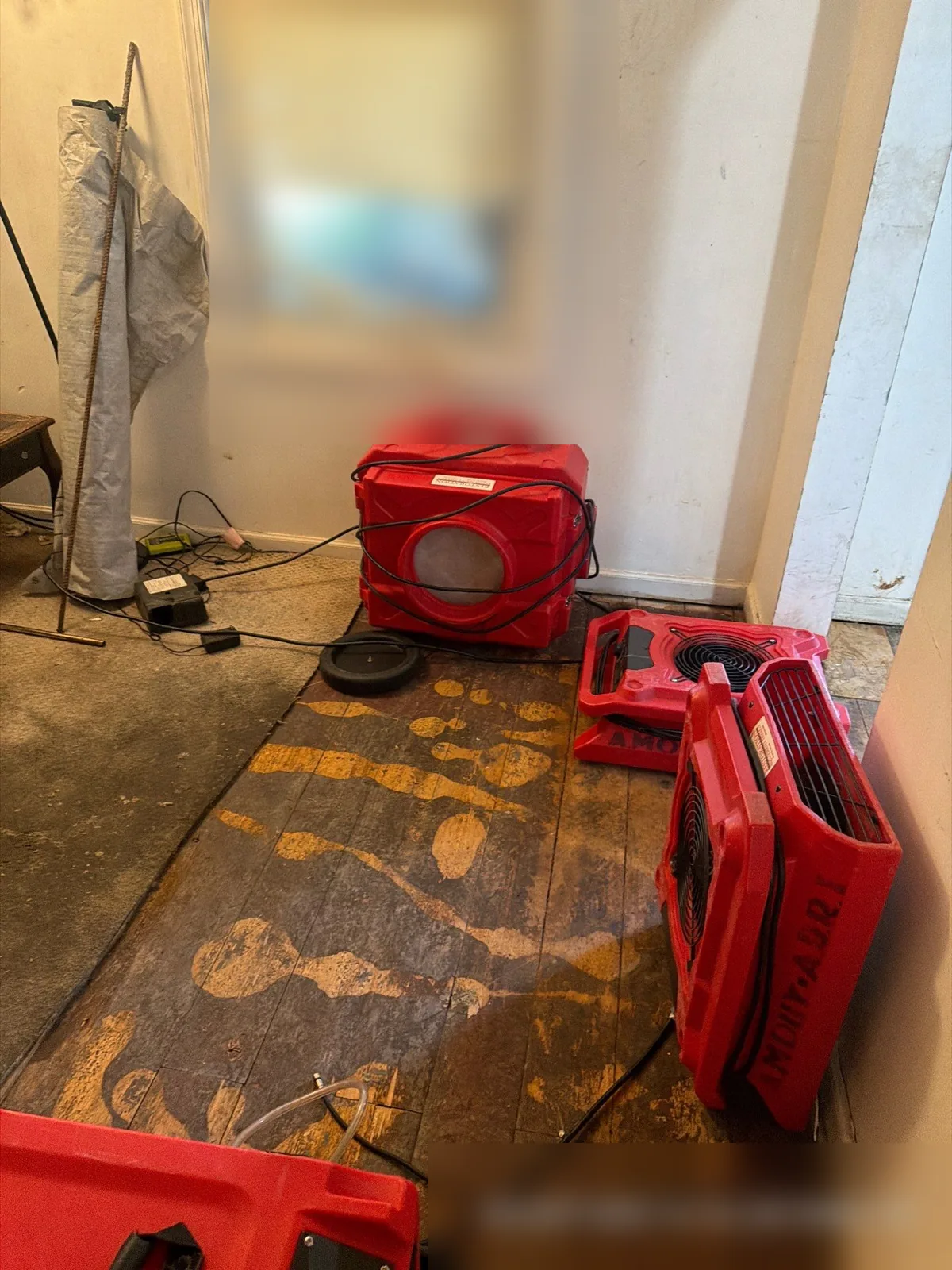
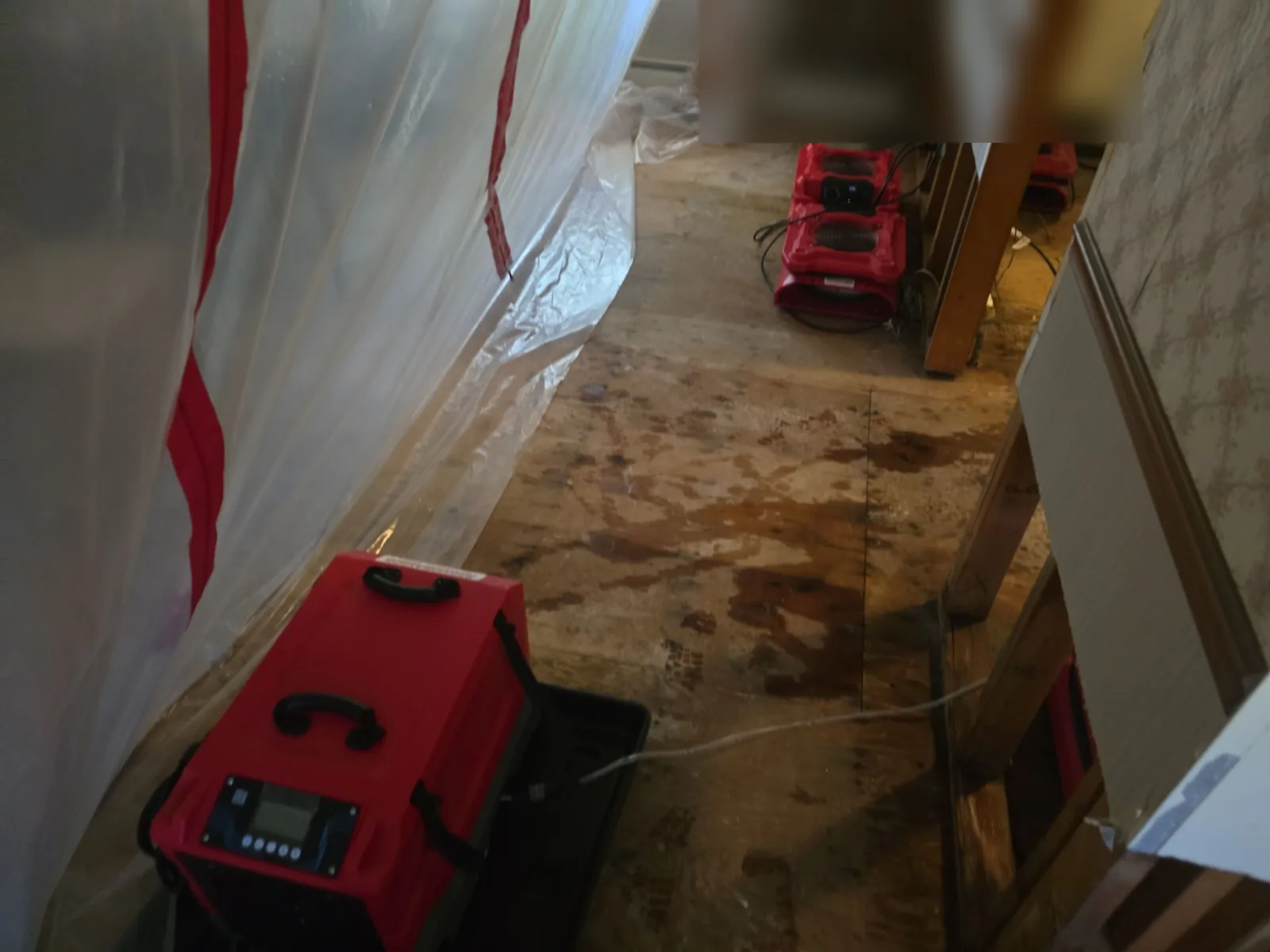
If the flooring has to come up, the drying setup looks more like this: commercial air movers aimed across the bare subfloor, with readings taken daily until it hits its drying goal.
What You Can Dry in Place and What Has to Go
The rows below are adapted from U.S. EPA, Mold Remediation in Schools and Commercial Buildings, Table 1: Water Damage - Cleanup and Mold Prevention. EPA notes these guidelines are for clean-water damage dried within 24 to 48 hours.
| Material | What EPA's table says | What that means for you |
|---|---|---|
| Books and papers | Discard non-valuable items; photocopy, freeze or freeze-dry valuables | Freeze important papers until a pro can help |
| Carpet and backing | Extraction vacuum, dehumidifier, fans | Extract thoroughly; pad and subfloor must dry too |
| Cellulose or fiberglass insulation | Discard and replace | Wet insulation comes out |
| Concrete or cinder block | Extraction vacuum, then dehumidifiers, fans and/or heaters | Dries in place, slowly |
| Hard surface, porous flooring (linoleum, tile, vinyl) | Clean, then check that underflooring is dry | The surface isn't the whole story |
| Upholstered furniture | May be difficult to completely dry within 48 hours | Valuable pieces need a specialist |
| Wallboard (drywall) | Dry in place if not swollen and seams intact; ventilate cavity | Swollen or split board gets replaced |
| Wood surfaces | Dehumidifiers, gentle heat, fans; caution with heat on hardwood | Act fast; go easy on heat |
What we see in the field (IICRC S500 practice). Carpet pad from a clean-water loss can sometimes be dried in place after thorough extraction. With Category 2 water it is generally removed, and with Category 3 water the carpet and pad both go. Floating floors such as laminate or luxury vinyl plank over a slab trap water underneath, where no vacuum reaches, so they are often lifted to dry the slab.
More on carpet: salvage or replace, and when drywall can be saved.
Extraction Mistakes We See After DIY Cleanups
- Using a household vacuum. No float, not built for liquid, real shock and motor risk.
- Vacuuming materials that have started to dry. EPA warns this may spread mold spores.
- Vacuuming Category 3 water. It contaminates the machine and you.
- Cranking the heat with no dehumidifier. Heat speeds evaporation, but without a dehumidifier the moisture just moves into dry materials or condenses on cooler surfaces.
- Trusting "it feels dry." Hands can't read the inside of a wall.
- Cutting carpet into strips or drilling holes in walls. Strips usually can't be re-stretched and seamed, and a drill bit can hit wiring or a supply line. Neither speeds up drying the way extraction does.
- Hauling soaked carpet to the curb before photographing it. Once it's gone, so is the record of what was damaged.
Where Water Hides After You've Vacuumed
Water typically collects where a shop vac can't reach:
- The bottom of walls and the cavity behind baseboards.
- Under floating floors and inside the layers of a subfloor.
- Crawlspaces and the framing beneath the room that flooded.
Our guide to hidden water damage areas to check has the full list. EPA says mold usually won't grow if wet items are dried within 24 to 48 hours, and hidden wet material is how that window gets missed. More on the 24-48 hour microbial growth window.
From a recent job. In September 2026 our Toms River crew handled a kitchen leak that had already moved into the subfloor and crawlspace. The floor surface was the least of it: extraction was followed by subfloor and crawlspace drying. See our water damage restoration in Toms River.
Professional Water Extraction and Drying: Equipment and Techniques Our Crews Use
We work 24/7 out of 11 offices and typically arrive within 90 minutes in nearby service areas. The order is the same for a kitchen leak or a flooded basement:
- Moisture inspection and mapping. Moisture meters (our crews carry Tramex meters) and thermal imaging show where the water traveled; the meter readings confirm what the camera suggests.
- Category and Class under IICRC S500. This sets protective gear, tear-out and the size of the drying setup.
- Bulk extraction. Submersible pumps for standing water, then truck-mounted or portable extractors for carpet and hard floors.
- Controlled removal of wet materials. Flood cuts and pad removal only where readings say the material can't be dried in place.
- Drying setup. LGR (low grain refrigerant) dehumidifiers and air movers inside plastic containment, plus HEPA air scrubbers where demolition or contamination calls for them.
- Daily monitoring and documentation. Readings are logged daily, and equipment comes out when each material hits its drying goal, not on a schedule.
The drying setup from item 5, in practice:
Techniques the industry uses are mostly refinements:
- Weighted or stand-on extraction tools that squeeze water out of carpet and pad.
- Portable extractors where truck-mount hoses can't reach, such as high-rises.
- Desiccant dehumidifiers for cold or already-dry conditions.
- Low-profile air movers for floors and under cabinets.
- Wall-cavity injection and hardwood drying mats where readings justify them.
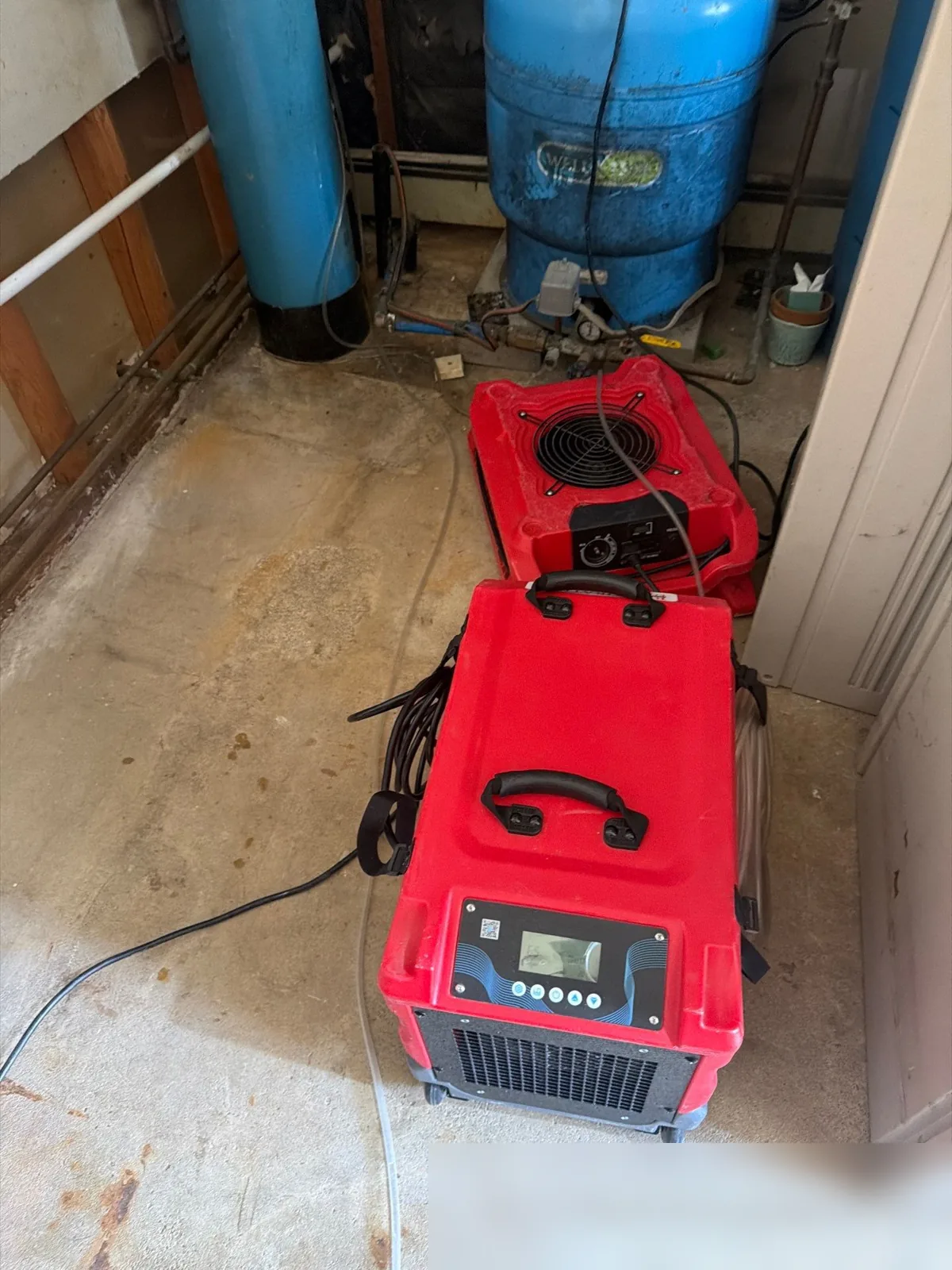
See what our water damage restoration service includes, or how the structural drying process works from day one to the final reading. Rather hand it off now? Call (845) 294-8919.
When to Stop and Call a Professional
Put the vac down and call if:
- Sewage or any other Category 3 water.
- More water than a wet/dry vac can keep up with.
- Water in more than one room or on more than one floor.
- Water in walls or ceilings, or a ceiling that sags.
- Any electrical exposure you can't safely shut off.
- A musty smell or visible mold.
- A pre-1978 house where trim or drywall has to come out.
- Hardwood that is starting to cup.
Basements and outdoor flood water. Outdoor flood water is Category 3. Water from inside the house (a burst pipe, water heater or washer) can be pumped out right away if the ground outside isn't saturated. If the ground is saturated, or flood water is still outside, go in stages. North Dakota State University Extension advises waiting until the water around the house recedes, then pumping out about one-third of the water each day, because the water inside helps brace the walls against outside pressure. FEMA notes that most homeowners insurance does not cover flood damage. Our basement flood response guide walks through the full procedure.
Frequently Asked Questions
What should I do while waiting for the restoration crew to arrive?
Stop the water at the valve, keep power off in wet areas, photograph everything, move contents to a dry room, and remove clean standing water with a wet/dry vac if it is safe to do so. Don't vacuum sewage or flood water, and don't start cutting walls.
How long does it take to dry out water damage?
There's no fixed number: it depends on the class of the loss, the materials and indoor conditions, and it ends when meter readings match the dry standard. EPA advises drying water-damaged materials within 24 to 48 hours to prevent mold growth.
Can drywall be saved after water damage?
Often yes, if the water was clean, the board isn't swollen and the seams are intact; EPA says such wallboard may be dried in place with the wall cavity ventilated. Drywall soaked by Category 3 water should be removed.
Is water from a burst pipe safe to clean up myself?
A burst supply line usually starts as clean Category 1 water, so extracting it yourself is reasonable if the power is safely off. If it ran into a ceiling or walls, the drying needs moisture readings.
How much does professional water extraction cost?
Cost depends on the water category, the class of the loss, the square footage and how much material has to be removed, so an accurate quote follows an inspection.
For regional context, see our water damage restoration cost index.
Categories
Need Restoration Services?
Our team is available 24/7 for emergency response. Call us today for a free phone consultation.


Questions About Restoration?
Our experts are ready to help. Contact us for a free consultation.