
Hidden Leak Detection in Toms River, NJ: Finding and Mapping the Moisture
Tyler McClelland leads mitigation operations for Advanced DRI across New York's Hudson Valley, directing water, mold, and large-loss response in the field. He holds IICRC Water Restoration Technician (WRT) and Applied Microbial Remediation Technician (AMRT) certifications and a New York State Mold Supervisor certification, and is trained in IRCA hospital safe construction practices recognized by The Joint Commission.

Hidden leak in Ocean County? IICRC-certified techs trace it with thermal imaging and moisture meters, map the wet area and dry it. Toms River office, 24/7.
A hidden leak rarely shows itself where it starts. You notice a brown ring on the ceiling, a musty closet, a floor that feels warm underfoot, or a water meter that creeps while every faucet is off. By then the water has usually traveled along framing, subfloor and insulation, sometimes several feet from the fitting that failed.
That is the job we take on: tracing where the water went, mapping it and drying it, alongside the plumber who fixes the pipe. Our IICRC-certified technicians work out of our office at 5 Executive Drive. If water is already on the floor, go straight to our Toms River water damage restoration team.
At a glance: we find and map hidden water with thermal imaging and moisture meters, dry it, and document it for your insurer. 24/7 line: (845) 294-8919, with crews typically on site within 90 minutes in nearby service areas.
If you can hear or see water moving
Shut the main water valve. Stay out of rooms with standing water and don't touch the breaker panel while standing in water; if the panel itself is wet, call your utility or an electrician. Take photos, then call (845) 294-8919.
Who Finds a Hidden Leak: Your Plumber, Us, or Both?
Often both. We trace the water with thermal imaging and moisture meters and map how far it spread inside walls, ceilings and floors. A licensed plumber or leak-detection specialist confirms the pipe source when it's inside a slab or wall, and a licensed plumber makes the repair. Then we remove only what's wet and dry the structure to IICRC S500 drying goals.
Leak finders from the two trades answer different questions: where the pipe failed, and where the water went. A plumber pressure-tests a supply line, listens for it, or runs a camera down a drain; specialists may use tracer gas on buried lines. We follow the wet trail from the visible damage and draw the boundary of everything that got wet.
Seeing staining, swelling or a musty smell? Call us first. We map the water and coordinate with your plumber, so nobody opens a wall in the wrong place.
| Task | Plumber or specialist | Advanced DRI |
|---|---|---|
| Map wet materials outward from the visible damage | Sometimes | Yes |
| Moisture mapping of walls, floors and ceilings | Rarely | Yes |
| Pressure, acoustic or tracer-gas location on supply lines | Yes | No |
| Repair the pipe or fitting | Yes | No |
| Controlled tear-out, drying, dehumidification | No | Yes |
| Moisture logs and photos for the insurer | Partial | Yes |
What Happens When You Call Our Toms River Office
A hidden-leak visit follows the same order every time, because each step decides the next one.
- A short interview: when you noticed it, whether the water bill changed, any recent plumbing, roof or appliance work.
- Visual and infrared scan of the affected rooms and the rooms above, below and beside them.
- Meter confirmation of every thermal anomaly, compared against dry material of the same type in your home.
- The moisture map: wet boundaries marked on a sketch and photographed with the meter in view.
- Source repair by your plumber. Drying an area that is still being fed with water wastes everyone's time.
- Mitigation: removal of what can't be dried, containment if mold is suspected, equipment sized to the wet area.
- Daily readings at the same marked points with the same meter.
- Final readings and a documentation package for your adjuster.
Mapping and drying are part of our water damage restoration work, so the crew that finds the wet area is the crew that dries it. For a non-urgent inspection, call the office at (732) 228-7582.
Whoever you hire, ask for written readings and photos before anyone cuts drywall. New Jersey also requires home improvement contractors to register with the Division of Consumer Affairs, and the state's consumer brief on hiring contractors tells homeowners to confirm that registration and expect the number on the contract.
How We Find Hidden Leaks Without Tearing Open Walls
| Method | What it shows | Limits |
|---|---|---|
| Thermal camera (both trades) | Surface temperature patterns that may point to water | Shows temperature, not water |
| Pin meter (restoration) | Moisture at a point and depth in wood or drywall | Two tiny holes; one spot at a time |
| Pinless meter (restoration) | Fast scan of large surfaces | Shallower, less precise |
| Borescope (restoration) | Inside the cavity through a small hole | Needs an opening |
| Acoustic, pressure, tracer gas (plumber or specialist) | Whether and where a supply line is leaking | Doesn't show where the water went |
| Drain camera (plumber) | Breaks inside drain and sewer lines | Sees only the pipe interior |
Thermal imaging gets oversold. The camera reads surface temperature: wet drywall often shows cooler as water evaporates, and a hot-water line shows warm, but the camera does not see water. Consulting firm J.S. Held's guide to infrared testing says thermal images "do not depict moisture or distinguish between wet or dry." Sun on an exterior wall can create a false spot, and wet material with no temperature difference can show nothing. So our crews treat the camera as a pointer and put a meter on every suspect spot before anything is cut. More in how thermal imaging reveals water damage.
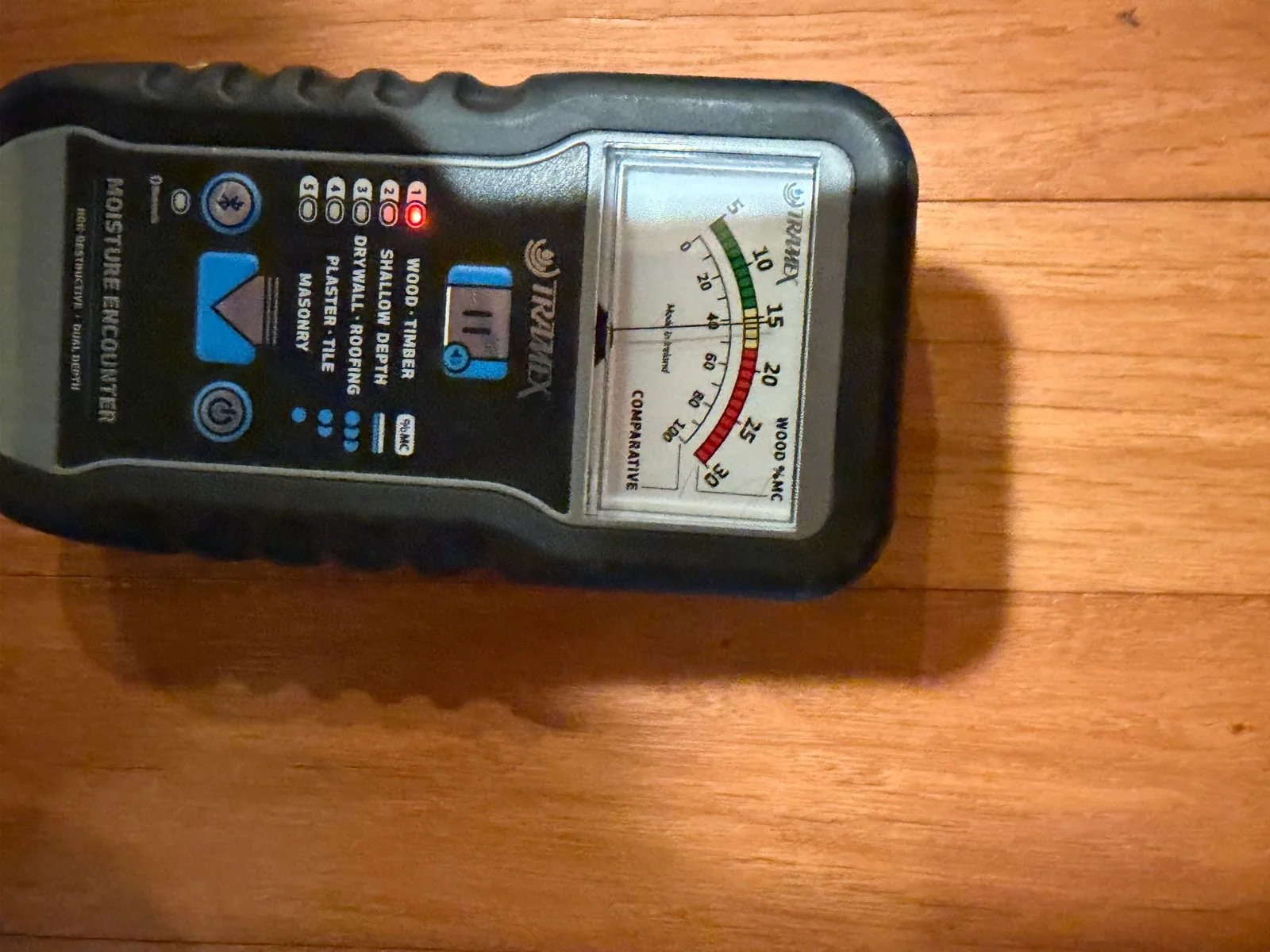
Meters do the confirming. Pin meters read moisture at a known depth; pinless meters sweep a floor quickly without marking it, like the one reading a kitchen hardwood floor in the Hoboken photo above. A thermo-hygrometer logs the air's temperature and humidity. To make sense of the numbers on a report, see how to read moisture meter results.
When opening the wall is unavoidable, the first step is a small inspection hole for a borescope. If the cavity must come open, the cut follows the map, a few inches above the highest wet reading rather than a fixed height. Our article on when water-damaged drywall can be saved and when it must be replaced covers those calls.
What Moisture Mapping Is and Why It Decides How Much Gets Torn Out
Moisture mapping is a room-by-room record of meter readings taken on a grid and compared against a "dry standard" reading from unaffected material of the same type. The readings mark the boundary of the wet area on a sketch or photos, show what must be removed or dried, and are repeated daily until drying goals are met.
The dry standard comes from your own house: your drywall in a room the water never reached, not a universal percentage. We read outward from the suspected source until the numbers match it, then mark and photograph the boundary. Air readings go on record in the affected room, outdoors and at the dehumidifier exhaust.
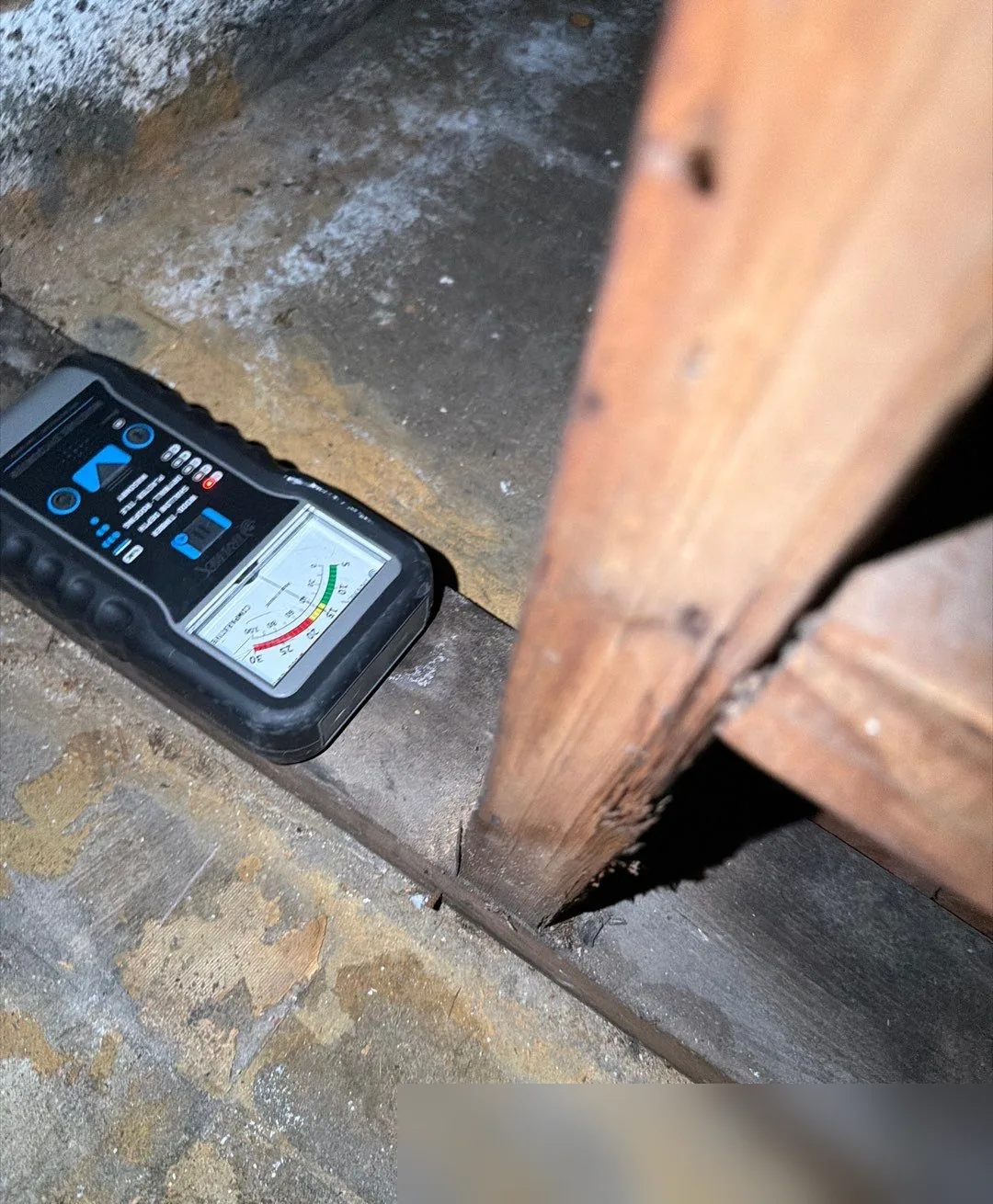
This photo shows why the map goes past the drywall. The wall is open and the meter sits on the sill plate at its base. Water running down a cavity tends to collect at that bottom plate, and the wood can stay wet after the drywall face looks fine. If nobody reads the framing, it gets closed up damp.
A good map means only wet material comes out, your adjuster gets numbers instead of opinions, and drying ends at a measured point rather than after a set number of days. The steps that follow are in the structural drying process.
Where Hidden Leaks Hide in Ocean County Homes
Slab leaks
A warm spot on a tile or concrete floor, together with a water meter that keeps moving while every fixture is off, is the classic sign of a supply leak under the slab. Cracked tile and flooring that lifts or tents can follow. The plumber or specialist confirms it with pressure isolation and acoustic or tracer methods; we handle the flooring, the wall bases and drying the slab surface. New cracking or settling deserves a look from a structural engineer.
Shower and tub enclosures
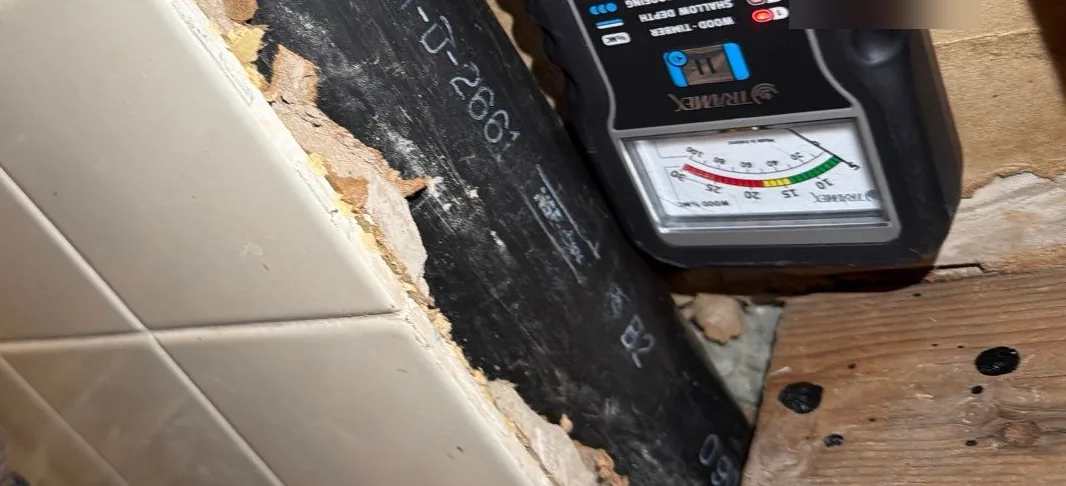
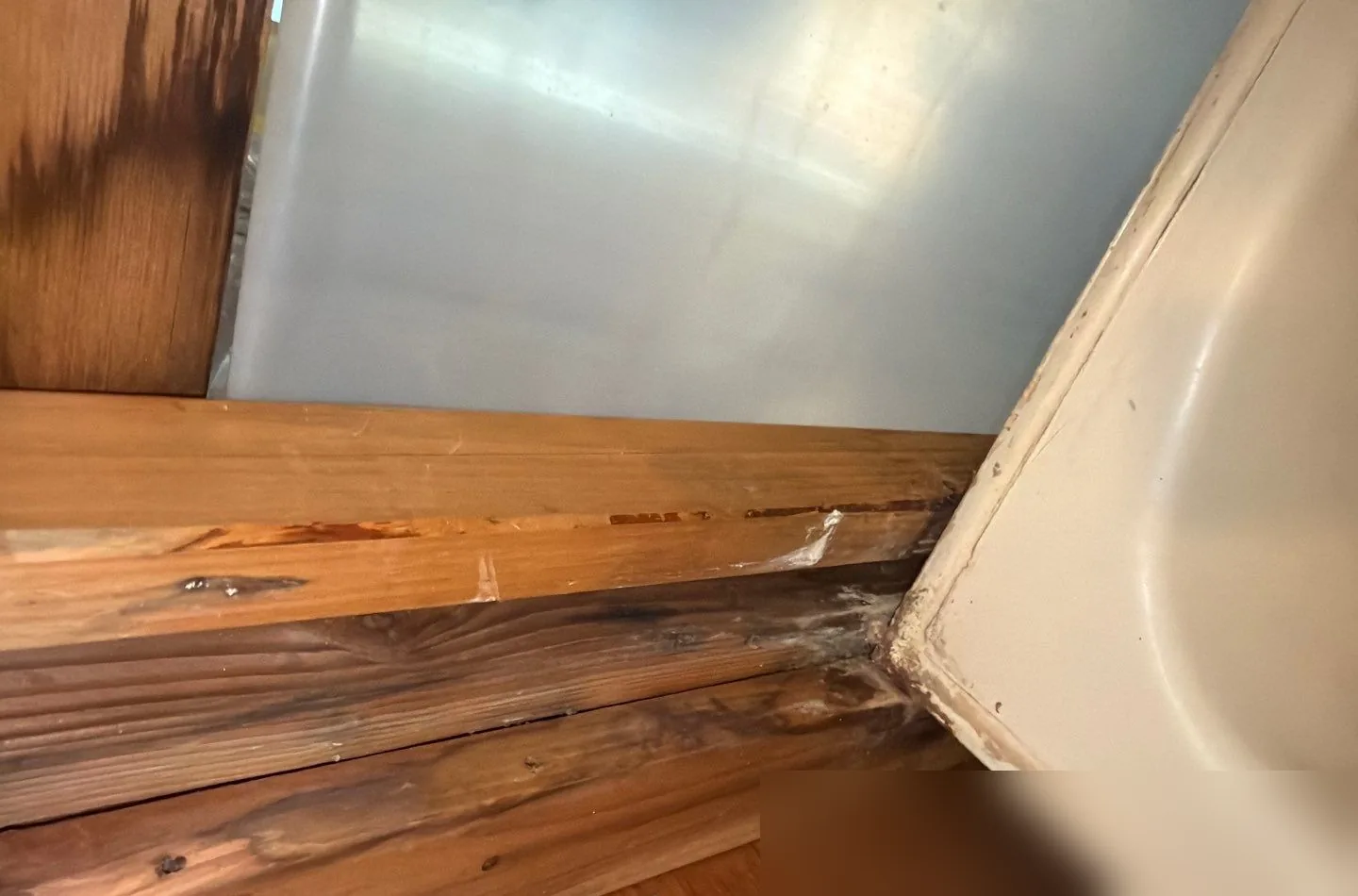
This Leonia bathroom shows what a slow enclosure leak can look like once the wall is open: dark staining and decaying wood framing along the edge of the tub. Usual sources are a failed shower pan, cracked grout or caulk, the valve body or the drain. A scan from the next room or the ceiling below, then meter readings, shows how far it spread before tile comes off. Dark grout or a smell that won't clear? Read about hidden mold behind shower tiles.
Kitchens, subfloors and crawlspaces
Look at the floor of the sink cabinet, not just the pipes. Swollen particleboard there often signals a drip from a supply connection, dishwasher hookup or ice-maker line. Over a crawlspace, the subfloor and insulation below tell you more than the kitchen floor does. Our appliance leak guide lists the common failure points.
Ceilings below bathrooms, and roof leaks
Water runs along joists and rafters before it finds a low point, so a stain can sit well away from its source. Roof leaks are traced from inside after rain: thermal scan, then readings at the stain and upslope along the framing. The roofer fixes the roof; we map, dry and, when needed, provide emergency roof tarping. Early stain patterns are covered in ceiling water damage warning signs.
Frozen and burst lines in winter
Pipes in exterior walls, garages, crawlspaces and attics are most exposed. In February 2026, frozen pipes burst at Toms River Town Hall and flooding affected three floors of the building, Patch reported. A split line may not leak at all until it thaws, and when it does, the water is often inside a wall where no one sees it. Our guide to burst pipe insurance claims explains what adjusters look for.
Signs of a Hidden Leak and the 2-Hour Meter Test
- A ceiling stain that grows or darkens over days
- Bubbling paint or lifting wallpaper
- Baseboards or door casings that swell
- A musty smell in one room, closet or cabinet
- A warm patch on a tile or concrete floor
- Running-water sounds with every fixture off
- A water bill that jumps for no reason
Where these usually show up first: the places hidden water damage usually starts.
How to run the meter test
Turn off every faucet, appliance and irrigation zone, then write down your water meter reading. Wait two hours without using any water and read the meter again. If the number changed, water is escaping somewhere: a running toilet, a dripping fixture, or a hidden supply leak in a wall, slab or yard line.
That method comes from the EPA's WaterSense Fix a Leak Week page, which estimates household leaks can waste more than 9,300 gallons a year. It suggests two more checks: put food coloring in the toilet tank, and if color reaches the bowl after 10 minutes without flushing, the toilet leaks; and if a family of four uses more than 12,000 gallons a month in winter, there are likely serious leaks. On a private well, watch instead for the pump switching on while nothing is running.
Meter moving, no water in sight? The leak is in a wall, under the slab or underground: a plumber finds the source, and the damage needs mapping.
What Leak Detection Costs in Toms River, and What Insurance Usually Covers
Locating the leak and drying the damage are two separate bills. For the first, Yelp's cost guide, built from quotes businesses sent customers on its platform, says leak detection averages about $175 to $350 (Yelp, updated October 2026). Hard-to-reach slab and buried lines can cost more, so get a written quote. The second bill depends on how much material is wet and how long it takes to dry, which is what the map measures; see what water damage restoration costs locally.
Coverage varies by insurer and form. The Insurance Information Institute lists "accidental discharge or overflow of water or steam from within a plumbing, heating, air conditioning, or automatic fire-protective sprinkler system, or from a household appliance" among the perils covered by common homeowners forms, including HO-3 and the condo HO-6 (Triple-I). The same page says damage due to lack of maintenance isn't covered, so a slow leak that ran for months can be disputed; sewer backup needs a separate product or an endorsement; and flood is excluded from standard policies. Your policy wording controls, so check it with your agent. Rising water is its own job: flood damage in Toms River.
For the adjuster, keep the discovery date, the plumber's invoice naming the cause, the moisture map and daily logs, the first-visit thermal and meter photos, and a list of removed materials.
When the Leak Is Dirty Water, or Mold Has Already Started
A cracked drain, failed toilet seal or broken waste line releases water that may carry sewage. EPA guidance says that when water is known or suspected to be contaminated with sewage, protective equipment and containment are needed, and fans shouldn't run until the water is known to be clean (EPA, Table 1). We handle that water as Category 3 under the IICRC S500 procedures we follow, which usually means soaked porous materials such as drywall, insulation and carpet pad are removed rather than dried in place. For drain failures, see sewer backup cleanup.
Mold is the other clock. The EPA advises drying water-damaged areas and items "within 24-48 hours to prevent mold growth" (EPA mold and moisture guide). A leak running inside a wall for weeks has had far longer, so opened cavities get checked for rot and growth before drying starts. The same guide says cleanup isn't finished until the water or moisture problem is fixed, which is why the plumber's repair comes before our drying. If growth is found, our mold remediation crews follow IICRC S520 containment procedures.
Toms River Leak Detection: Frequently Asked Questions
How much does leak detection cost in Toms River?
Locating a leak averages about $175 to $350, according to Yelp's October 2026 cost guide, with slab or buried lines often costing more. That covers finding the leak, not repairing it. Moisture mapping and drying are a separate scope priced by the size of the wet area and the materials, and on many claims that part goes through homeowners insurance.
Local ranges: local water damage restoration costs.
Can a hidden leak be found without opening walls?
Usually the area can be narrowed down without cutting. Thermal imaging, pin and pinless meters, and a plumber's acoustic or pressure tests often point to a single wall bay or section of floor. Confirming a saturated cavity sometimes takes a small inspection hole, and the moisture map keeps any opening limited to what is wet.
Which leak detection services offer 24/7 emergency response near Toms River?
Advanced DRI answers its emergency line around the clock, and crews typically arrive within 90 minutes in nearby service areas. Our local office handles inspections across Ocean County. Before you call, shut the main water valve if water is running, and keep clear of wet electrical panels and outlets.
24/7 line: (845) 294-8919. Local office: (732) 228-7582.
How do I choose a trustworthy leak investigation company?
Look for IICRC-certified technicians, written moisture readings with photos, and a clear scope before any demolition. Ask for proof of insurance and whether they will work directly with your adjuster. In New Jersey, also get the home improvement contractor registration number and confirm it with the Division of Consumer Affairs before you sign.
Does homeowners insurance cover leak detection and the water damage?
Sudden, accidental discharge from plumbing is generally a covered peril on common homeowners forms, while damage from lack of maintenance is not, and a long-running slow leak can fall on that side. Sewer backup usually needs its own endorsement. Your policy wording decides. Report the claim promptly and keep the plumber's invoice naming the cause, the moisture map and the daily drying logs.
How long does it take to find and dry a hidden leak?
The inspection and mapping visit is usually measured in hours, depending on how many rooms the water reached. Drying has no fixed day count. It ends when daily readings at the marked points match the dry standard for each material, so saturated framing and dense materials take longer than drywall alone.
Who figures out the moisture source when mold shows up?
Mold is a symptom of moisture, so the inspection traces the source first: a plumbing leak, a roof or window leak, condensation, or groundwater. Meters and thermal imaging show where wet material starts and stops. Fixing that source before remediation is what keeps growth from returning.
More on our mold remediation process.
Call Our Toms River Office
Advanced DRI, Toms River Office
5 Executive Drive, Toms River, NJ 08753
Office: (732) 228-7582
24/7 emergency line: (845) 294-8919
The office serves Toms River, Berkeley Township, Brick, Jackson, Lakewood, Manchester and the rest of Ocean County.
Categories
Need Restoration Services?
Our team is available 24/7 for emergency response. Call us today for a free phone consultation.

Questions About Restoration?
Our experts are ready to help. Contact us for a free consultation.