
Elsa Boyer is a Regional Operations Manager for Advanced Disaster Recovery, based in Harrisburg, Pennsylvania, overseeing commercial and healthcare restoration projects. She holds a Bachelor of Arts from Valparaiso University and a deep certification portfolio, including ICRA Certified Healthcare Remediator Supervisor and multiple IICRC designations across commercial drying, structural drying, water, and fire & smoke restoration.
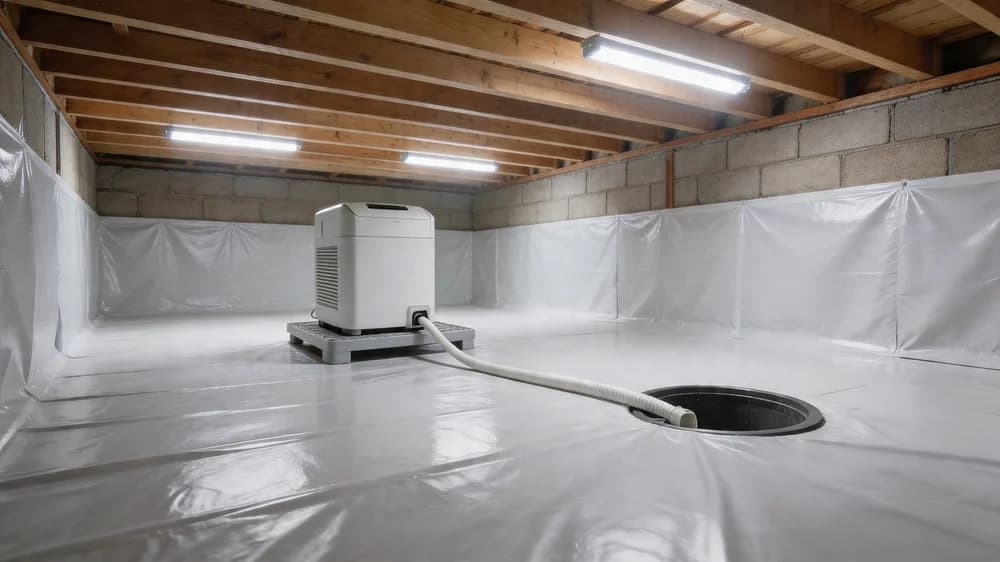
Choosing the right crawl space dehumidifier matters. Advanced DRI walks you through sizing, features, drainage and installation tips for long-term.
Why Crawl Space Humidity Matters
At Advanced DRI, we respond to countless calls where the root cause of upstairs mold, warped hardwood, and musty odors traces directly back to an untreated crawl space. Crawl spaces are often the most humid area of a home because they sit against bare earth, receive little airflow, and experience wide temperature swings between the ground and the subfloor above.
When humidity stays above sixty percent for extended periods, mold begins to colonize wood framing, insulation fails, and moisture migrates upward into the living space through a phenomenon called the stack effect. A properly chosen and installed dehumidifier is one of the most effective tools for protecting your home long-term.
But not every dehumidifier is suited to crawl space conditions, and choosing the wrong one can waste money while failing to solve the problem. This guide walks you through what to consider before buying.
Why a Regular Dehumidifier Is Not Enough
Standard residential dehumidifiers sold at big box stores are designed for living spaces with stable temperatures, easy access, and frequent emptying of the water tank. Crawl spaces are the opposite environment. Our team regularly finds homeowner-installed dehumidifiers that have frozen up in winter, overflowed from lack of drainage, or burned out after a few months because they simply could not handle the conditions.
A true crawl space dehumidifier offers specific features that make it suitable for the environment:
- Low-temperature operation that continues functioning as temperatures drop into the forties or fifties.
- Automatic defrost cycles to prevent ice buildup on the coils.
- Continuous drainage that eliminates the need to empty tanks.
- Built-in humidistat with remote monitoring capability in better models.
- Rugged construction that stands up to dusty, dirty conditions.
- Energy efficiency ratings that account for the high runtime typical of crawl spaces.
How to Size a Crawl Space Dehumidifier
The single biggest mistake homeowners make is buying a unit that is undersized for the space. Capacity in crawl space dehumidifiers is measured in pints of water removed per day. Here is how our team approaches sizing.
Calculate the Square Footage
Measure the length and width of your crawl space and multiply them. For irregular layouts, break the space into rectangles and add them together.
Consider the Starting Humidity
If your crawl space regularly sits above seventy percent relative humidity, you need more capacity. If it is closer to sixty percent, a smaller unit may suffice.
Account for Encapsulation Status
An encapsulated crawl space with a sealed vapor barrier, closed vents, and insulated walls needs far less dehumidification capacity than an unencapsulated space with exposed earth and open vents.
General Sizing Guidelines
For an encapsulated space between one thousand and fifteen hundred square feet, a seventy to ninety pint per day unit is often sufficient. For unencapsulated spaces or areas with persistent moisture issues, upgrading to a one hundred pint or higher capacity unit is wise. Our team always recommends sizing up rather than down because a dehumidifier running at seventy percent capacity lasts longer than one running at full tilt continuously.
Key Features to Prioritize
Continuous Drainage Capability
Any dehumidifier you install in a crawl space must drain automatically. Look for a condensate pump option if your drain location is above the unit. Gravity drainage works when there is a lower drain point available.
Built-In Pump
A built-in condensate pump allows the unit to push water uphill and over longer distances. This is essential in crawl spaces without a nearby sump pit or drain.
Remote Humidistat and Monitoring
Because you will rarely be in your crawl space, a remote readout or smartphone connectivity is more than a luxury. It lets you verify the system is working without climbing under the house.
Automatic Defrost
Any unit rated for low temperatures should include automatic defrost. Without it, coils can freeze solid and the unit will run without actually removing moisture.
Energy Star Certification
Crawl space dehumidifiers often run for thousands of hours per year. An energy-efficient unit can save hundreds of dollars over its lifespan while also reducing wear.
Durable Housing
Crawl spaces are dirty, dusty, and sometimes wet. Look for units with corrosion-resistant housings and washable filters designed for the environment.
Installation Best Practices
Even the best dehumidifier fails if installed incorrectly. Our team follows a careful approach whenever we install one during mold remediation or moisture control projects.
Elevate the Unit
Place the dehumidifier on a platform, concrete blocks, or a manufacturer-designed stand. This prevents flooding from submerging the unit and improves airflow around the intake.
Position for Optimal Airflow
Locate the unit where conditioned dry air can circulate through the entire crawl space. In larger or L-shaped spaces, supplemental ducting may be necessary.
Plan Drainage First
Before choosing a unit, identify where condensate will drain. Options include a sump pit, a nearby floor drain, a condensate pump discharge, or an exterior daylight discharge. Get this solved before you buy.
Run Power from a Dedicated Circuit
A dedicated fifteen or twenty amp circuit reduces tripped breakers and ensures reliable operation. Extension cords are never appropriate for long-term installation.
Seal the Crawl Space First
A dehumidifier trying to dry an open, vented crawl space with exposed earth is fighting a losing battle. Seal vents, install a vapor barrier, and insulate walls first. Our team can handle this as part of a full moisture control project.
Common Mistakes to Avoid
- Buying a standard residential dehumidifier that cannot handle cool temperatures.
- Skipping the vapor barrier and expecting the dehumidifier to compensate.
- Installing the unit in a corner with no airflow circulation.
- Ignoring drainage until after installation.
- Setting humidity too low, forcing the unit to overwork and shorten its lifespan.
- Forgetting to change or clean filters regularly.
- Oversizing to the point of short cycling, which is also hard on the unit.
What a Dehumidifier Cannot Do
We want homeowners to have realistic expectations. A dehumidifier addresses humidity, but it cannot fix bulk water intrusion, solve active leaks, or replace proper crawl space encapsulation. If you have standing water, exposed dirt, deteriorated insulation, or existing mold, these issues need to be addressed first. Otherwise the dehumidifier becomes an expensive bandage on a much larger problem.
When to Bring in Professionals
You should consider professional help when:
- Visible mold is already present on framing, insulation, or the vapor barrier.
- The crawl space has standing water, regardless of source.
- The existing insulation is sagging, stained, or smells musty.
- Sizing and installation are beyond your comfort level.
- You want a full encapsulation system rather than just a dehumidifier.
Our team handles crawl space water damage, mold removal, and moisture control as integrated projects. We also coordinate dehumidifier sizing with the rest of the system so the end result actually works.
If you are not sure where to start, contact Advanced DRI. We can evaluate your crawl space, recommend the right equipment, and handle installation with confidence that the problem is fully addressed.
Frequently Asked Questions
How long should a crawl space dehumidifier last?
Quality crawl space dehumidifiers typically last between eight and twelve years when properly sized, installed, and maintained. Units that run continuously at maximum capacity, or those exposed to flooding and extreme conditions, may fail sooner. Regular filter cleaning and annual inspection help extend lifespan significantly.
What humidity level should I set my crawl space dehumidifier to?
Aim for fifty percent relative humidity as your target. Setting it below forty-five percent forces the unit to work much harder with diminishing returns. Setting it above sixty percent leaves you in the range where mold can still grow. Fifty percent is the sweet spot for most homes.
Can I install a crawl space dehumidifier myself?
Some homeowners handle installation themselves, especially when a condensate pump and straightforward drainage are already in place. The most common DIY challenges involve sizing errors, drainage planning, and electrical work. If any part of the project feels uncertain, Advanced DRI provides installation and can integrate the dehumidifier with encapsulation and other moisture control measures.
Categories
Need Restoration Services?
Our team is available 24/7 for emergency response. Call us today for a free phone consultation.



Questions About Restoration?
Our experts are ready to help. Contact us for a free consultation.