
Water Damage Behind and Inside Walls: Signs, Checks and Next Steps
Tyler McClelland leads mitigation operations for Advanced DRI across New York's Hudson Valley, directing water, mold, and large-loss response in the field. He holds IICRC Water Restoration Technician (WRT) and Applied Microbial Remediation Technician (AMRT) certifications and a New York State Mold Supervisor certification, and is trained in IRCA hospital safe construction practices recognized by The Joint Commission.
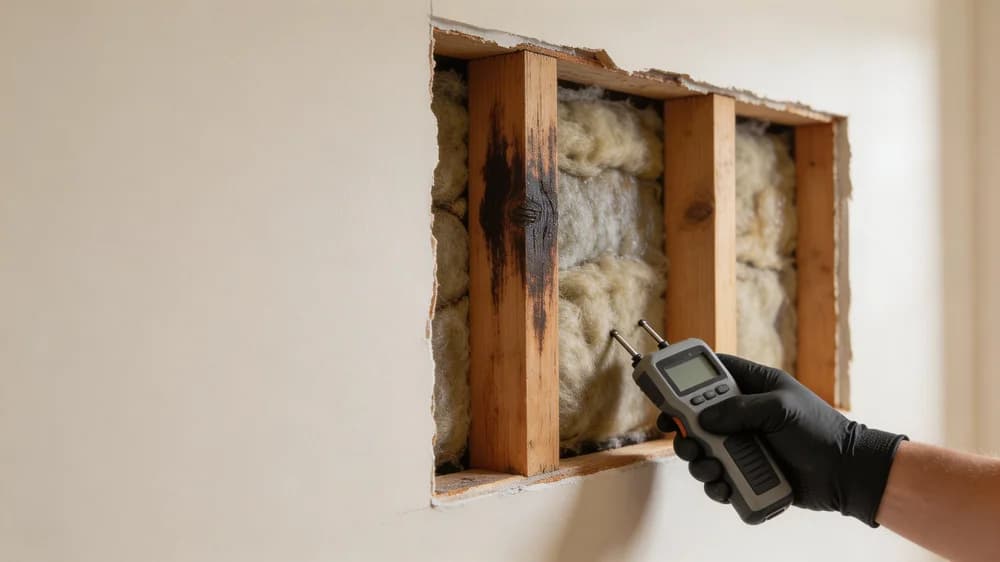
Spot water damage behind or inside walls: 12 signs, a simple meter test, what happens if it waits, and when a pro should open the wall.
Common signs of water damage in walls, including water hidden behind the drywall, are:
- a yellow-brown stain or tide line
- bubbling or peeling paint
- drywall that feels soft or looks swollen
- a warped or stained baseboard
- a musty smell in one spot
Dripping with every fixture off, or an unexplained jump in the water bill, points to an active leak inside the wall.
If water is running or a wall is soft or bulging right now, shut off the water and call our 24/7 line at (845) 294-8919. The rest of this page can wait.
A stain shows where water ended up, not where it started, and a wall that looks dry has not been checked with a meter. Below: 12 signs sorted by urgency, where to look first, a home check that needs no demolition, and what to do today.
Signs of Water Damage in Walls (and Behind Them)
Signs show up late and low. Water inside a cavity runs down the studs to the bottom plate, pools there, then wicks up into the drywall and out under the baseboard. The bottom foot of a wall deserves the closest look.
Act today: likely active water
| Sign | What it usually means | Quick check |
|---|---|---|
| A yellow-brown stain or tide line that is growing | Water wicking through; rings mean repeat wetting | Pencil the edge, look again in 24 hours |
| A paint bubble holding water | Liquid water behind the paint | Press gently over a towel |
| Soft, swollen or bowed drywall | Saturated gypsum core | Press lightly; don't push through |
| Warped baseboard, a gap at the floor, or water seeping out at the base | Water collecting on the bottom plate | Probe the caulk line; see mold on baseboards |
| Visible mold spots | Long-term moisture; more may be hidden | Don't scrape or sand it |
| Dripping or running water inside the wall, fixtures off | An active supply or drain leak | Do the meter test below |
EPA notes that mold may be hidden on the back side of drywall, wallpaper or paneling. Any of these with water still coming in? Call (845) 294-8919.
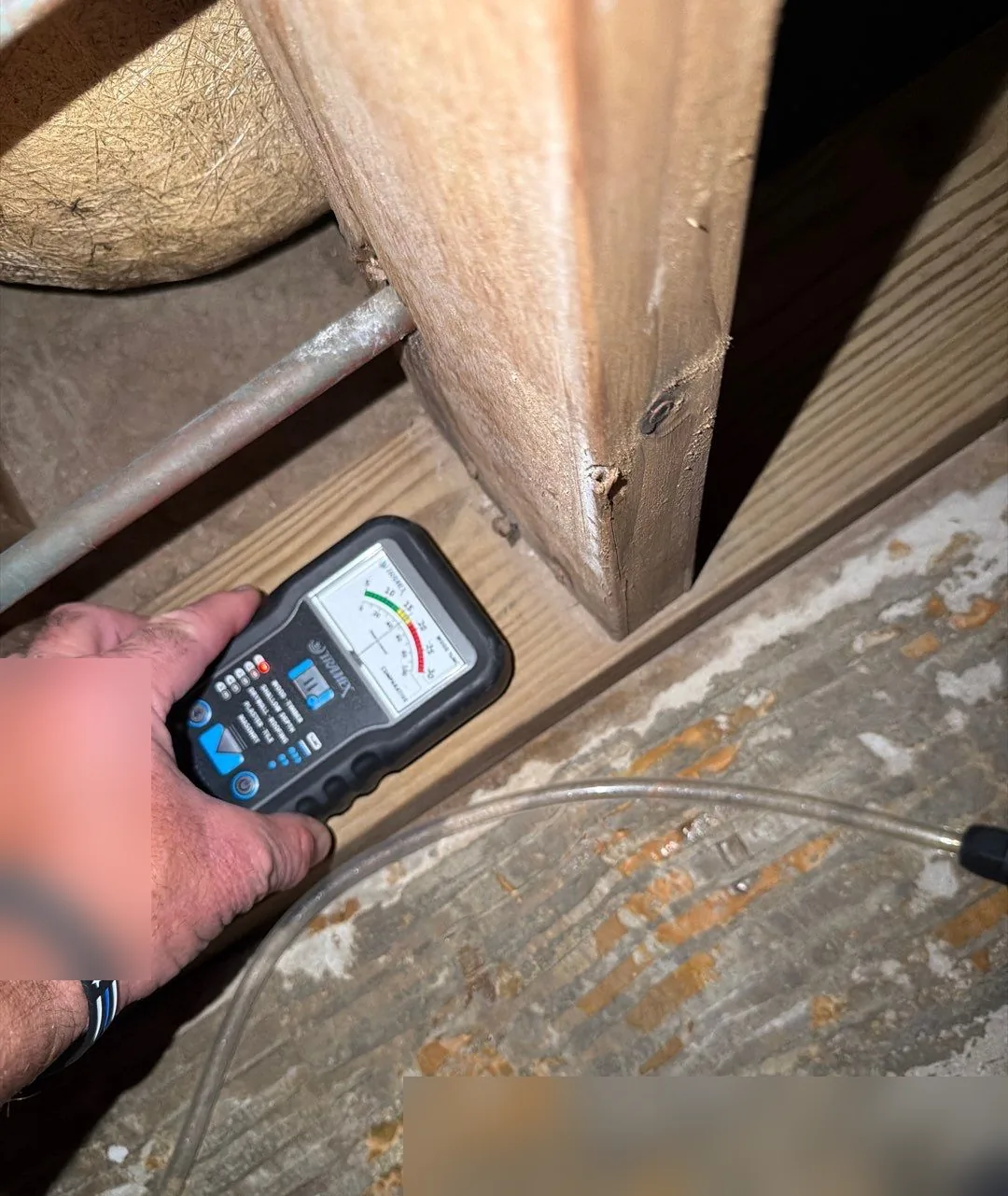
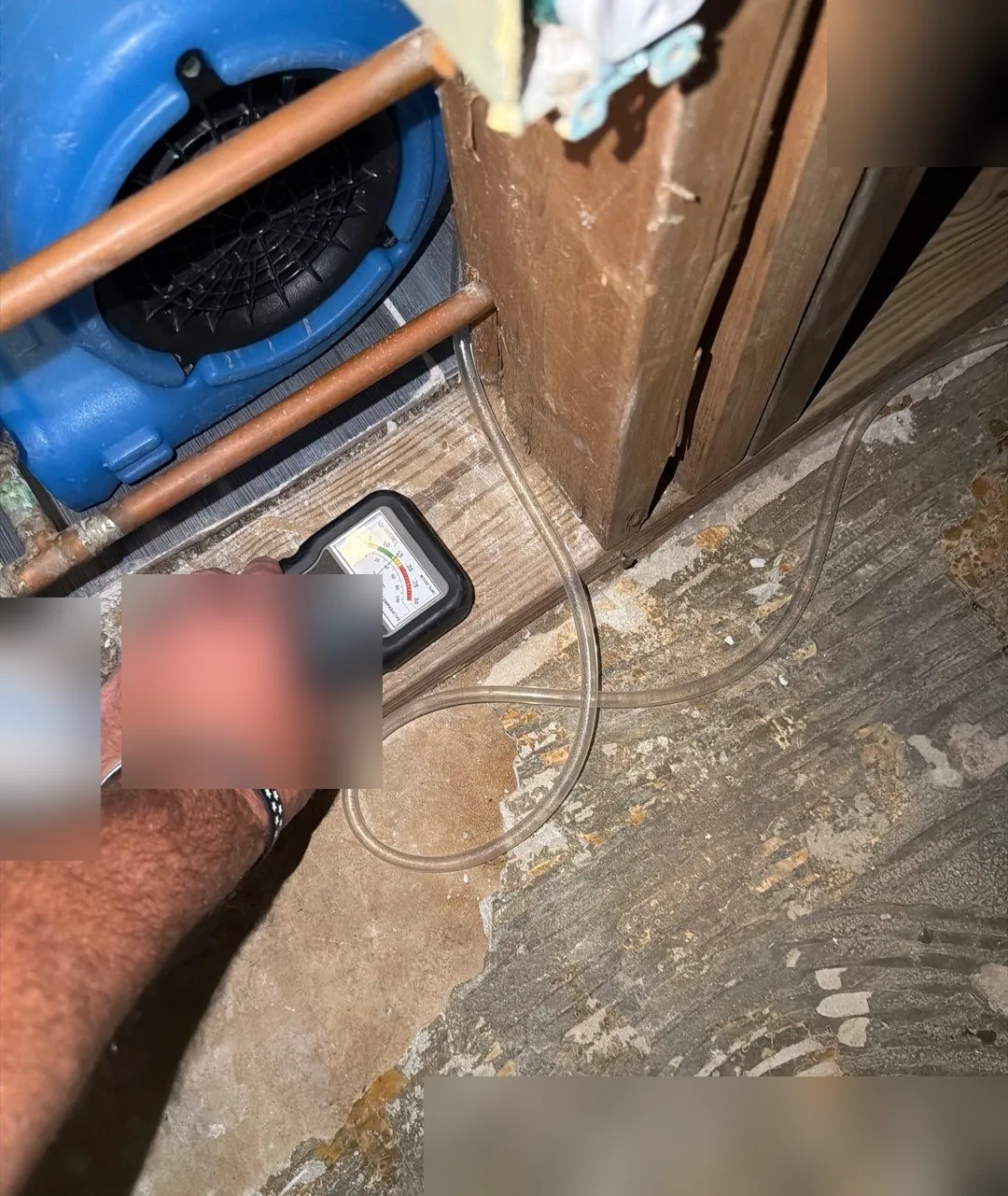
In this West Orange, NJ photo the wall is open and the meter goes straight to the stud-to-plate joint, where water settles. On a closed wall, that tells you where to press first.
Check this week
| Sign | What it usually means | Quick check |
|---|---|---|
| Wallpaper lifting at the seams | Adhesive failing from moisture | Compare with paper on a dry wall |
| A musty smell in one spot | Possible growth in the cavity | Smell at outlet covers and baseboard gaps |
| A higher water bill, same usage | A hidden supply leak | Do the meter test |
| A cold, damp spot, or winter frost inside an exterior wall | A leak or condensation | See the winter section below |
| White crust (efflorescence) on brick or block | Water moving through masonry | Brush it off; if it returns, water is still moving |
| Rust stains at screws or the corner bead | Fasteners corroding from repeated wetting | Run a meter along the line |
On brand-new masonry, efflorescence can just be construction moisture leaving. The bill matters too: EPA WaterSense estimates the average household's leaks waste more than 9,300 gallons a year.
Drywall vs plaster-and-lath walls
Plenty of older homes in New York, New Jersey, Pennsylvania and Connecticut have plaster. It stains more slowly than drywall; look instead for new cracks, crumbling, a chalky bloom, or a section sagging off the lath. Compare meter readings with a dry area of the same plaster wall, never with drywall.
Before anyone cuts in: contractors disturbing paint in homes built before 1978 must follow EPA's Renovation, Repair and Painting rule because of lead dust, and EPA lists wall patching compounds and textured paint among products that may contain asbestos.
What water damage on an exterior wall looks like
Inside, watch for stains under window corners, peeling paint below sills, and damp where the wall meets the ceiling under an ice-dam area. If it's spreading overhead, check the signs a ceiling leak is an emergency. Outside, look for swollen siding, stained or cracked stucco, and eroded mortar. In the Northeast, three things drive most of it: wind-driven rain (see how nor'easters cause hidden damage), freeze-thaw cycles that widen cracks, and ice dams that push water over the top of the wall.
Where to Look First: Wall Hotspots
- Shower valve and tub spout wall. For tile, see behind a tiled shower wall.
- Toilet supply and the wall behind the tank.
- Kitchen sink wall and dishwasher supply. Check the back panel of the sink base.
- Washer box and laundry wall.
- Below windows and door-frame corners on exterior walls.
- Walls under an upstairs bathroom.
- Walls by the water heater or boiler, or carrying an HVAC condensate line.
- Exterior walls under roof valleys and gutters.
- Basement walls at the floor joint.
Walls clean but something still smells wet? Here are other places hidden water collects.
How to Tell If There Is Moisture Behind a Wall (Without Cutting It Open)
Check your water meter before and after two hours with no water in use. Then press the wall and baseboard for soft spots and smell at outlets. A moisture meter confirms it: compare the wall with the same material in a dry room. A thermal camera shows only temperature.
- Water-meter test. Turn off every fixture and appliance, read the meter, wait two hours without using any water, then read it again (EPA WaterSense). If it moved, there's a supply leak somewhere. Shut irrigation and outdoor spigots too. It won't catch drain leaks, roof leaks or condensation.
- Rule out toilets first: a few drops of food coloring in each tank. Color in the bowl after 10 minutes without flushing means a leaking flapper, not the wall. Flush afterward.
- On a private well, with everything off, listen for the pump kicking on by itself.
- Look and press. Hold a flashlight flat to the wall so swelling throws a shadow. Press the baseboard top and the bottom of the wall. Check the sink base and behind the vanity.
- Smell and listen at outlet covers and switch plates, fixtures off. They're the only openings into the cavity.
- Moisture meter, compared. Pinless scans, pin confirms. Take the same reading on the same material in a dry room; readings depend on the meter and material, so compare instead of chasing a number. More on how to read moisture meter results. In our experience, pinless meters read high over metal (foil-faced insulation, metal studs, corner bead, wiring), so confirm with a pin meter.
- Thermal camera, with limits. It shows surface temperature, not water. Wet spots often read cooler from evaporation, but a hot-water line can read warm, and studs, insulation gaps and drafts make patterns too. Makers like FLIR pair the camera with a moisture meter to verify. See what thermal imaging can and can't see.
- Electrical safety. Near outlets or switches, turn that circuit off at the breaker first. If the panel sits in a wet area, stay away and call the utility or an electrician. Ready.gov: don't touch electrical equipment if it is wet or if you are standing in water.
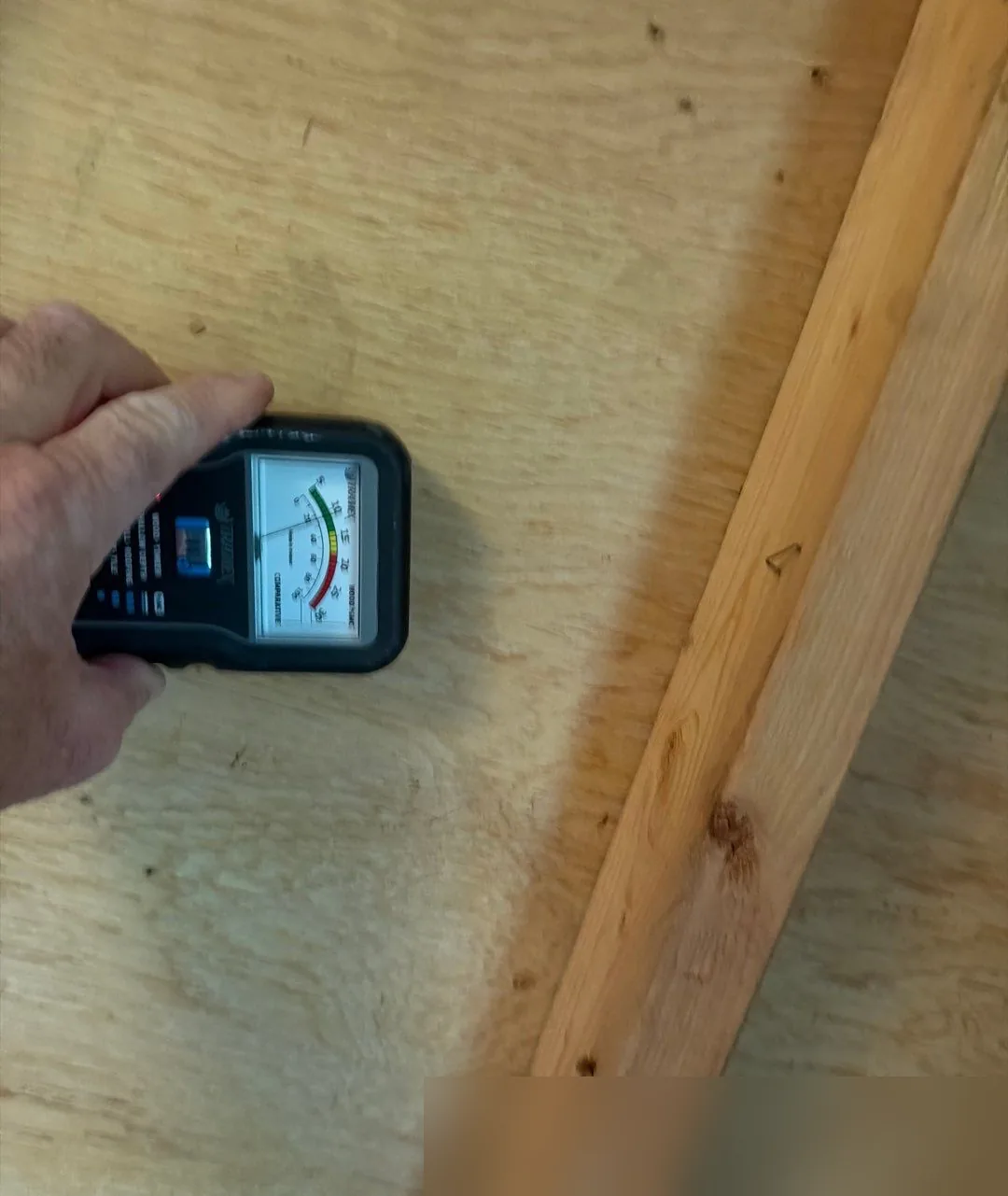
The Chester, NJ photo shows step 4 on an opened wall: the meter on the sheathing beside the framing, where leaks and winter condensation both tend to sit. On a closed wall our crews take readings through the drywall first and open only where the numbers point.
Home checks run out when readings stay high with no visible source, there's a smell but no reading, or the area is behind tile or in a wall shared with a neighbor.
What Happens If Water Gets in Your Walls: A Timeline
Water inside a wall soaks drywall and insulation, runs down to the bottom plate and keeps framing wet. EPA advises drying water-damaged materials within 24–48 hours to prevent mold growth. Left longer, drywall weakens, wood can rot and fasteners corrode, turning a dry-and-patch job into removal and rebuilding.
- First hours. Drywall wicks water upward. Insulation holds it against the framing (see wet insulation inside walls). Wiring and boxes in the cavity are exposed.
- 24–48 hours. EPA's window for drying to prevent mold. Dry the wall inside it and mold has little chance to start.
- Days to weeks. Drywall loses strength. The CDC lists paper, wood, drywall and insulation among materials mold can grow on. Water quality can slide too: under the IICRC water categories, gray water left untreated for more than 48 hours may become Category 3 (Northern Arizona University water-damage guideline). Under the IICRC S500 procedures we follow, porous materials soaked with Category 3 water, such as drywall and insulation, are generally removed rather than dried.
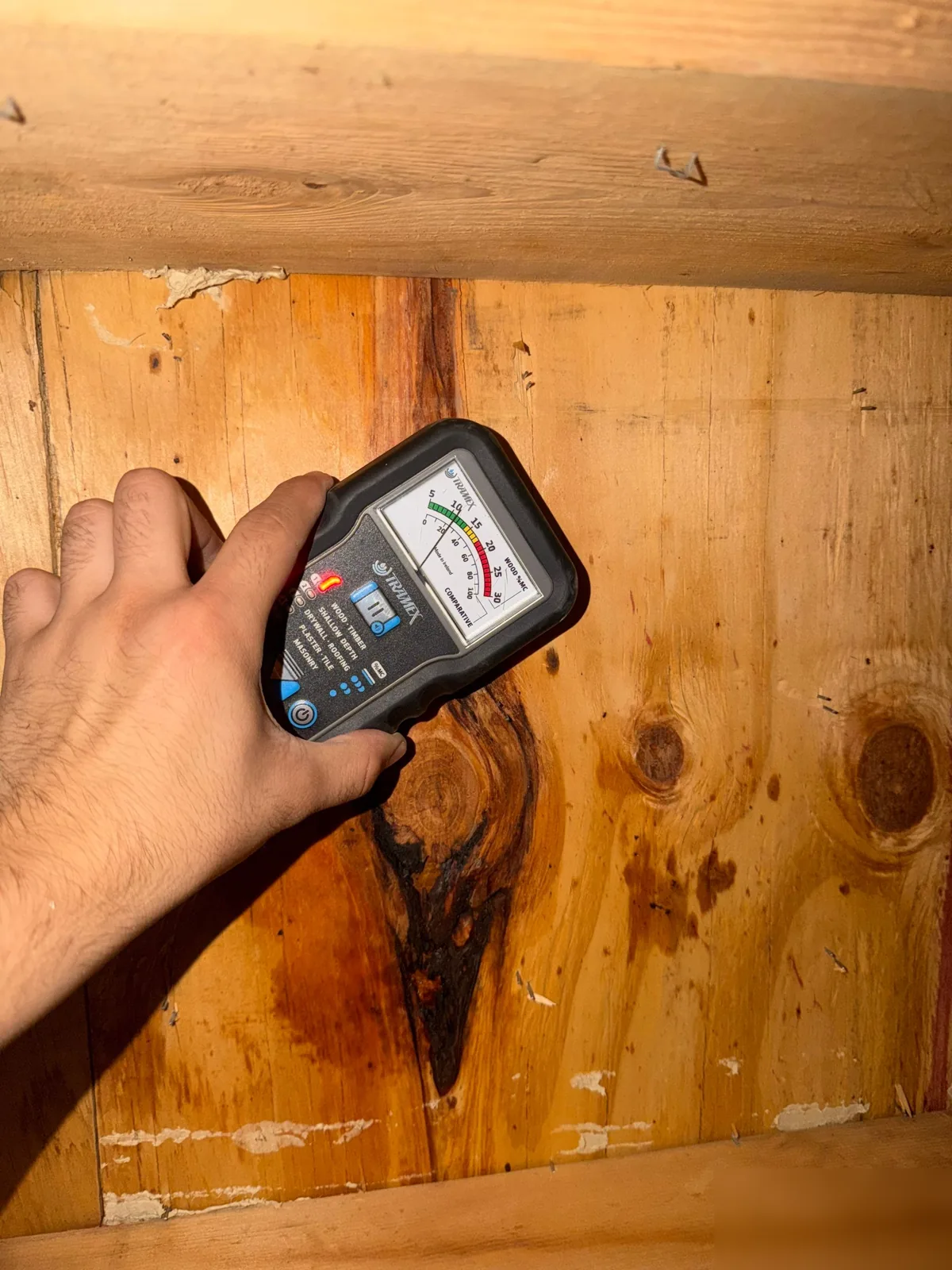
- Weeks to months. Slow leaks rot sill plates, sheathing and subfloor and corrode fasteners. The Monroe Township photo shows the result on framing: dark staining running down the grain along the water's path.
Fast drying keeps most jobs at "dry and patch"; waiting turns them into "remove, remediate, rebuild." Past that point? Read when drywall can be saved and when it has to be replaced.
Why Water Gets Inside Walls
Plumbing. Pinholes in copper, failed joints, cracked drain fittings. Drain leaks run only when a fixture is used, so the meter test misses them. A toilet overflow carrying waste is Category 3 water; the NAU guideline treats toilet back flows from beyond the trap as black water.
Exterior intrusion and ice dams. Failed flashing, cracked sills, gaps at windows and damaged siding let rain in; ice dams force meltwater over the top plate.
Upstairs overflows. A tub, toilet or washer overflowing upstairs sends water into the walls below, usually a job for full water damage restoration.
Condensation. In winter, warm indoor air leaking into an exterior wall condenses on the cold sheathing. A U.S. Department of Energy Building America report says that in most circumstances airflow transports an order of magnitude more water vapor than vapor diffusion, so air gaps at outlets and penetrations matter.
"Sweating" walls in winter: leak or condensation?
Condensation forms on the coldest spots, like outside corners and behind furniture, worsens in cold snaps and high humidity, and fades when it warms. A leak is localized, follows rain or fixture use, and stays. On basement concrete or block, tape plastic sheeting tight to the wall for a day or two: moisture behind it is coming through the wall, moisture on the room side is condensation. It's a rough check, and useless on drywall. EPA's humidity target: below 60 percent, ideally 30 to 50.
What to Do Right Now If You Find Water in a Wall
- Stop the water at the fixture shutoff or the main.
- Cut power to circuits in the wet wall if the panel is dry. Have an electrician check any wet outlet, switch or box before reuse.
- Photograph the stain, any readings and the date.
- Move furniture and rugs away, ventilate and dehumidify.
- Don't paint over the stain or re-caulk the baseboard, and don't close an opened wall until it reads like the dry reference.
- Leave mold alone. EPA says do not paint or caulk moldy surfaces and warns that removing wallpaper over mold can release a massive amount of spores. Don't sand it either.
- Tell your insurer promptly. Triple-I advises photographing damage, then taking reasonable steps to protect your property from further damage. Save receipts, and photograph anything that has to be removed before the adjuster visits.
Water still coming in? Call (845) 294-8919, day or night.
Call a pro if…
- readings stay high or spread after the water is off
- drywall is soft or bowed, or a musty smell lingers
- water reached outlets or wiring
- the water came from a drain or toilet (sewage or drain-line water needs different handling)
- the wall is shared with another unit, or there's mold inside the cavity
EPA says homeowners can usually clean mold areas less than about 10 square feet; in our view, anything larger or inside a cavity calls for a pro. In New York, Labor Law Article 32 requires licensed mold assessors and remediators, bars one person from doing both on the same property, and has limited exceptions for owners working on their own property (NYS DOL). In NYC, owners of buildings with 10 or more units must hire independent licensed assessors and remediators for more than 10 square feet of mold (NYC HPD). Rules differ in NJ, PA and CT.
A note on insurance
Water damage and freezing made up 22.6% of homeowners insurance losses in 2023, with an average claim around $15,400 over 2019–2023 (Triple-I, citing ISO). Many policies exclude "constant or repeated seepage or leakage" over weeks, months or years. When a sudden plumbing leak is covered, policies often pay to open and repair the wall but not to replace the failed pipe itself. Wording varies; read your own policy. This isn't coverage or legal advice. More on burst pipe insurance claims.
How Advanced DRI Finds and Dries Water Inside Walls
Moisture mapping before demolition
Meters and thermal imaging, measured against a dry reference of the same material elsewhere in the house. Every wet area is mapped, not just the stain, and readings are logged daily.
Opening only what has to come out
When drywall must go, a flood cut removes the wet lower section in a straight line and leaves the dry wall above, exposing studs, plate and insulation. Wet insulation usually comes out too.
Drying to a measured standard
Air movers run along the open framing while dehumidifiers pull moisture from the air; the bottom plate is usually the last part to dry. We follow IICRC S500 standard procedures: "dry" means matching readings from unaffected material, and the wall stays open until it does.
Mold, then rebuilding
Growth in the cavity is contained and cleaned with HEPA filtration following IICRC S520 procedures for mold remediation. Then the source is fixed and the wall rebuilt.
How to Keep Water Out of Your Walls
- Replace braided supply lines on the manufacturer's schedule.
- Re-caulk windows and doors and clean gutters before winter.
- Add leak sensors behind the washer, dishwasher and water heater; consider an automatic shutoff valve.
- Know your main shutoff, and keep winter humidity at 30–50%.
Advanced DRI has handled water damage across New York, New Jersey, Pennsylvania and Connecticut since 2000, from 11 offices, typically arriving within 90 minutes in nearby service areas. Call (845) 294-8919 or contact our team.
Frequently Asked Questions
What does water damage on a wall look like?
Usually a yellow or brown stain with a darker edge or rings, bubbling or peeling paint, a soft or bulging patch, or a swollen baseboard, sometimes with rust along screws. On plaster, look for new cracks or a chalky white bloom.
Why is water leaking from the bottom of my wall?
Water inside a wall runs down the studs and collects on the bottom plate, so it shows at the base first. Likely sources: a supply line or drain in that wall, a shower valve, a window above, or an upstairs bathroom. Shut off the water and check the meter.
What are the earliest signs of water damage in walls?
Faint discoloration low on the wall, a baseboard caulk line opening, paint that dulls or blisters slightly, a smell you notice only in a closed room, and a water bill creeping up.
Can you detect moisture inside walls without cutting drywall?
Often, yes: pinless meters scan, pin meters confirm, and thermal imaging guides where to measure. Metal studs and foil-faced insulation can fool pinless meters. In older homes, check for lead paint and asbestos before cutting an inspection hole.
How do professionals check for hidden water damage in walls?
They map the whole wet area with meters against a dry reference, use thermal imaging to decide where to measure, and log readings until materials match that reference. Walls are opened only where readings point.
Can water damage inside walls spread?
Yes. Drywall wicks upward, the bottom plate carries water into neighboring stud bays, and it can reach flooring and the ceiling below. Mold can grow on any of those that stays damp.
Is drywall always replaced after water damage?
No. Firm drywall wet with clean water and dried quickly can often stay. Soft or sagging drywall, visible mold, or contaminated water usually means removal.
Categories
Need Restoration Services?
Our team is available 24/7 for emergency response. Call us today for a free phone consultation.


Questions About Restoration?
Our experts are ready to help. Contact us for a free consultation.