
Tyler McClelland leads mitigation operations for Advanced DRI across New York's Hudson Valley, directing water, mold, and large-loss response in the field. He holds IICRC Water Restoration Technician (WRT) and Applied Microbial Remediation Technician (AMRT) certifications and a New York State Mold Supervisor certification, and is trained in IRCA hospital safe construction practices recognized by The Joint Commission.
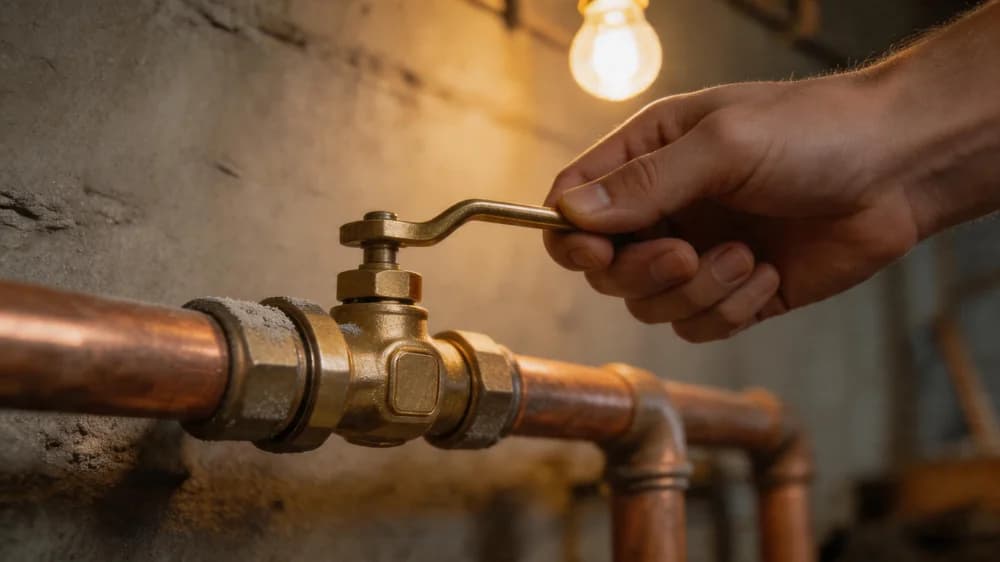
A step-by-step guide to locating and shutting off your home's main water valve before an emergency. Advanced DRI shows you what to practice today.
When a pipe bursts or a water heater ruptures, you don’t have time to Google where your shutoff valve might be. You have minutes — not hours — before the damage becomes expensive. At Advanced DRI, we’ve been on hundreds of emergency calls where the homeowner saved thousands of dollars simply because they knew where their main water shutoff was and how to close it.
This guide walks you through finding your shutoff, testing it, and practicing so that when you actually need it, you can do it in the dark, in a panic, with wet hands.
Why the Main Shutoff Matters More Than the Fixture Shutoff
Most homeowners know about the small valves under sinks and behind toilets. Those work great when a toilet tank or faucet supply line is the problem. But if the failure is a burst pipe in a wall, a ruptured water heater, or a whole-house line break, individual fixture shutoffs won’t help. You need to kill the supply to the entire house.
That’s the job of the main water shutoff valve, and every home has one. Finding yours before an emergency is the single most important thing you can do today.
Where to Look
The main shutoff is always on the line where water enters the house from the street or well. Its location depends on your region and home style:
Homes with Basements (Common in the Northeast)
Look along the wall that faces the street. You’ll usually see a pipe coming up through the concrete floor or poking through the wall, with a large valve and a water meter attached. The main shutoff is typically on the house side of the meter.
Homes with Crawlspaces
Check the crawlspace near the front of the house, or look for an interior access panel in a closet or utility room on the ground floor.
Homes on Slab Foundations
The shutoff is often in the garage, a utility closet, or an exterior wall. Some homes have it outside near the foundation in a small access box.
All Homes: The Curb Stop
Out by the street, there is a second shutoff called the curb stop, usually in a round or rectangular metal cover near the property line. This is owned by the water utility and requires a special key (called a curb key or street key) to operate. It’s your backup if the interior valve fails.
The Two Types of Valves
Ball Valve (Easy, Modern)
A ball valve has a straight lever handle. Turning the handle 90 degrees — a quarter turn — closes it. When the handle is parallel to the pipe, the valve is open. When it’s perpendicular to the pipe, it’s closed. Simple, fast, and reliable.
Gate Valve (Older Homes)
A gate valve has a round wheel handle. You close it by turning the wheel clockwise, usually six to ten full rotations. Gate valves are common in older homes and have one big problem: they seize up if they aren’t exercised regularly. A valve that hasn’t moved in 20 years may be impossible to close when you need it — or worse, the stem may snap off in your hand.
Step-by-Step: How to Shut Off Your Main
- Locate the valve. Use the guide above. If you cannot find it, your water bill or your home inspection report usually notes the location.
- Clear access. Make sure nothing is stacked in front of it. In an emergency you need it reachable in under 30 seconds.
- For a ball valve: Push the lever 90 degrees. It should move smoothly.
- For a gate valve: Turn the wheel clockwise until it stops. Do not force it past the natural stop.
- Confirm the shutoff worked. Open a faucet somewhere in the house. Water should run briefly and then stop.
Practice — Once a Year
The reason older gate valves fail is that they sit untouched for decades and mineral deposits lock them in place. Exercising the valve once a year — fully closing and reopening it — keeps it working. Same with ball valves: flipping them back and forth once a year keeps the seal healthy.
Pick a memorable date (daylight savings time is a good one) and add it to your calendar along with testing smoke alarm batteries and flipping your mattress.
If the Valve Won’t Close
If you try to shut off your main and it won’t budge, do not force it. A stuck valve that breaks mid-close can be worse than no valve at all. Instead:
- Call your water utility’s emergency number — they can shut off the curb stop from outside.
- Call a plumber to replace the interior valve as a preventive upgrade.
- If you’re actively flooding, get a curb key from a hardware store (they’re cheap) and shut off the curb stop yourself.
Label Everything
Put a bright tag on your main shutoff that says “MAIN WATER SHUTOFF.” Do the same for the water heater valve, the washing machine valves, and any irrigation shutoffs. If you have house-sitters, a guest, or family staying over, they shouldn’t have to play detective during a flood.
Also: take a photo of your shutoff’s location and save it to your phone in an album labeled “Home Info.” It’s one of those small things that saves your future self a lot of panic.
What to Do After You’ve Stopped the Water
Once the water is off, the clock is ticking on drying. Our water damage restoration team can be on-site within hours of your call with truck-mounted extractors, commercial air movers, and hygrometers to track progress room by room. The faster professional drying begins, the less chance of mold, warped flooring, and drywall damage.
Ready for Help?
If you’ve just shut off your water because of a leak, contact Advanced DRI right now. We answer the phone 24/7 and can dispatch a crew to your home while you’re still mopping. Even if you’re not sure yet whether you need help, call — we’ll help you assess over the phone at no charge.
Frequently Asked Questions
How long does it take for water to stop after I close the main?
Water in the pipes between the shutoff and your fixtures will continue to drain out for 30 seconds to a few minutes. Opening a faucet somewhere in the house helps it drain faster and confirms the shutoff worked.
Should I replace an old gate valve?
Yes, especially if it’s more than 20 years old. Modern ball valves are more reliable and easier to use in an emergency. A licensed plumber can swap it in under an hour in most homes.
Is the curb stop the same as the meter shutoff?
No. The curb stop is the utility-owned valve at the edge of your property. The meter shutoff is usually just before or after the water meter inside your home. Both can stop water, but the meter shutoff is the one you’ll use in an emergency.
Categories
Need Restoration Services?
Our team is available 24/7 for emergency response. Call us today for a free phone consultation.


Questions About Restoration?
Our experts are ready to help. Contact us for a free consultation.