Fire-Resistant Building Materials: What Works and What Doesn't
Rob Temples manages emergency restoration operations for Advanced DRI's Fairfield, NJ and New York City service areas. With 10 years in the restoration industry and prior experience working for a general contractor, he integrates construction knowledge with mitigation expertise on every project and holds an IICRC Water Restoration Technician (WRT) certification.
Not all fire-resistant building materials perform as expected. Advanced DRI explains which materials truly protect your property and which fall short under real
Understanding Fire Resistance in Building Materials
When property owners think about fire protection, they often focus on smoke detectors and extinguishers. But the building materials that make up your walls, floors, roof, and structural frame play an equally critical role in determining how a fire behaves and how much damage it ultimately causes. At Advanced DRI, our experience restoring fire-damaged properties across New York, New Jersey, Pennsylvania, and Connecticut has given us firsthand insight into which materials stand up to real fire conditions and which fail in ways that surprise property owners.
Understanding fire-resistant building materials is valuable whether you are rebuilding after a fire, planning a renovation, or simply want to make informed decisions about your property's safety.
Fire Resistance Ratings Explained
Before evaluating specific materials, it helps to understand how fire resistance is measured. Fire-resistance ratings are expressed in time increments, typically one hour, two hours, or four hours, indicating how long an assembly can withstand standard fire exposure while maintaining structural integrity and preventing fire passage.
Important distinctions to understand:
- Fire-resistant vs. fireproof: No building material is truly fireproof. Fire-resistant means the material resists ignition and slows fire spread, but it will eventually fail under sustained heat exposure.
- Assembly ratings vs. material ratings: Fire-resistance ratings apply to complete assemblies, such as a wall system including studs, insulation, and finish materials, not individual components. A fire-rated drywall sheet alone does not create a fire-rated wall.
- Testing conditions vs. real fires: Standard fire tests use controlled, uniform heat exposure. Real fires produce uneven, turbulent conditions that may cause materials to perform differently than laboratory results suggest.
Materials That Perform Well
Concrete and Concrete Masonry
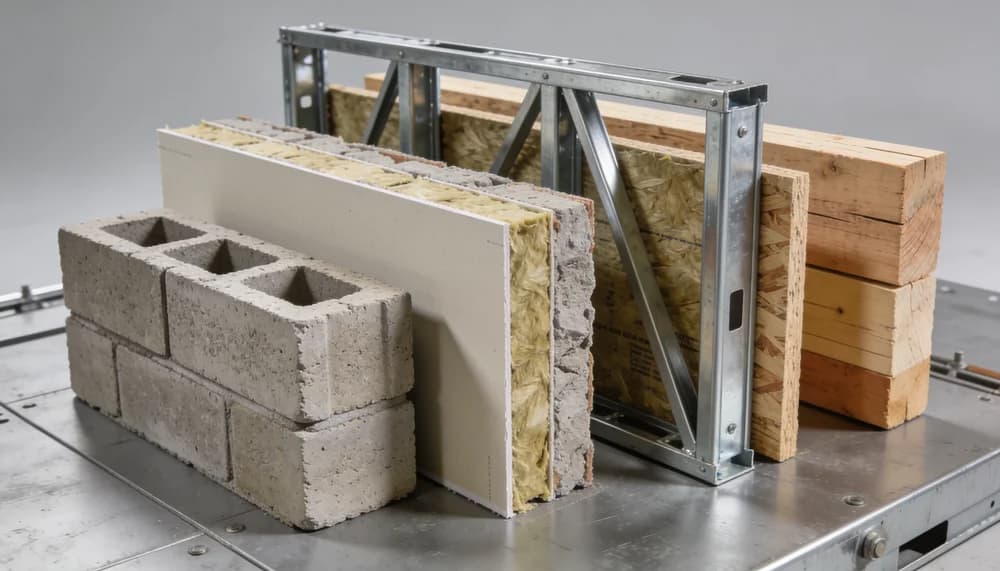
Concrete is one of the most fire-resistant structural materials available. It does not burn, does not contribute fuel to a fire, and maintains significant structural capacity at elevated temperatures. Concrete masonry walls routinely achieve two-hour and four-hour fire-resistance ratings. However, as we discuss in our assessment of fire damage restoration projects, concrete does suffer damage at extreme temperatures, including spalling and strength reduction, so it should not be considered invulnerable.
Type X Gypsum Board
Type X gypsum board, commonly known as fire-rated drywall, contains glass fiber reinforcement and additional crystalline water content that extends its fire resistance. When properly installed in rated assemblies, Type X gypsum provides one-hour fire protection in single-layer applications and two hours or more in double-layer configurations. This material is one of the most cost-effective fire protection options for interior walls and ceilings.
Steel Framing
Steel does not burn and will not contribute fuel to a fire. However, steel loses approximately 50 percent of its strength at around 1,100 degrees Fahrenheit. For this reason, structural steel typically requires additional fire protection, such as intumescent coatings, spray-applied fireproofing, or encasement in gypsum or concrete, to achieve meaningful fire-resistance ratings.
Fiber Cement Siding
Fiber cement siding is highly fire resistant, achieving class A fire ratings. It does not ignite, burn, or melt when exposed to direct flame. For properties in areas with wildfire risk or in dense urban environments where fire spread between structures is a concern, fiber cement siding provides excellent exterior protection.
Fire-Treated Lumber
Pressure-treated fire-retardant lumber has chemical treatments that significantly reduce flame spread and smoke development. While it will eventually char and burn under sustained heat, it resists ignition and slows fire progression much more effectively than untreated wood. It is commonly used in roof trusses, wall framing, and exterior decking where fire resistance is required by code.
Materials That Underperform Expectations
Standard Vinyl Siding
Vinyl siding melts and deforms at relatively low temperatures, around 165 degrees Fahrenheit. While it does not sustain flame as aggressively as some materials, melting vinyl exposes the underlying sheathing and framing to fire. Melted vinyl also produces toxic hydrogen chloride gas. Many property owners are surprised at how quickly vinyl siding fails in a fire scenario.
OSB and Plywood Sheathing
Oriented strand board and plywood are combustible materials that contribute significant fuel to a fire once ignited. While they are commonly used in residential construction, they offer minimal fire resistance on their own. Properties that rely on these materials without additional fire-protective layers are at increased risk.
Spray Foam Insulation
Closed-cell spray foam insulation provides excellent thermal performance but raises fire safety concerns. While modern formulations include fire retardants, spray foam is combustible and can produce dense, toxic smoke when burning. Building codes require that spray foam be covered by a thermal barrier, typically half-inch gypsum board. Installations that do not meet this requirement create a significant fire risk.
Engineered Wood Products
Engineered wood products such as I-joists, laminated veneer lumber, and glulam beams offer structural advantages but can fail rapidly in fire conditions. Engineered I-joists in particular are known to lose structural capacity much faster than solid lumber when exposed to fire because their thin web section burns through quickly. Fire departments have raised significant safety concerns about fighting fires in buildings framed with these products.
EIFS (Synthetic Stucco)
Exterior Insulation and Finish Systems use expanded polystyrene foam covered by a thin synthetic finish coat. While the finish coat may resist surface flame spread, the underlying foam is combustible. In fire conditions, EIFS can melt, deform, and contribute fuel to the fire while also trapping heat against the structural sheathing behind it.
Smart Material Choices for Rebuilding
When rebuilding after a fire, property owners have an opportunity to upgrade their building materials for improved fire resistance. Our reconstruction team recommends considering:
- Type X gypsum board on all walls and ceilings, including garages and utility rooms
- Fiber cement or masonry exterior cladding in place of vinyl siding
- Concrete or clay tile roofing materials instead of asphalt shingles
- Fire-rated door assemblies for bedrooms, utility rooms, and garage entries
- Mineral wool insulation, which is naturally fire resistant, in place of fiberglass or foam
- Fire-treated lumber for framing in critical areas
These upgrades add moderate cost to a reconstruction project but can significantly reduce the severity of damage in a future fire event. Many insurance carriers also offer premium discounts for homes built with fire-resistant materials.
Building Code Requirements
Local building codes in New York, New Jersey, Pennsylvania, and Connecticut specify minimum fire-resistance requirements for various building components. These requirements vary based on occupancy type, building size, and proximity to other structures. When Advanced DRI manages reconstruction projects, we ensure full compliance with all applicable fire-resistance code requirements and often recommend exceeding minimum standards where practical.
If you are rebuilding after a fire or planning renovations, contact Advanced DRI to discuss how fire-resistant building materials can be incorporated into your project for better long-term protection.
Frequently Asked Questions
Is concrete really fire resistant?
Concrete is one of the most fire-resistant common building materials. It does not burn, does not produce toxic fumes, and maintains structural integrity at temperatures well above what most other materials can withstand. However, it does experience damage at extreme temperatures, including surface spalling and gradual strength loss, so it should not be considered completely fireproof.
Does fire-rated drywall really make a difference?
Yes, significantly. Type X fire-rated drywall can buy critical time during a fire by slowing the passage of heat and flame through walls and ceilings. In many fire restoration projects we handle, we observe clear differences in damage levels between areas protected by fire-rated drywall and those with standard drywall.
Are metal roofs fire resistant?
Metal roofing panels are classified as class A fire resistant, the highest rating available. They will not ignite from airborne embers or radiant heat exposure. However, the fire resistance of the overall roof assembly also depends on the underlayment and decking materials beneath the metal panels.
Should I replace my vinyl siding with something more fire resistant after a fire?
We strongly recommend considering fire-resistant alternatives during reconstruction. Fiber cement siding, brick veneer, and stone veneer all offer substantially better fire performance than vinyl while providing comparable or superior aesthetics and durability. The cost difference is often modest when factored into a full restoration project.
Categories
Need Restoration Services?
Our team is available 24/7 for emergency response. Call us today for a free phone consultation.
Questions About Restoration?
Our experts are ready to help. Contact us for a free consultation.