Fire and Smoke Damage Restoration Cost in New York: What Homeowners Actually Pay
Rob Temples manages emergency restoration operations for Advanced DRI's Fairfield, NJ and New York City service areas. With 10 years in the restoration industry and prior experience working for a general contractor, he integrates construction knowledge with mitigation expertise on every project and holds an IICRC Water Restoration Technician (WRT) certification.
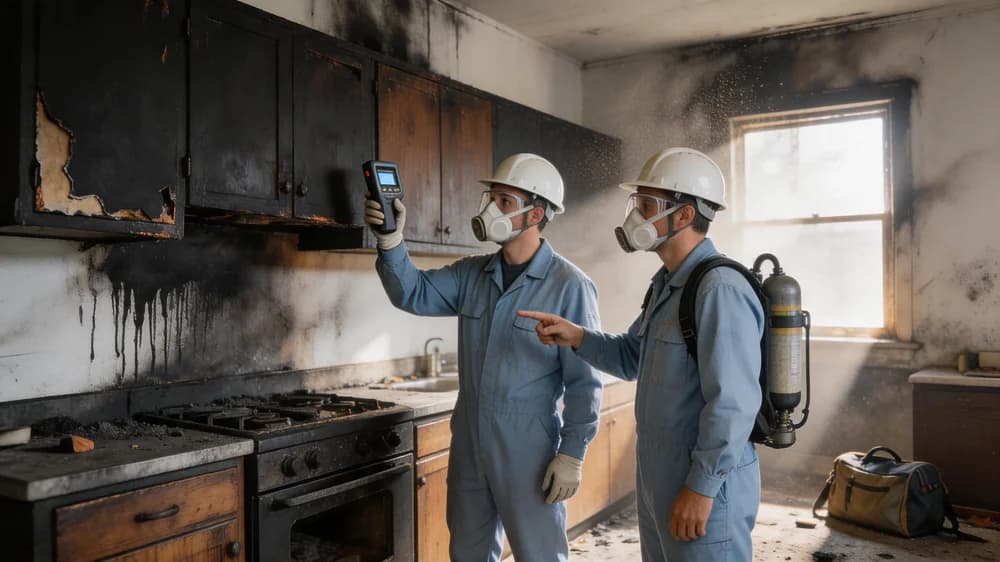
Fire damage repair in NY: Angi's 2026 state average is $78,200. Costs by severity, smoke cleanup per room, per sq ft, and what NYC buildings add.
Quick answer: Angi's 2026 cost data puts the national average for fire damage restoration at $27,477, with most projects between $3,083 and $52,031. New York's state average in the same guide is $78,200, second only to California in Angi's state table. Smoke-only cleanup is priced per room, starting around $200; fires that reach framing, wiring or the roof cost far more.
Those are third-party averages, not quotes. A fire bill is built from what burned, what got wet from the hose lines, where the smoke went and what the building rules require before anyone can rebuild. In New York City, asbestos and lead rules, shared smoke paths and building access add steps suburban jobs often skip.
If you are dealing with a fire right now, our fire damage restoration services team answers (845) 294-8919 around the clock, and crews typically arrive within 90 minutes in nearby service areas.
What Fire Damage Restoration Costs: National and New York Benchmarks
| Benchmark | Figure | Source |
|---|---|---|
| U.S. average restoration cost | $27,477 (most projects $3,083 to $52,031) | Angi, 2026 data |
| New York State average | $78,200 | Angi state table, 2026 |
| California average (highest listed) | $91,700 | Angi state table, 2026 |
| Cost per square foot | $4 to $7 (average $5.50) | Angi, 2026 |
Angi's state and national figures come from different project samples, so compare New York with other states in that table, not with the national number. Angi and HomeAdvisor belong to the same company and share cost data, so matching figures on both sites are one data family, not two confirmations.
Insurers measure something else. The Insurance Information Institute (Triple-I), citing ISO/Verisk, reports that the average non-catastrophe homeowners fire claim reached $173,111 in 2024, up from $99,613 in 2020. Claim severity includes everything the insurer paid, including contents, living expenses and total losses, so it is not a restoration bill.
An average blends a stovetop fire that scorched one cabinet run with a house that lost its roof, so the severity breakdown below places a specific loss better.
Cost to Repair a Fire-Damaged House, by Severity
We scope every fire by working outward from the point of origin: where it burned, where the heat went, where the smoke traveled and where the water landed. That pattern maps onto five rough tiers.
| Tier | Typical scope | Published range (source) |
|---|---|---|
| Smoke only | Soot cleaning, deodorization, seal and repaint | $200 to $1,200 per room (Angi) |
| One room, such as a kitchen | Remove burned finishes, clean, rebuild the room | About $16,000 to $20,000 on average to restore a fire-damaged kitchen (Angi) |
| Several rooms or a floor | Cleaning plus drywall, insulation and finishes | $4 to $7 per sq ft (Angi average range) |
| Structural | Framing, roof, wiring and permit work | Priced trade by trade from a full estimate |
| Total loss | Demolition and reconstruction | Priced from a full reconstruction estimate |
Figures from Angi's 2026 cost guide; scope descriptions from our field practice. No reliable public range exists for the last two rows, because the price depends on the structure, not a formula.
A one-room fire still touches the rooms around it: neighbors need smoke cleaning, and hose water has to dry before anything is closed up. With several rooms involved, contents often get packed out and the HVAC system needs a look. At the structural tier, permits, engineering and code upgrades enter the bill.
Almost every tier starts the same way, with an emergency board-up to keep weather and intruders out. We cover board-up pricing separately.
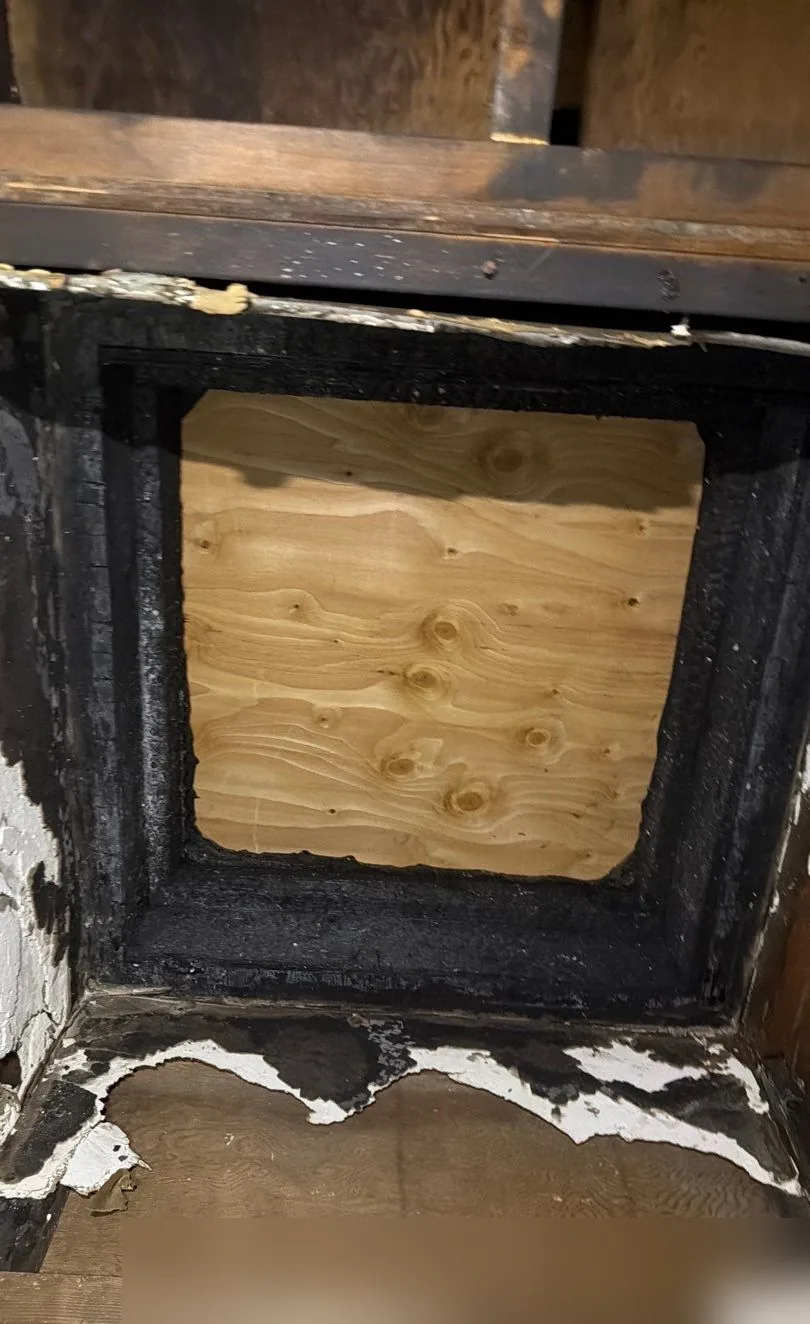
Charred framing like this, around a boarded opening on a 2026 job in Pomona, NY, is what moves a loss into the structural tier: before anyone prices drywall, someone decides whether those members get cleaned and sealed or cut out.
Fire Damage Cleanup and Restoration Cost per Square Foot
Angi puts fire damage restoration at about $4 to $7 per square foot, with an average of $5.50, in its 2026 guide. In our experience, square-foot pricing fits cleaning and deodorization best. Fires that burn framing, wiring or roofing are priced trade by trade and usually run well above that.
| Home type | At $4 per sq ft | At $7 per sq ft |
|---|---|---|
| 900 sq ft city apartment | $3,600 | $6,300 |
| 1,800 sq ft ranch | $7,200 | $12,600 |
| 2,800 sq ft colonial | $11,200 | $19,600 |
Calculated from Angi's $4 to $7 per square foot range; not a quote. Multiply by the affected area, not the whole house, unless smoke really did reach every room. Apartments are rarely priced this way at all: we scope them by affected rooms, contents and what the building requires.
Smoke Damage Restoration Cost: Light Residue, HVAC and Wall Cavities
Smoke damage without fire damage is usually priced per room. Angi lists professional smoke removal at about $200 to $1,200 per room, with duct cleaning ($250 to $500), ozone treatment ($400 to $800) and thermal fogging ($200 to $600) billed separately. After a fire, HVAC cleaning and odor work inside wall cavities usually push the price higher.
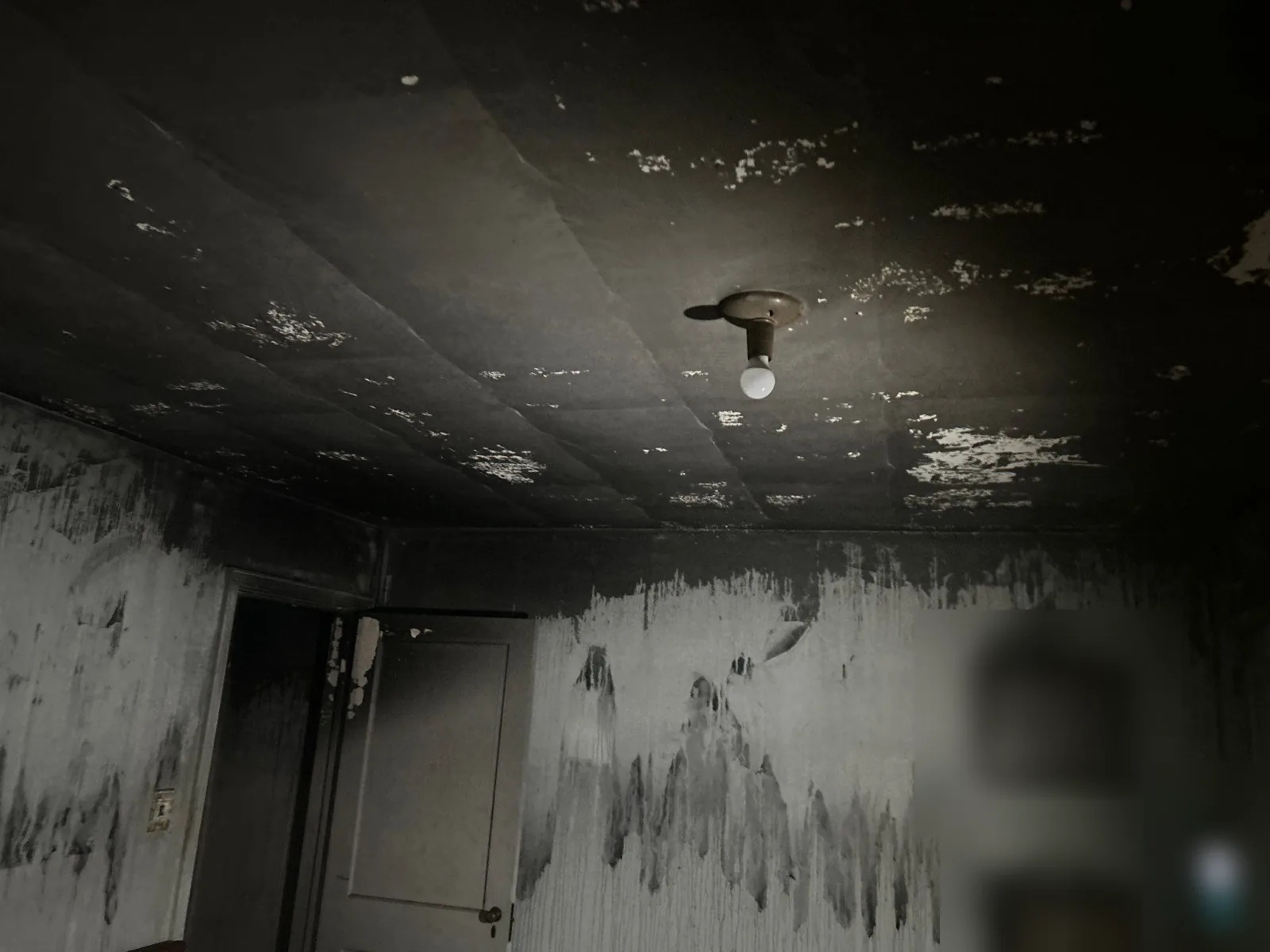
This bedroom, photographed at inspection on a 2026 job in Manheim, PA, did not burn, yet soot darkens the ceiling and streaks the walls. Cleaning it is mostly labor: dry removal, wet cleaning, then a call on whether surfaces need sealing before paint.
We sort smoke losses into three levels:
- Light residue in one area. Surface cleaning and deodorization, where Angi's per-room figure fits best.
- Smoke pulled through the HVAC system. A standard duct cleaning price assumes ordinary dust. After a fire, the system's components are inspected and cleaned, which usually costs more. See smoke in HVAC systems.
- Odor in wall cavities or contents. Odor that soaked into insulation, framing or upholstery needs removal of affected materials, sealing, fogging, hydroxyl or ozone treatment, and sometimes a contents pack-out. More on odor sealing after a fire.
Ozone is not a room spray. The EPA warns that inhaled ozone can damage the lungs, and that when high concentrations are used in unoccupied spaces, conditions should be controlled so no person or pet is exposed. Hydroxyl generators are a different tool. Ask your restorer which one they plan to use and when you can go back inside.
Oil-heated homes add one more case: a puffback, when a misfiring burner pushes fine soot through the house. Nothing burns, so it is priced as soot cleaning.
Why residue type changes the price
- Dry smoke from hot, fast fires is powdery and usually the easiest to remove.
- Wet smoke from smoldering fires is sticky and smears under the wrong method.
- Protein residue from kitchen fires is nearly invisible but carries a strong odor.
- Synthetic residue from burning plastics is dark and can stain surfaces.
Our guide to professional soot cleaning methods covers the techniques.
What Drives the Price on a New York Fire Job
The fire, and the water used to fight it
Hose lines and sprinklers put a lot of soot-laden water into a building. We dry it under IICRC S500 procedures, and the EPA advises drying water-damaged areas and items within 24 to 48 hours to prevent mold growth, so drying is often its own line item, handled by the same crews who handle water damage from firefighting.
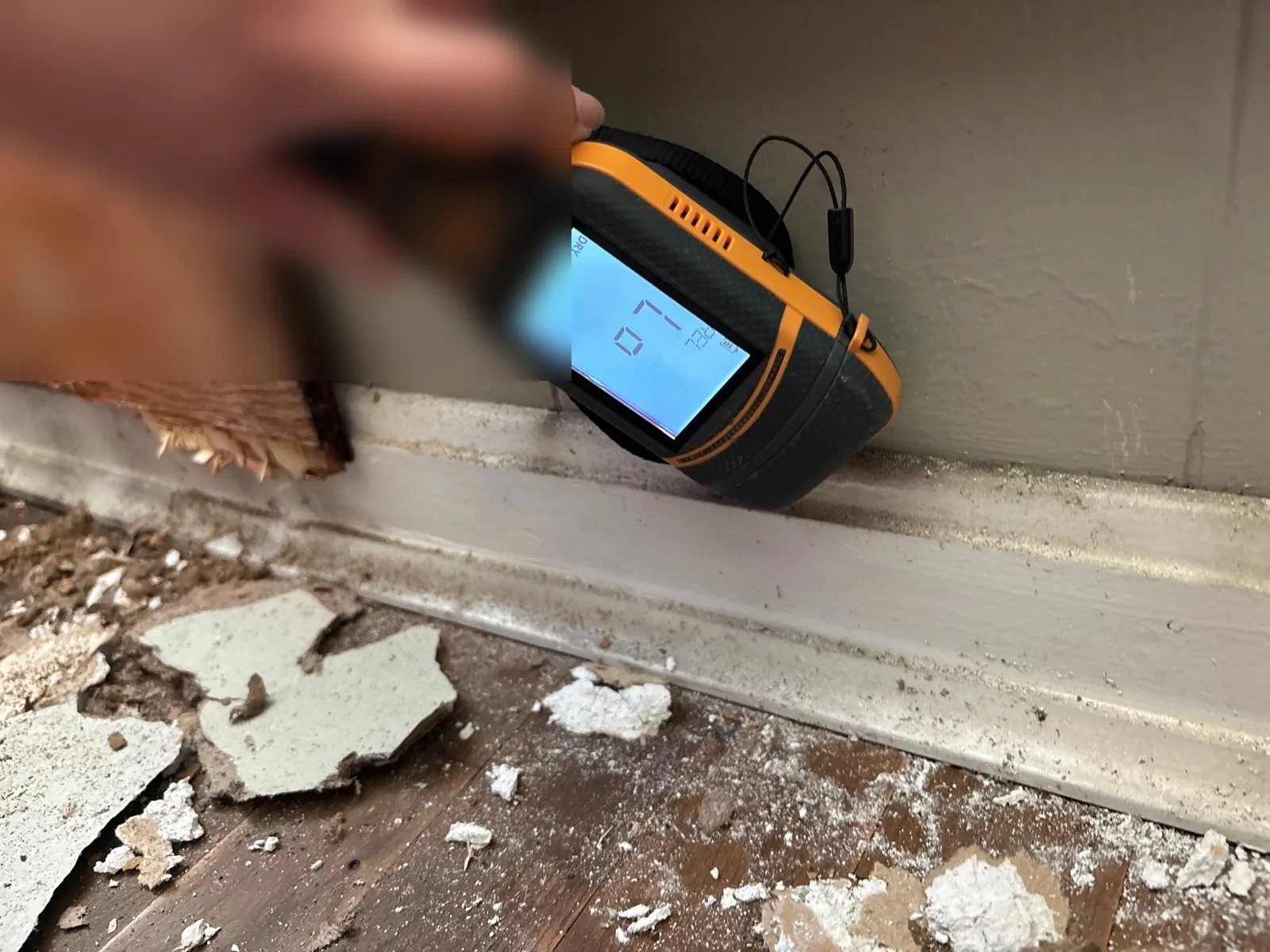
A reading like this one, from a 2026 job in Carlisle, PA, decides how much drywall and baseboard stay. Walls that look fine can still be wet behind the paint.
Asbestos and lead in older New York buildings
- New York City. According to the NYC Department of Buildings, work on buildings constructed before April 1, 1987 needs an asbestos assessment by a DEP-certified investigator before the permit moves forward: an ACP-5 report if the work is not an asbestos project, or an ACP-7 notification and abatement under DEP rules if it is. Newer buildings are exempt from that certification, but known asbestos-containing material that will be disturbed must still be abated.
- Elsewhere in New York State. Industrial Code Rule 56 (12 NYCRR 56-5.1) requires an asbestos survey by a licensed asbestos contractor before demolition, renovation or repair of buildings whose construction began before January 1, 1974. The rule has exemptions, including structures certified in writing as structurally unsound by an engineer, architect, building or fire inspector (which are then presumed to contain asbestos for demolition), and treats owners of one- and two-family homes who hire out the work differently, so ask your contractor how the survey will be handled.
- Lead paint. The EPA's Renovation, Repair and Painting rule covers paid work that disturbs paint in housing and child-occupied facilities built before 1978. Emergency renovations, such as work after a fire, are exempt from some requirements only as far as the emergency requires, and still have to meet the rule's cleaning and cleaning verification requirements.
- NYC Local Law 1. HPD requires owners of pre-1960 buildings to presume paint contains lead, and safe work practices apply when more than two square feet of that paint is disturbed in a unit or common area where a child under six lives.
Testing and abatement are separate line items and can hold up the rebuild. Requirements vary by building, so confirm yours with your contractor or the agency. Background: lead and asbestos in older NYC buildings and our lead and asbestos abatement service.
Permits and code upgrades
Structural, electrical and plumbing repairs after a fire generally need permits, and utilities may need inspection before they come back on. When a repair must meet current code rather than the original one, the difference is real money; Ordinance or Law coverage addresses it. See fire repair permits and building codes.
What started the fire
For a 2,500 sq ft home, Angi's 2026 guide puts kitchen oil fires at $12,000 to $20,000, electrical fires at $12,000 to $23,000, gas fires at $14,000 to $20,000 and ordinary combustible fires at $9,000 to $14,000. Grease fires leave protein residue that spreads odor well past the visible damage; electrical fires often mean opening walls to trace and replace wiring.
In the city, the FDNY keeps warning about lithium-ion batteries. In a July 2026 release, it said fire marshals traced a fatal Queens basement apartment fire to a battery charging in the kitchen, and it urged New Yorkers to charge and store these batteries outside where possible and never overnight. Battery fires burn plastics, so expect synthetic residue.
Contents and temporary housing
Furniture, clothing, electronics and documents are often restorable. On larger losses, items are inventoried, packed out and cleaned off site; see contents restoration and how contents pack-out works. Living-expense limits can run short on a long rebuild in the New York rental market, so check yours early. Business losses add their own layers; see commercial restoration.
How a Fire Damage Estimate Is Built (and Why Quotes Differ)
Every fire estimate has two halves. Mitigation covers board-up, extraction and drying, soot cleaning, deodorization and pack-out. Reconstruction covers demolition, framing, electrical, insulation, drywall and finishes, and is usually the larger share. Durations are in our fire restoration timeline.
Many estimates are written in Xactimate, so two can look alike. They differ on scope: whether a surface is cleaned or replaced, whether testing is included, and whether the restorer wrote down what they found before pricing it.
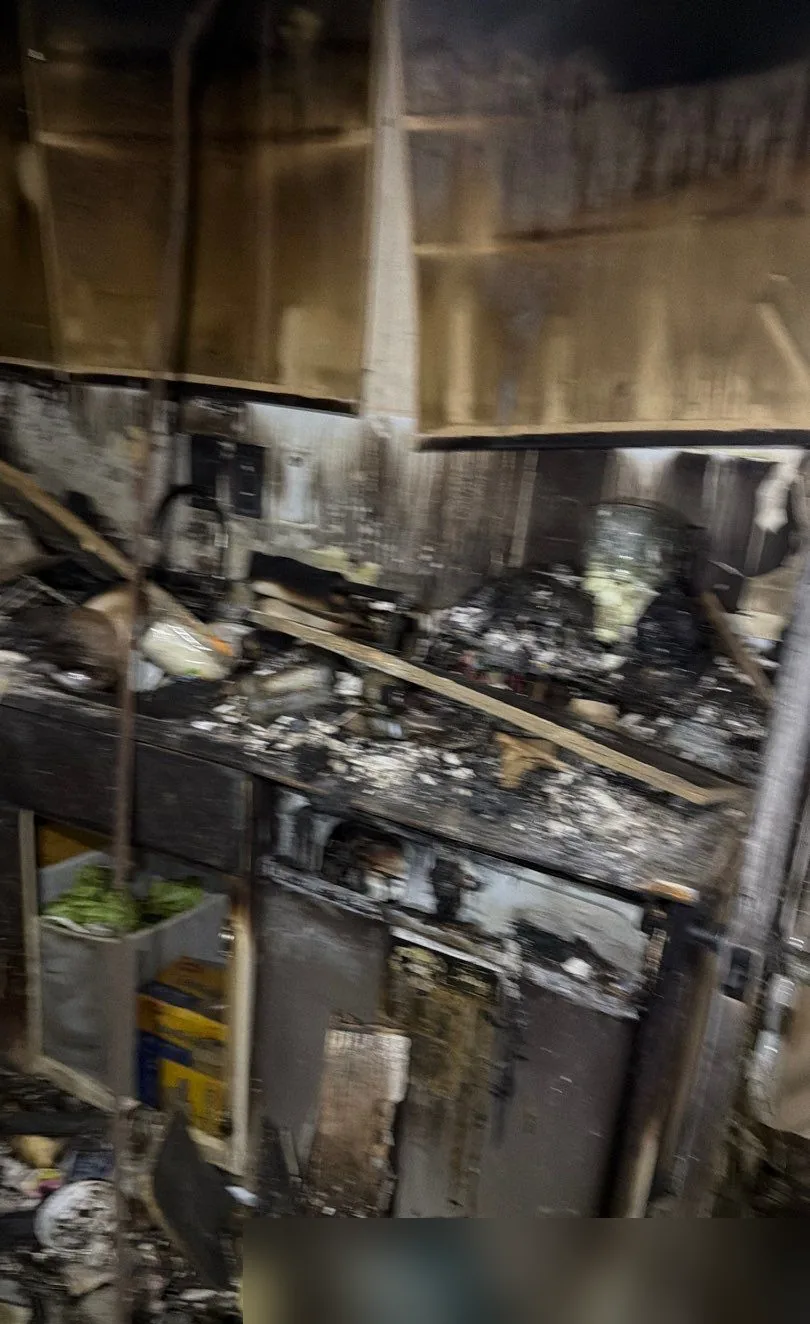
This kitchen, on the same 2026 Pomona, NY job as the board-up above, was where the fire started. A one-room kitchen fire estimate typically runs in this order:
- Board-up and securing the property
- Water extraction and drying
- HEPA dry soot removal
- Wet cleaning of protein residue on surfaces that stay
- Contents pack-out and cleaning
- Removal of charred cabinets, drywall and flooring
- Sealing and priming cleaned surfaces
- Deodorization and an odor check before walls close
- Drywall, cabinetry and finishes
Red flags on a fire estimate:
- Lump sums with no line items
- No written assessment of affected areas, residue type and cleaning method
- No odor check before walls are closed
- No asbestos or lead step on an older building (pre-1987 in NYC, pre-1974 elsewhere in New York, pre-1978 for lead paint)
- Pressure to sign a contract, direction to pay or assignment of benefits before you see a written line-item scope
Want a second look at an estimate you already have? We will walk the loss and price it line by line. Call (845) 294-8919, 24/7. Adjusters build their own estimate, and the two are reconciled; see how adjusters price a fire claim.
Restore, Rebuild or Sell As-Is?
Angi notes that restoring existing materials usually costs less than full replacement. Whether that holds for your house depends on four questions:
- How deep is the char? A structural assessment after a fire decides what framing stays.
- Does the estimate fit your dwelling limit? Check it against Coverage A.
- How much code upgrade work is triggered? Older homes pick up electrical and egress work.
- What timeline can you absorb? Living-expense limits matter as much as price.
Some owners sell as-is; cash offers on fire-damaged houses are typically discounted, so get a repair estimate first. If you rebuild, start with post-fire reconstruction planning.
Fire Damage in NYC Apartments, Co-ops and Condos
First question in an apartment fire: whose policy pays for what? In a condo, the association's master policy generally covers the building and common areas; how far it reaches into units (from everything inside to bare walls) depends on the policy and bylaws, and the owner's HO-6 covers the rest, plus belongings. Co-ops work from the proprietary lease and building policy; renters rely on their own policy for belongings and living expenses. Check your lease, bylaws and policy.
Smoke rarely stays in one unit; it moves through shafts, hallways and shared ventilation, so apartments that never saw a flame may each need a cleaning scope. Access sets the schedule: work starts after fire marshals release the scene, and many boards require an alteration agreement, a certificate of insurance and set work hours before a crew goes in.
For tenants, as general information and not legal advice: under New York Real Property Law section 227, if a building is made untenantable by fire without the tenant's fault, the tenant may surrender the premises unless a written agreement says otherwise, and owes no rent after surrender.
More on cleanup in NYC apartment smoke damage. Our Manhattan office at 776A 6th Avenue, 2nd Floor, handles New York City restoration across the five boroughs: (917) 781-1944.
Hudson Valley and Westchester: What Changes Outside the City
Outside the five boroughs, homes are larger and detached, so the per-square-foot math applies more directly. Asbestos surveys follow State Industrial Code Rule 56 instead of the NYC DOB and DEP process, and the pre-1978 lead rules apply statewide.
Our New Hampton office at 2713 NY-17M, New Hampton, NY 10958, covers Orange County and the wider Hudson Valley restoration area at (845) 294-8919, alongside our Kingston and Stormville offices. Westchester is served from our Hudson Valley and New York City offices.
Does Insurance Cover Fire Damage Repair in New York?
Fire is a covered peril in standard homeowners policies. A standard policy splits a fire loss into dwelling (Coverage A), other structures, personal property and loss-of-use coverage, each with its own limit.
Debris removal may carry its own limit, and Ordinance or Law coverage for code upgrades varies by policy and endorsement; your declarations page shows both. As Consumer Reports explains, replacement cost coverage pays to repair or replace, while actual cash value pays the value less depreciation. Ask your adjuster whether your policy pays actual cash value first and releases the rest only after repairs are completed.
Your insurer may suggest vendors from its network; check your policy for any terms on who does the repairs before you sign with anyone. Photograph and video everything before cleanup and keep living-expense receipts. This is general information, not legal advice.
Frequently Asked Questions
What is the average cost of fire damage restoration services?
In Angi's 2026 data, New York's state average is $78,200, while the U.S. figure of $27,477 comes from a different sample, so it is better to compare New York with other states than with the nation. Either way, an average mixes stovetop fires with total losses; the severity tiers above place a specific loss more accurately.
How much does smoke damage cleanup cost per room?
Angi lists professional smoke removal at about $200 to $1,200 per room. That typically covers HEPA vacuuming, dry soot removal, wet cleaning and deodorization. Duct cleaning, ozone or fogging and material removal are priced separately, and they add up if the HVAC system ran during the fire.
Can I get an estimate for smoke damage cleanup in my apartment?
Yes. The walkthrough covers affected rooms and surfaces, residue type, whether smoke reached the ventilation, and which contents need cleaning. We also separate what belongs to the building from what belongs to you, since the master policy and your HO-6 or renters policy may split the cost. You can book one through our contact page or by phone, day or night.
Why is one restoration company's quote higher than another's?
Usually because the scopes differ. One quote may clean what the other replaces, include asbestos or lead testing the other leaves out, or price contents and HVAC work the other skips. Ask both for line items and a written assessment, then compare scope before price.
Is it cheaper to restore or rebuild after a fire?
Restoring is often the cheaper path, but not every structure can be restored. The deciding factors are char depth in the framing, what a structural assessment finds, how the estimate compares with your dwelling limit and how much code upgrade work the repair triggers.
Can I choose my own fire restoration contractor?
Check your policy first. Insurers may suggest vendors from their network, but your policy sets the terms. Keep your adjuster informed, and whoever you hire, get a written line-item scope before signing a contract or an assignment of benefits.
Who pays when smoke from a neighbor's apartment fire damages my unit?
It depends on the policies involved. The master policy typically covers the structure and common areas; your HO-6 or renters policy usually covers your belongings, living expenses and, for condo owners, finishes the master policy leaves out. The other owner's liability coverage may also apply. Check your policy and building documents.
How much does commercial fire damage restoration cost?
No reliable public average covers commercial losses; scope varies too much between buildings. The main drivers are business interruption, after-hours or phased work, larger HVAC systems, inventory and records, and tenant coordination. Only a site walkthrough gives a meaningful number.
Every fire is priced from what is actually there, not from an average. For a line-item estimate or a second look at one you already have, contact us online. Our crews follow IICRC standards on every job.
Sources
Figures checked October 24, 2026; third-party averages, not ADRI quotes.
- Angi: How Much Does Fire Damage Restoration Cost? (2026 data)
- Insurance Information Institute: Homeowners and Renters Insurance statistics
- NYC Department of Buildings: Project Requirements, Asbestos
- 12 NYCRR 56-5.1, asbestos survey requirements
- EPA: Renovation, Repair and Painting Program
- 40 CFR 745.82, emergency renovations
- NYC HPD: Lead-Based Paint (Local Law 1 of 2004)
- EPA: Ozone Generators that are Sold as Air Cleaners
- EPA: A Brief Guide to Mold, Moisture and Your Home
- FDNY: Lithium-ion battery safety tips (July 2026)
- New York Real Property Law section 227
- Consumer Reports: Filing a homeowners claim after a fire
Categories
Need Restoration Services?
Our team is available 24/7 for emergency response. Call us today for a free phone consultation.
Questions About Restoration?
Our experts are ready to help. Contact us for a free consultation.