Landlord vs. Tenant Water Damage: Who Pays for What?
Tyler McClelland leads mitigation operations for Advanced DRI across New York's Hudson Valley, directing water, mold, and large-loss response in the field. He holds IICRC Water Restoration Technician (WRT) and Applied Microbial Remediation Technician (AMRT) certifications and a New York State Mold Supervisor certification, and is trained in IRCA hospital safe construction practices recognized by The Joint Commission.

Left a tub running? Pipe burst? In a rental, the cause decides who pays. See whose insurance pays first, deposit rules and NY, NJ, PA and CT law.
In a rental, whoever caused the water usually bears the cost. Building systems, the roof and repairs a landlord put off belong to the landlord. Damage from a tenant's own carelessness belongs to the tenant. In practice, each side's insurance usually pays first, and fault gets sorted out afterward.
Since 2000, Advanced DRI has dried out apartments and high-rises across NY, NJ, PA and CT. Every time water crosses a unit line, the same questions decide who pays: where did it start, how long did it run, and who knew?
General information, not legal advice.
Jump to: I rent the unit · I own or manage it · Scenarios: washer hose, frozen pipe, slow leak, riser or sewer, flood
Who Is Responsible for Water Damage in a Rental?
Responsibility follows the cause. The landlord generally pays for damage from building systems, normal wear, or repairs delayed after notice. The tenant pays for damage their negligence caused, such as an overflowing tub or heat turned off in freezing weather. Unless the landlord was negligent, a tenant's belongings are covered by the tenant's renters policy, not the landlord's.
What the Landlord Is Responsible For
- Plumbing, supply lines, drain stacks and risers
- The roof, windows and the rest of the building envelope
- Appliances and water heaters the landlord supplied
- Hallways, basements and other common areas
- Keeping the unit livable and making repairs within a reasonable time after notice
That last point matters for belongings: a landlord who knew about a leak and let it ride can be liable for what it ruins afterward.
What the Tenant Is Responsible For
- Using fixtures, appliances and plumbing with reasonable care
- Reporting leaks and stains promptly, preferably in writing
- Their own belongings and their own insurance
- Damage caused by the tenant, guests or pets
- Keeping heat on where the lease or local code requires it
Common causes of rental water damage and who usually pays
| Cause | Usually pays |
|---|---|
| Pipe or supply line fails from age or wear | Landlord |
| Roof or window leak | Landlord |
| Tenant lets a tub or sink overflow | Tenant |
| Washer supply hose fails | Depends on who installed it (Scenario 1) |
| Pipe freezes | Depends on heat and conduct (Scenario 2) |
| Slow leak nobody reported | Depends on what was visible (Scenario 3) |
| Building sewer line or riser fails | Landlord or association (Scenario 4) |
| Storm or surface flood | Each party's own flood coverage (Scenario 5) |
Your lease can shift some of this: look for clauses on renters insurance, minimum heat, appliances, reporting and alterations. One thing a lease can't do in New York is waive the warranty of habitability; Real Property Law § 235-b makes any such waiver void.
What Counts as Tenant Negligence?
A tenant is responsible when their failure to use reasonable care causes or worsens the damage. Common examples: a tub left running, heat turned off in a freeze, a botched appliance hookup, drains clogged with wipes or grease, or a visible leak never reported. Guests and pets count too.
What usually isn't tenant negligence: a pipe that fails from age, a defective part the landlord installed, a roof leak, or water that started in somebody else's unit.
Ordinary carelessness can make a tenant pay for the repairs. Losing the apartment over it takes more: in New Jersey, for example, eviction for damage requires that the tenant caused it willfully or through gross negligence (see the FAQ below).
Slow Leaks and the "Knew or Should Have Known" Test
To charge a tenant for a slow leak, a landlord usually has to show the tenant knew, or should have known, something was wrong. Typical evidence:
- Staining, bubbling paint or a sagging ceiling patch
- Soft, cupped or lifting flooring around a fixture
- A new musty smell
- A jump in the water bill, where the tenant pays it
- Texts or emails showing when the problem was first raised, or that it never was
Insurance makes slow leaks worse for everyone. Policies are generally written for sudden, accidental water damage, and gradual leaks are commonly excluded. Check your own policy. An unreported slow leak can be denied by the insurer and blamed on whoever ignored it.
A moisture survey shows how far water spread, not exactly when the leak began. Our post on ceiling water damage warning signs covers what to watch for.
Five Common Scenarios, Walked Through
Cause, who usually pays, whose policy responds first, and the first move.
1. The Upstairs Washer Supply Hose
If the tenant hooked it up badly or ignored a visibly bulging hose, that points to tenant negligence. If a landlord-supplied hose failed with no warning, the loss usually lands on the landlord. If nobody was negligent, each party claims on its own policy. If the upstairs tenant is legally liable, the liability part of their renters policy typically pays for other units' damage, up to its limit. Supply-hose water starts as clean Category 1; drain water from the washer is Category 2. Next hour: close the washer valves and notify management in writing.
2. The January Freeze With the Heat Off or Low
Frozen pipes turn on who controlled the heat. In New York City, HPD's heat rules require at least 68°F from 6 a.m. to 10 p.m. when it is below 55°F outside, and at least 62°F overnight, from October 1 to May 31. A building that falls short points the loss toward the landlord. A tenant who shut off heat they control or left windows open in a hard freeze can still be found negligent. Outside NYC, check the lease and local code. Next hour: shut the water, and never thaw a pipe with an open flame.
3. The Slow Sink Leak Nobody Reported
A trap drips into the vanity for months. This is the "knew or should have known" test in practice. The insurer may deny it as long-term seepage, so responsibility comes down to visibility and reporting. A leak hidden in a wall usually stays with the owner; a swollen cabinet floor ignored all season is harder to defend. Next hour: photograph everything before it moves.
4. The Building Riser or Sewer Line Fails
A riser, drain stack or building sewer line is part of the building, so the landlord or the condo or co-op association is generally responsible. Sewage is Category 3, so soaked porous materials usually come out (see our sewage cleanup process). Sewer and drain backup is typically excluded from landlord and renters policies unless a backup endorsement was added. If a City sewer main is the source in New York City, a property-damage claim against the City must be served within 90 days under General Municipal Law § 50-e, per the NYC Comptroller. See sewer backup cleanup in NYC. Next hour: stop using drains.
5. The Storm or Surface Flood
Standard landlord and renters policies exclude flood. The building needs NFIP or private flood coverage, and a tenant can buy contents coverage on their own: per FEMA, the NFIP residential contents limit of $100,000 is available to renters, with a 30-day wait before most new policies take effect. Basement coverage is narrow: FEMA lists cleanup and service equipment such as furnaces, water heaters, washers and dryers, and says the contents of a finished basement aren't covered. That matters for basement apartments. Nobody causes a storm, but a landlord can still be liable for negligent drainage or a known defect. Next hour: stay clear of water near outlets.
Whose Insurance Pays First?
Landlords typically insure the building on a dwelling-fire form (DP-1 or DP-3) or a landlord package. Tenants carry renters insurance, often called an HO-4.
Whose insurance responds first, and who may be pursued afterward
| What was damaged | Usually responds first | May be pursued afterward |
|---|---|---|
| Walls, floors, ceilings | Landlord's building policy (landlord's deductible) | A negligent tenant, depending on state law and lease |
| Tenant's belongings | Tenant's renters policy (tenant's deductible) | The landlord, if their negligence caused it |
| Tenant's temporary housing | Renters policy, additional living expenses | Depends on cause and lease |
| Landlord's lost rent | Lost-rent coverage, if purchased | A negligent tenant, depending on state law and lease |
| Unit below or next door | That unit's own policies | Whoever was negligent |
| Common areas | Landlord's or association's policy | Whoever was negligent |
| Flood | NFIP or private flood policy only | A landlord, only for negligent drainage or a known defect |
| Sewer or drain backup | Only with a backup endorsement | Depends on the source |
What Does Landlord Insurance Cover for Water Damage?
Landlord insurance usually covers sudden, accidental water damage, such as a burst pipe or a failed water heater. It typically excludes long-term seepage and poor maintenance, flood, and sewer backup without an endorsement, and it covers the building, not the tenant's belongings.
One landlord insurer lists lost rent during repairs as covered and warns that a known drip left unrepaired can be treated as deferred maintenance; check your own exclusions.
Does Renters Insurance Cover Water Leak Damage?
A renters policy has three parts, per the Insurance Information Institute: personal possessions, liability, and additional living expenses if a covered loss makes the home unlivable. It does not cover the building; that's the landlord's policy.
The liability part is narrower than many tenants think. It pays when the tenant is legally liable, and it covers other people's property, such as the unit below. Homeowners-type liability forms generally exclude damage to property the insured rents or occupies, except damage caused by fire, smoke or explosion (the standard exclusion wording is quoted here). So water damage to the apartment you rent is often not covered unless your renters policy adds a "damage to landlord's property" type endorsement. Flood is excluded, and sewer backup usually needs an endorsement.
Subrogation: How Insurers Settle Fault Later
After paying, the landlord's insurer may try to recover from a tenant whose negligence caused the loss. Whether it can depends on state law and the lease. Connecticut shows how much the lease matters: under DiLullo v. Joseph (2002), a landlord's insurer could not pursue a tenant by default, but in Amica Mutual Insurance Co. v. Muldowney, 328 Conn. 428 (2018), the state Supreme Court allowed it where the lease made the tenant responsible for damage they caused and required liability insurance, even without the word "subrogation." A tenant without liability coverage for the rented unit can be pursued personally.
Filing a Claim Without Weakening It
- Notify your insurer promptly
- Photograph the source and the damage before cleanup
- Keep damaged items until the adjuster says otherwise
- Take reasonable steps to stop further damage
- Ask the restoration company for the moisture map, drying logs and an itemized scope
More detail: burst pipe insurance claims and how to document property damage.
When One Leak Damages Several Units
Water runs along risers, slab penetrations and ceiling cavities, so the unit below often shows damage the source unit doesn't.
The claim chain when water crosses a unit line:
- Stop the source and notify management or the super.
- Each owner and tenant notifies their own insurer. The affected neighbor claims on their own policy first.
- In a condo or co-op, the bylaws split coverage between the master policy and each unit owner's policy.
- Afterward, insurers may pursue whoever was negligent, depending on state law and the lease (see subrogation).
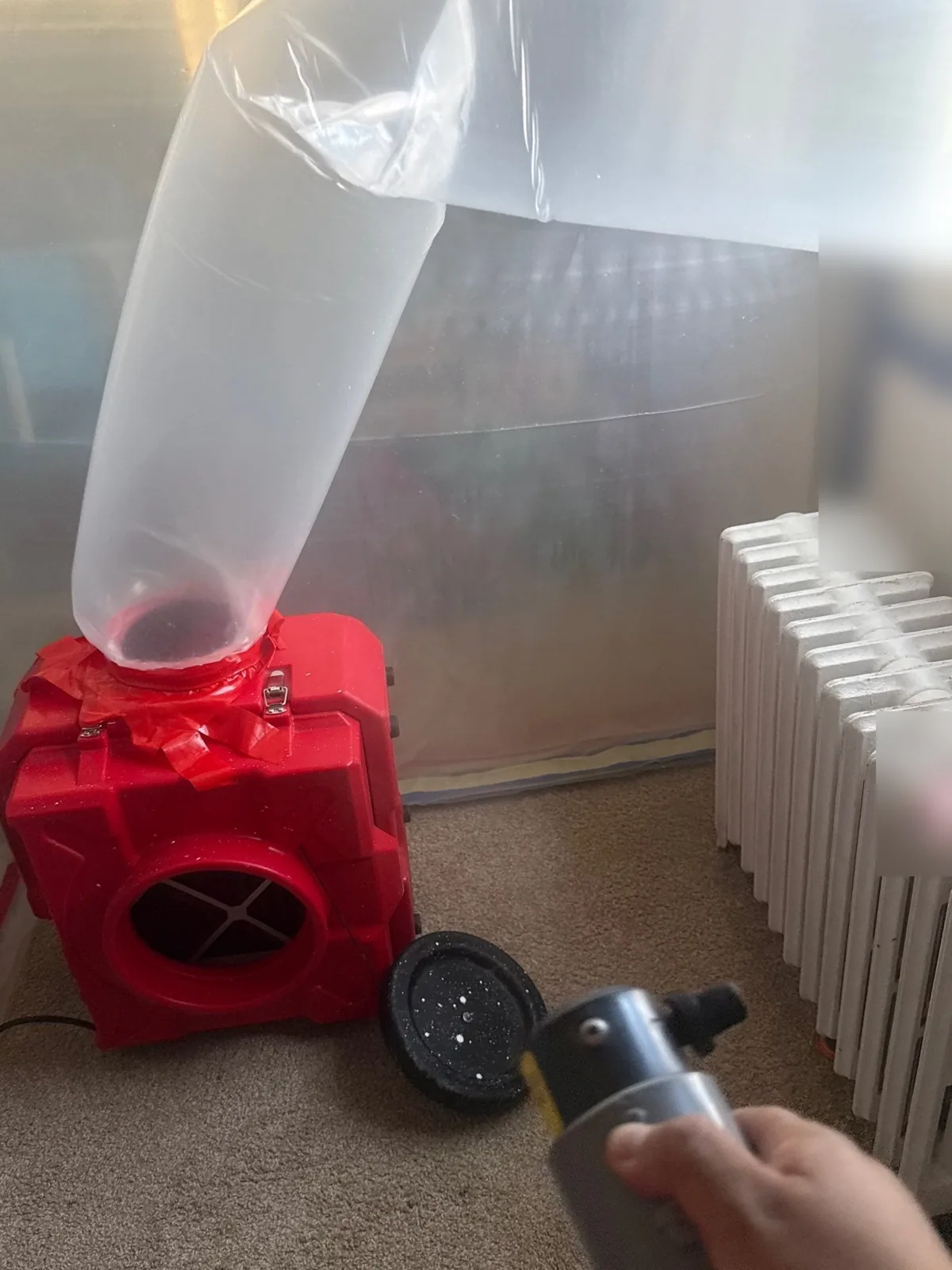
That Newburgh job (2026) is what containment looks like in practice: plastic walls and a ducted air scrubber keep dust inside the work area. In shared buildings our crews take readings in the units around the source and get the neighboring owner's authorization before any of their ceiling comes down.
If You Rent Out a Condo
A renting condo owner sits between the master policy, their own unit policy (usually an HO-6 with a rental endorsement) and the tenant's renters policy. Read the bylaws on unit boundaries, deductible allocation and subrogation waivers.
Managing a multi-unit building? See how we handle commercial and multi-unit buildings.
First Steps After a Leak in a Rental
If You Rent the Unit
- Shut off the fixture or its valve if it's safe
- Move belongings out of the water's path
- Notify the landlord in writing, with photos and the time you noticed it
- Call your renters insurer
- Don't start structural repairs yourself
Step by step: what to do when your apartment has water damage. Unsure what to ask your landlord or insurer? Call (845) 294-8919 and we'll explain what a drying report should show.
If You Own or Manage It
- Respond fast and arrange access to adjacent units
- Call an IICRC-certified restoration company
- Notify your carrier
- Document the source before it's repaired
- Update tenants in writing
- Decide on temporary housing per the lease and local law
Active leak in an occupied building? Call (845) 294-8919, 24/7. We typically arrive within 90 minutes in nearby service areas, take moisture readings in the source unit and the units around it, and keep the drying record your insurer will ask for.
Why the Water Category Changes the Job
The ANSI/IICRC S500 standard sorts water into Category 1 (clean, such as a supply line), Category 2 (significantly contaminated, such as washer or dishwasher discharge) and Category 3 (grossly contaminated, such as sewage or floodwater). Delay changes the category: clean water left in a ceiling or under flooring degrades, which means more removal. The EPA advises drying water-damaged areas within 24 to 48 hours to prevent mold. Background: IICRC standards explained.
Drying Records: Neutral Evidence for Both Sides
In a dispute, the drying file is often the one document neither side wrote. It usually holds:
- A moisture map of affected walls, floors and ceilings
- Daily moisture, temperature and humidity readings
- Day-one photos of the source and damage
- Equipment placement
- A list of removed materials
- Confirmation that materials reached the drying goal
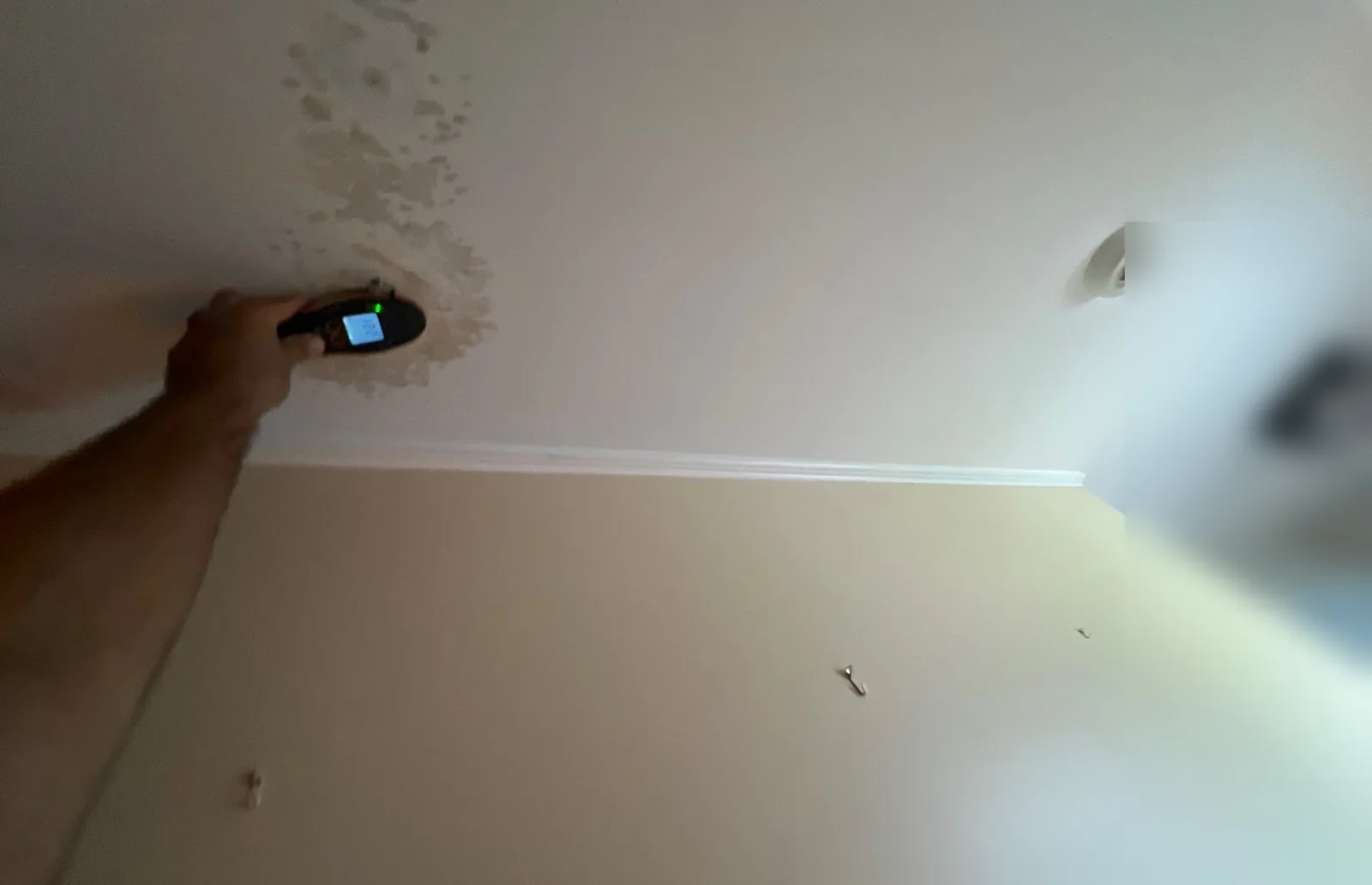
A stain only proves water got there at some point. The meter, as on this Croton-on-Hudson ceiling in 2026, says whether it is still wet now.
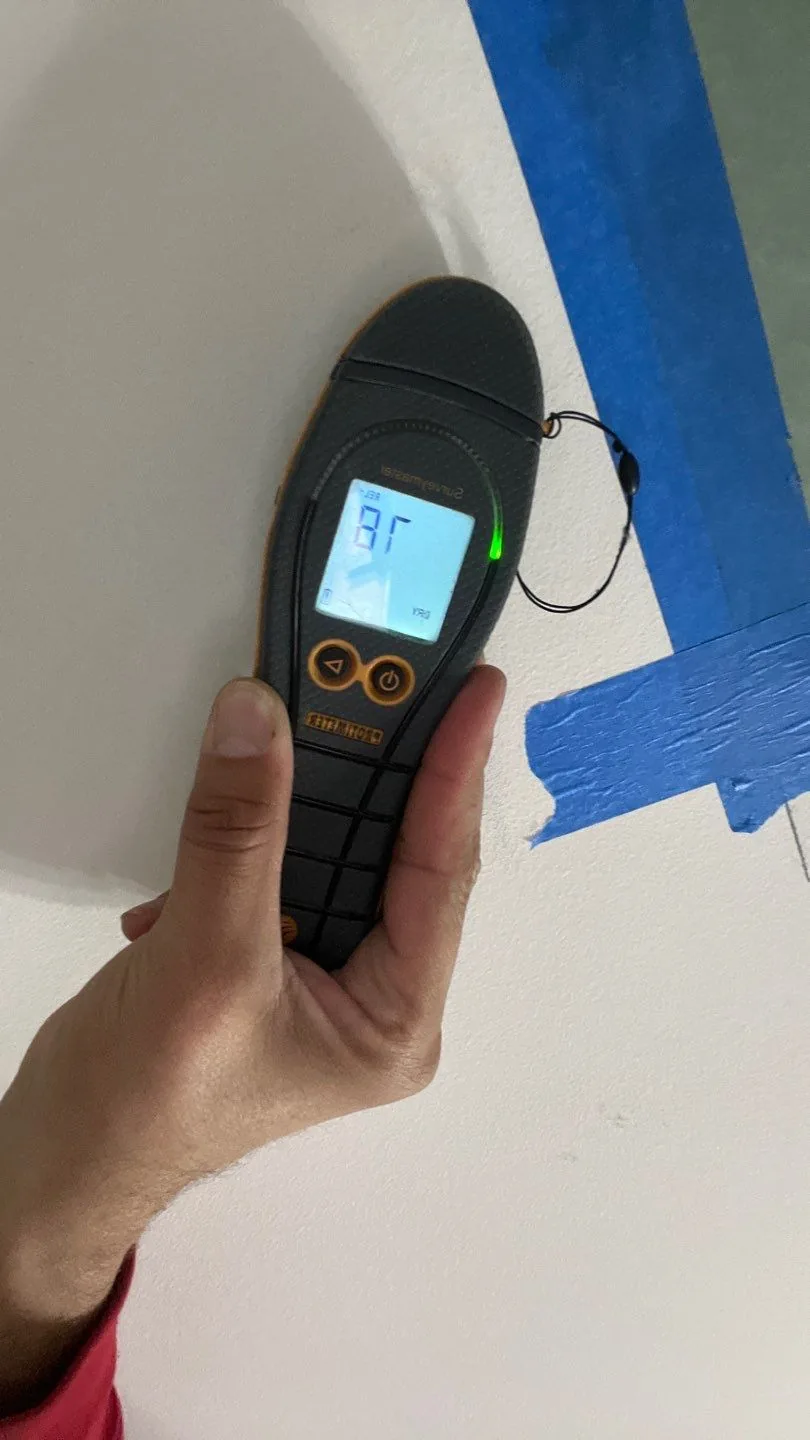
In Spring Valley (2026) the crew logged readings like this one before mitigation began. A single reading proves nothing on its own, but a series of them taken at the same points shows whether a wall is actually drying.
More: the science of structural drying and our water damage restoration service.
State Rules That Decide Fault and Deposits: NY, NJ, PA, CT
All four states make the landlord keep a rental livable. Tenant duties are similar; Connecticut's CGS § 47a-11 requires tenants to use plumbing and appliances reasonably and not to willfully or negligently damage the premises.
Landlord duties, deposit deadlines and water-loss rules by state
| State | Landlord repair duty | Deposit return | Rule triggered by the loss |
|---|---|---|---|
| New York | Warranty of habitability, RPL § 235-b (can't be waived) | 14 days after move-out, itemized (GOL § 7-108) | RPL § 227: may surrender an untenantable unit, no further rent |
| New Jersey | Implied warranty of habitability (Marini v. Ireland, 1970) | 30 days, itemized (N.J.S.A. 46:8-21.1) | Displaced by fire or flood: deposit within 5 business days* |
| Pennsylvania | Implied warranty of habitability (Pugh v. Holmes, 1979) | 30 days, written list of damages (68 P.S. § 250.512) | AG guide: leaking roof is a condition the landlord must fix |
| Connecticut | CGS § 47a-7: repairs, plumbing, supplied appliances | Later of 21 days or 15 days after forwarding address (§ 47a-21) | CGS § 47a-14: no rent while casualty impairs the unit, unless tenant at fault |
*The New Jersey rule applies when officials bar occupancy or an inspector certifies displacement will last more than 7 days.
New York's GOL § 7-108 also caps most deposits at one month's rent, puts the burden of proof on the landlord, and makes a landlord who misses the 14-day deadline forfeit the right to keep any of it; some regulated units differ. RPL § 227 applies when the unit is made untenantable without the tenant's fault, and a written lease can modify it. Connecticut's Chapter 830 holds § 47a-7 and § 47a-14; the rent relief in § 47a-14 does not apply when the damage came from the tenant's negligence or willful act. Official summaries: New Jersey's Truth in Renting guide, Pennsylvania's Attorney General guide and Connecticut's Chapter 831.
No statute here sets an hour-count for fixing leaks; the standard is a reasonable time after notice. Local pages: water damage restoration in New York City, water damage restoration in Fairfield, NJ and apartment water damage in Harrisburg.
Note: checked against the statutes and official guides in October 2026. General information, not legal advice; rules vary by city and lease.
Security Deposits and Damage Claims
Charging the Security Deposit
A landlord can deduct documented tenant-caused damage beyond normal wear, with an itemized statement within the state deadline above. If repairs cost more than the deposit, the landlord can pursue the difference separately, often in small claims court; in New Jersey, a landlord who wrongfully withholds a deposit can owe the tenant double.
Ways to Resolve a Dispute
Start with the photos, written notices and drying file; then mediation, small claims court, or an attorney when amounts are large.
Mold After a Rental Leak
Mold responsibility usually follows the water. In New York City, Local Law 55 of 2018 requires owners of multiple dwellings to remediate mold and its underlying defects, such as leaks, using safe work practices, per NYC HPD. The EPA guide linked above is a good plain-language reference; professional work follows ANSI/IICRC S520.
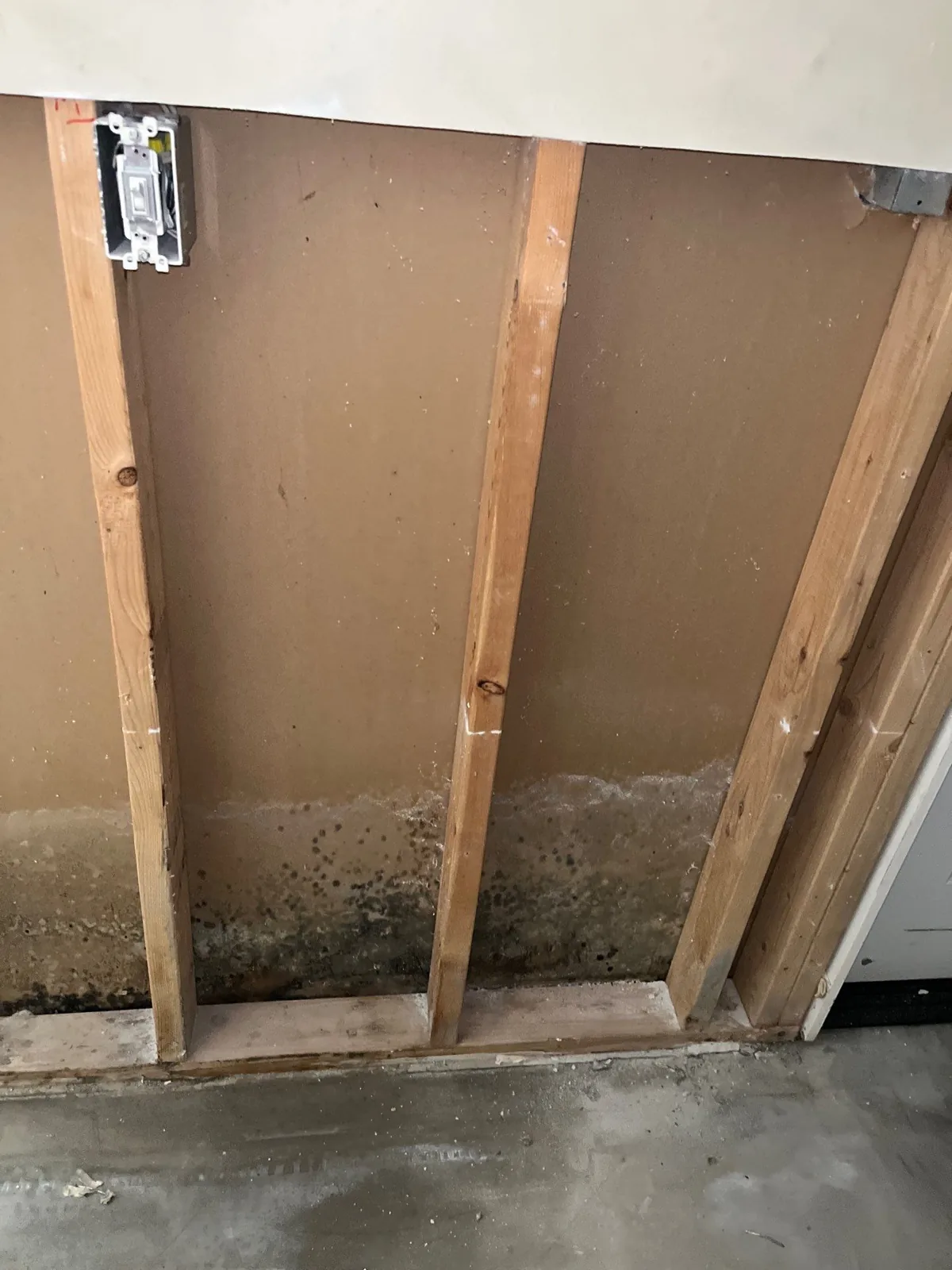
Once the drywall came off in Port Jervis (2026), mold was visible along the bottom plate and lower studs. See mold remediation, and for New Jersey rentals, mold rules for Monmouth County rentals and handling tenant mold complaints.
Preventing the Next Leak
Landlords: braided supply lines; check water-heater age; heat on in vacant units; leak sensors or automatic shutoffs; roof and gutters checked before winter.
Tenants: report leaks in writing; keep heat at the lease or code minimum; know your shutoff valve.
Frequently Asked Questions
Can a landlord sue a tenant for water damage?
Yes, if the tenant's negligence caused it. More often the landlord's insurer pays, then may pursue the tenant where state law and the lease allow. The liability part of a renters policy typically pays for neighbors' damage, but many policies exclude the rented unit itself, so check for a landlord-property endorsement.
Can a landlord evict you over water damage?
Not for a leak you didn't cause. In New Jersey, eviction for damage requires that the tenant caused it willfully or through gross negligence (N.J.S.A. 2A:18-61.1(c)), so an ordinary accident usually doesn't qualify. An eviction generally has to go through the court process. This is general information, not legal advice.
Does the security deposit cap what a tenant owes for water damage?
No. The deposit is security, not a limit. Documented tenant-caused damage above it can be pursued separately.
Can my landlord charge me if the heat was low and a pipe froze?
Low building heat generally points to the landlord, and in New York City adequate heat during heat season is the owner's legal duty. A charge is more likely to stick if the tenant controlled the heat and turned it down or off, or left windows open in a freeze. Keep your 311 or HPD complaint numbers.
Who hires the restoration company in a rental, and can my landlord choose it?
In practice, yes for the building itself. The owner or manager hires the restorer for walls, floors and ceilings because they control the structure and the building's insurance claim. Your belongings are between you and your own insurer, and you can ask for copies of the photos and moisture readings that relate to your claim.
Do I need renters insurance if my lease doesn't require it?
It isn't legally required when your lease doesn't call for it. But without it, your belongings and temporary housing are unprotected when the landlord wasn't negligent, and you have no liability coverage if water from your unit damages a neighbor's.
Rental and Multi-Unit Water Damage Help
Advanced DRI answers 24/7 at (845) 294-8919. IICRC-certified crews work from 11 offices across NY, NJ, PA and CT.
Categories
Need Restoration Services?
Our team is available 24/7 for emergency response. Call us today for a free phone consultation.


Questions About Restoration?
Our experts are ready to help. Contact us for a free consultation.