
Insulation Water Damage: Does It Dry Out or Need Replacing?
Tyler McClelland leads mitigation operations for Advanced DRI across New York's Hudson Valley, directing water, mold, and large-loss response in the field. He holds IICRC Water Restoration Technician (WRT) and Applied Microbial Remediation Technician (AMRT) certifications and a New York State Mold Supervisor certification, and is trained in IRCA hospital safe construction practices recognized by The Joint Commission.

Does wet insulation dry out? EPA says discard wet fiberglass and cellulose, but some clean-water batts can be saved. Verdicts by type, ceilings and walls.
Wet insulation can sometimes be dried, but less often than most homeowners expect. Whether yours can stay comes down to three things: what the material is, where the water came from, and whether the drywall, facing and framing around it can dry too. The verdict table below covers each common insulation type.
Does wet insulation dry out? Verdict by type
Sometimes, but less often than people hope. EPA's cleanup table for buildings lists wet fiberglass and cellulose insulation as discard-and-replace, even after a clean-water leak. Restorers may keep clean-water fiberglass or mineral wool only if it is exposed to moving air, dries within about 24–48 hours, regains its full thickness, and the framing and drywall around it test dry. Cellulose, open-cell foam, matted or moldy insulation, and anything touched by sewage or floodwater should come out.
The EPA guidance comes from Table 1, "Water Damage - Cleanup and Mold Prevention," in chapter 4 of Mold Remediation in Schools and Commercial Buildings. For both fiberglass and cellulose insulation the instruction is "Discard and replace." EPA adds two caveats worth knowing: the table is written for damage caused by clean water and handled within 24–48 hours, and mold "will not always" grow after 48 hours, which EPA calls "only a guideline."
So why does wet fiberglass ever stay? Glass and stone fibers don't absorb water the way paper does. When the conditions above are all met, a restorer may decide drying is reasonable. That is a documented professional judgment that departs from EPA's default, not a home remedy.
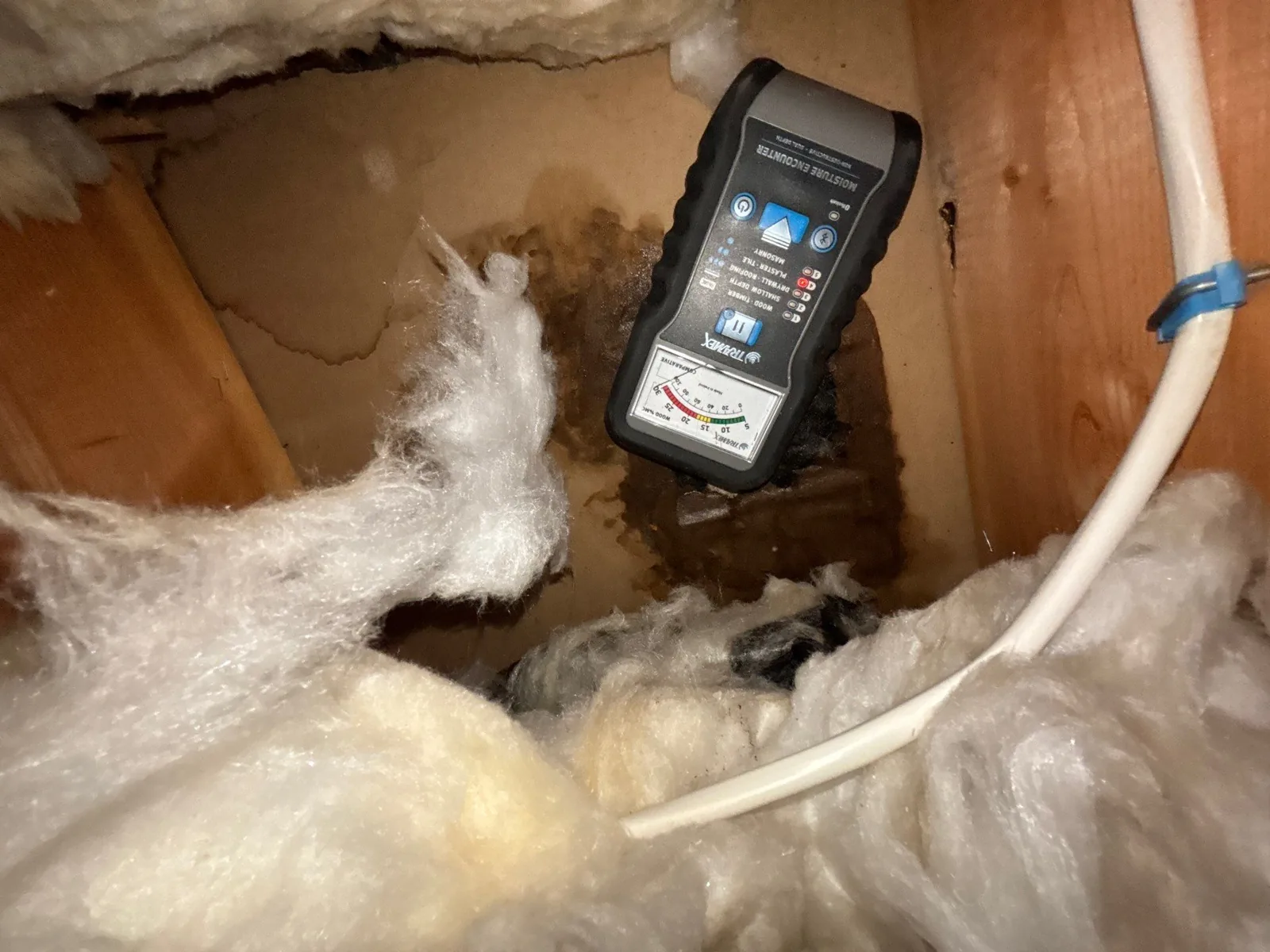
The table below is the short version. "Lightly damp" means the material is still at full thickness; "soaked or matted" means it has slumped or sagged. "Check behind it" means taking moisture readings on the sheathing or framing behind the foam, since foam can look fine while water sits behind it.
| Material | Clean, lightly damp | Clean, soaked or matted | Gray/black water or mold |
|---|---|---|---|
| Fiberglass batt (kraft-faced or unfaced) | Dry if air reaches it and it tests dry | Replace | Replace |
| Blown-in fiberglass | Remove wet zone, re-blow | Replace | Replace |
| Blown-in cellulose | Replace | Replace | Replace |
| Open-cell spray foam | Replace | Replace | Replace |
| Closed-cell spray foam | Usually stays; check behind it | Check behind it | Pro assessment needed |
| Mineral wool | Dry if air reaches it and it tests dry | Replace | Replace |
| XPS/EPS foam board | Usually stays; check behind it | Check behind it | Pro assessment needed |
| Polyiso board (foil- or paper-faced) | Check facing; check behind it | Replace | Replace |
If your insulation just got wet: first steps
The first hour matters more than the equipment that arrives later:
- Stop the water: close the fixture valve or the main shutoff.
- Switch off power at the breaker to any ceiling light, fan or outlet that is wet or dripping.
- Keep everyone out from under sagging or bulging drywall.
- Hold off on fans until you know the water is clean. EPA's cleanup table says the same, because moving air spreads whatever the water carried.
- Photograph everything before anything is removed.
- Move furniture, rugs and boxes out of the drip zone.
- Don't cover wet insulation with plastic or paint over a stain.
What you can do yourself. A small, clean-water wet batt in an open attic is a manageable homeowner job. EPA's home mold guide suggests an N-95 respirator, gloves and goggles; add long sleeves, because fiberglass itches. Step only on joists, never on the drywall between them. In some older homes in New York, New Jersey, Pennsylvania and Connecticut, knob-and-tube wiring may still run through attic insulation, so keep that circuit off and have an electrician look at it before anyone re-insulates. If the loose-fill looks like small gray-brown or silver-gold pebbles, leave it alone (see the vermiculite note below).
Bring in a professional for a sagging ceiling, any closed wall cavity, gray or black water, visible mold, possible vermiculite, or when you need moisture records for an insurance claim. Whether you can stay home during the work depends on the scope. For a contained area that is usually possible, but sewage or mold work can change that.
Sagging ceiling, water near light fixtures, or sewage involved? Call our 24/7 line: (845) 294-8919.
Wet insulation by type: what each material does
Fiberglass batts
This is the pink, yellow or white batt in most attics and stud walls. The glass fibers shed water, but the kraft paper facing and the dust caught in the fibers soak it up, and wet kraft facing softens and falls apart. The real test is loft. A batt that stays compressed no longer provides the R-value printed on its label, which depends on its full installed thickness. Lightly damp batts that fluff back up can stay. Soaked batts that have slumped between the joists usually go.
Blown-in (loose-fill) fiberglass
Loose-fill doesn't fail evenly. Where a leak lands it mats into a dense crust, while a few feet away it can be untouched. The usual fix is targeted: vacuum out the wet zone (readings on the drywall below define its edge), dry the ceiling, then re-blow to the original depth.
Cellulose
Cellulose is shredded paper, so it absorbs water readily, packs down and gets heavy. A soaked patch of cellulose lying on a drywall ceiling adds weight exactly where the gypsum is weakest, which is why wet cellulose ceilings are the ones crews watch for sagging. Piled up, it dries very slowly, and as an organic material it gives mold something to feed on. EPA's Table 1 lists it as discard and replace, and restorers rarely argue with that.
Spray foam: open-cell vs closed-cell
Open-cell foam is soft and spongy and takes on water, so wet sections are generally cut out. Closed-cell foam is dense and resists absorption, which is good news for the foam and bad news for detection: water can travel between the foam and the sheathing or framing and sit there unseen. With closed-cell foam, the question is less "is the foam wet?" and more "what is wet behind it?"
Mineral wool
Mineral (stone or slag) wool sheds water well and tends to tolerate incidental wetting better than fiberglass above flood level. It still traps silt and bacteria from dirty water, and FEMA does not rate it as flood damage-resistant, so contaminated mineral wool gets the same treatment as everything else.
Rigid foam board
XPS and EPS boards absorb little water from a typical leak (EPS somewhat more than XPS); the bigger risk is water trapped between the board and the wall or roof deck. Polyiso is different when it has paper facers, because the facer absorbs water and can delaminate. Foil-faced polyiso needs its facing and edges checked.
Insulation that got wet during construction
Is insulation supposed to get wet? No, but rain blows into open framing on job sites. Before drywall goes on, meter the studs and plates and look at every batt. Replace matted batts or ones with softened facing, and let wet framing dry first. Closing drywall or a vapor retarder over damp lumber traps the moisture where it has almost no way out.
What wet insulation looks and smells like
A leak often shows in the insulation before anyone sees a drip. Look for:
- Matted or flattened areas, often in a rough circle under the leak point
- Darker, gray or tea-colored patches, and water lines on kraft facing
- Loose-fill that has crusted or clumped
- Stains, bubbling paint or a soft, bulging spot on the ceiling below
- Drips from recessed lights, bath fans or HVAC registers
- Frost on the roof deck or damp insulation in a winter attic
Smell is the other giveaway: musty, earthy or like wet cardboard. A musty odor that hangs on after the leak is fixed usually points to microbial growth on the facing, dust or wood, even when nothing is visible yet.
One correction to a common assumption: a moisture meter gives meaningful numbers on wood framing, drywall and sheathing, not on a fiberglass batt. The batt itself is judged by touch, thickness and odor. Thermal cameras are useful for finding suspect areas, but every cool spot has to be confirmed with a meter. Our guide to reading moisture meter results explains what the numbers mean.
Wet insulation in a ceiling
Ceiling leaks are where insulation does the most damage, because it sits directly on the top face of the drywall, and that face cannot dry while a wet layer lies on it. Saturated insulation, especially cellulose and loose-fill, also adds weight. A sagging, soft or bulging ceiling can come down, so keep people out from under it.
That is why the ceiling usually gets opened, from the attic side or from below. Once the cavity is open, the joists and the back of the drywall can be metered, dried and checked for mold. Whether the drywall itself can stay is a separate decision, covered in our post on when water-damaged drywall can be saved. If you are still trying to work out whether you have a leak at all, start with the warning signs of ceiling water damage.
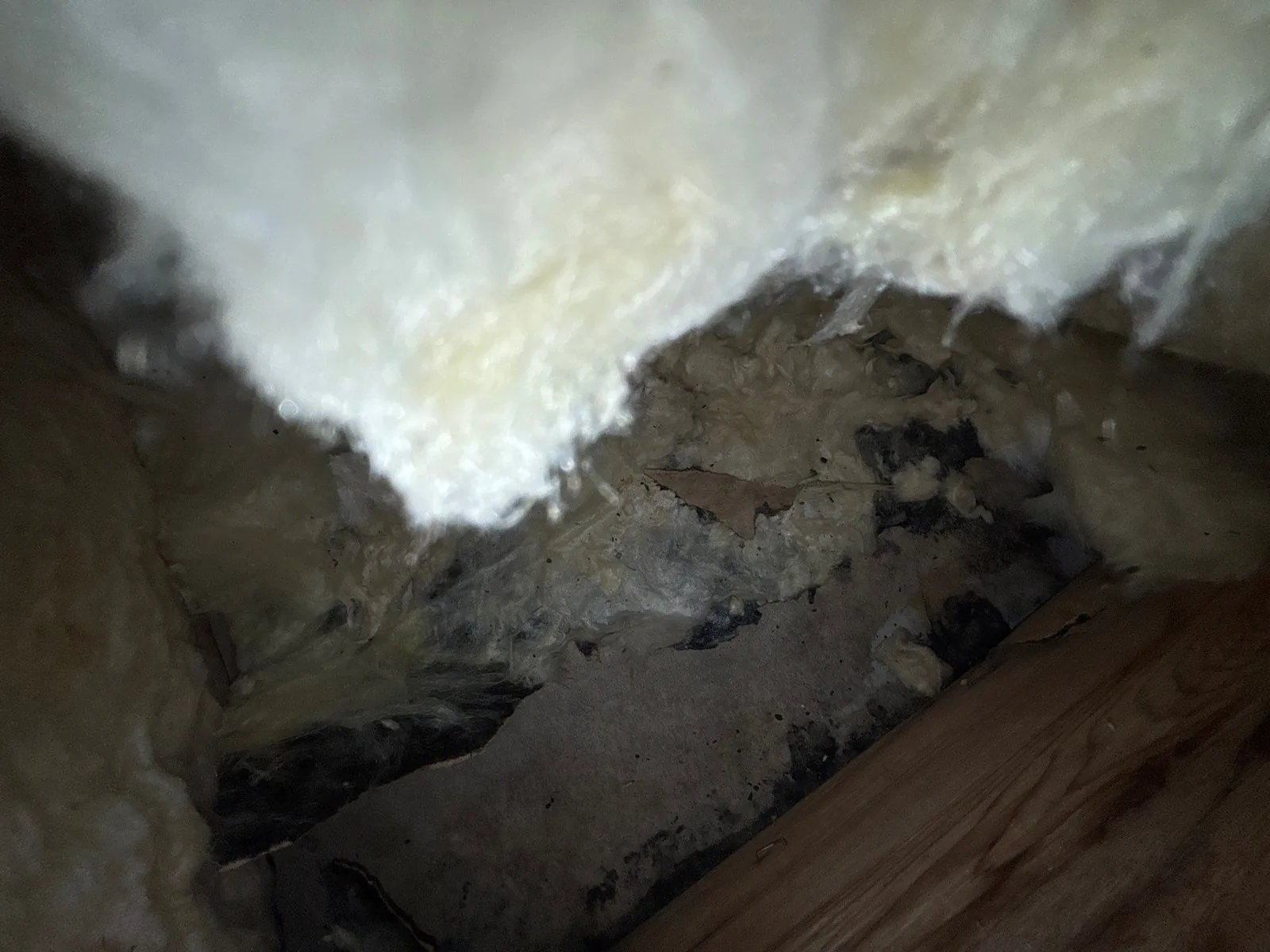
A ceiling that stays wet does not stay a drying job for long. Once mold shows on the materials under the insulation, the work becomes mold remediation, with containment and HEPA filtration, like the bedroom ceiling below. Our crews serving Jackson, NJ handle both.
Wet insulation inside walls
Insulation in a closed wall cannot be dried through the drywall. The paint, the gypsum and often a kraft or plastic vapor retarder all slow evaporation, and the batt stays wet against the studs and bottom plate.
Restorers open the wall instead: inspection holes for a small leak, or a flood cut a short distance above the highest wet line for a larger one. Wet batts come out, and the studs, bottom plate and sheathing are dried and re-read until they match unaffected framing. Only then does anyone insulate and close the wall.
Bathrooms and walls under windows are the usual suspects, because slow leaks there can run for weeks before a stain shows. Our post on signs of water damage behind walls covers what to look for from the room side.
Attic insulation after roof leaks, ice dams and condensation
Attic insulation in the Northeast usually gets wet in one of five ways:
- Ice dams that back meltwater up under the shingles
- Frozen pipes that split in an attic or exterior wall
- Nor'easter wind-driven rain at flashing, vents and skylights
- Attic HVAC units with an overflowing condensate pan or a clogged line
- Bath fans that vent into the attic instead of outdoors
Fix the source first. After a storm that may mean emergency roof tarping; for air handlers, see our guide to HVAC condensation leaks. Keep in mind that rainwater stops being clean once it runs through attic dust, debris or rodent droppings on its way to the insulation, and that changes the verdict (see the water categories below).
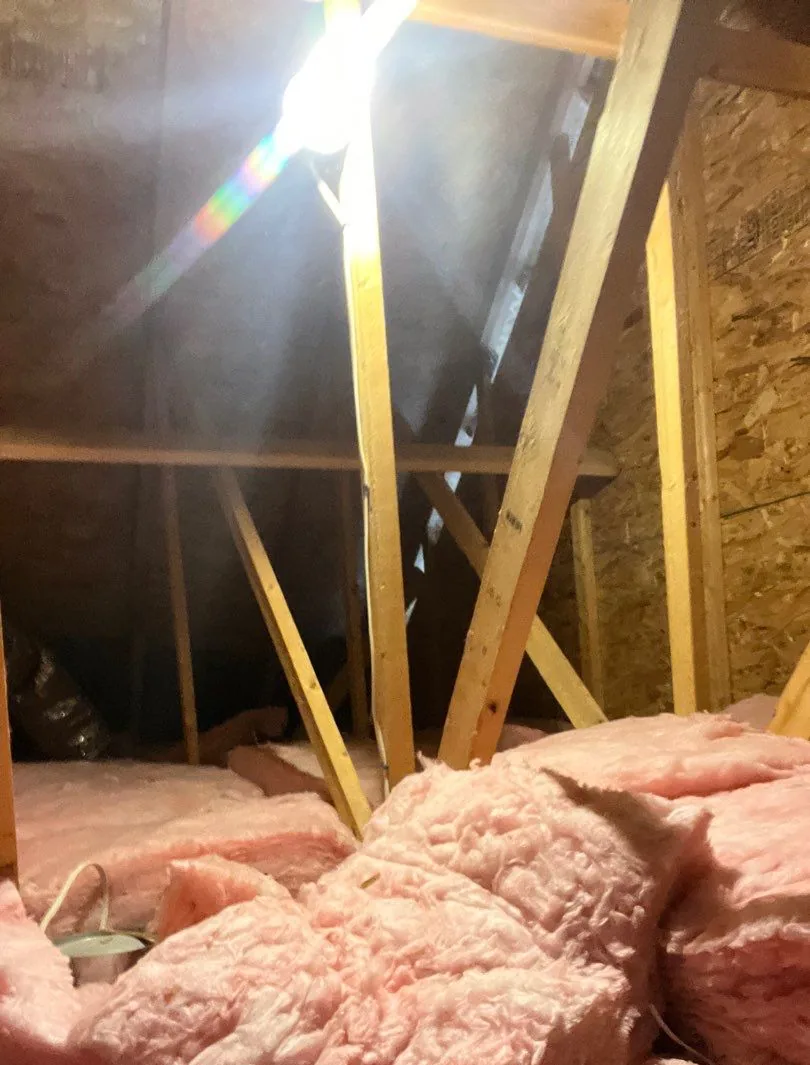
An attic leak also wets the roof sheathing and rafters, and those are where attic mold usually starts. Our crews serving Middletown, NY check the deck and framing along with the insulation, and our guide to preventing mold in the attic explains what keeps it from coming back.
Older attics: vermiculite caution
Some older homes have vermiculite loose-fill, which EPA describes as a pebble-like, pour-in product, usually gray-brown or silver-gold. EPA's guidance on asbestos-contaminated vermiculite insulation is to assume it contains asbestos, leave it undisturbed, not open walls to check for it, and hire a professional asbestos contractor if work would disturb it. A roof leak does not make it safe to scoop out wet vermiculite. Removal belongs with lead and asbestos abatement specialists.
Keeping it dry next winter. Air seal the attic floor and keep ventilation clear to limit ice dams, insulate attic and exterior-wall pipes, check the attic after a nor'easter, add a float switch to the condensate pan, and put a leak sensor under the air handler.
If insulation gets wet, does it need to be replaced?
Usually. Replace it if it is cellulose or open-cell foam, if it is matted or won't regain its thickness, if it smells musty or shows mold, if the water was gray or black water, or if it is still wet after 24–48 hours. Clean-water fiberglass or mineral wool that dries quickly in open air, with dry framing and drywall around it, can sometimes stay.
Signs you can check yourself:
- Visible mold on the facing, the framing or the back of the drywall
- A musty odor that lingers after the leak is fixed
- Insulation that doesn't fluff back to its original thickness
- A ceiling or wall that is still soft after a day or two
Water source changes the answer: IICRC categories
Professional restorers sort water by contamination using the categories in ANSI/IICRC S500, Standard for Professional Water Damage Restoration. Porous insulation can't be cleaned inside its fibers, so the category often settles the question on its own:
| Category | Typical sources | What it means for porous insulation |
|---|---|---|
| Category 1 (clean) | Supply-line break; clean water that has not passed through contaminated materials | May be dried if it meets the conditions above |
| Category 2 (gray) | Washing machine or dishwasher discharge | Remove porous insulation. Cleaning cannot reach inside the fibers. |
| Category 3 (black) | Sewage backup, toilet overflow containing feces, floodwater | Remove and dispose, with containment and protective gear |
Roof or ice-dam water that runs through attic dust, debris or rodent droppings may no longer count as clean, and restorers often treat it as Category 2 or 3. The standard also recognizes that clean water can degrade in category when it sits, or when it passes through contaminated materials, which is one more reason to start drying the same day. CDC notes that people with asthma or mold allergies can react severely to mold, and it advises drying a home fully within 24–48 hours after a flood (CDC, About Mold). For sewage-related losses, see our sewage and Category 3 cleanup service, and for how the standards work in practice, IICRC standards explained.
How we confirm insulation and framing are dry
Drying time is set by readings, not by the calendar. On an insulation loss our crews follow IICRC S500 procedures, roughly in this order:
- Find and stop the source.
- Moisture-map the framing, drywall and sheathing with pin and pinless meters, using thermal imaging only to find spots to check.
- Open ceilings or wall cavities where readings or staining call for it.
- Remove insulation and drywall that fail the criteria above, bagging it inside the work area.
- Set dehumidifiers and air movers on the exposed framing.
- Re-read the same points each day and log the numbers.
- Document photos, readings and removed materials for the insurer, so the scope matches what was actually done.
- Rebuild only when the surrounding materials match unaffected material (the dry standard) and any insulation kept is dry, full thickness and odor-free.
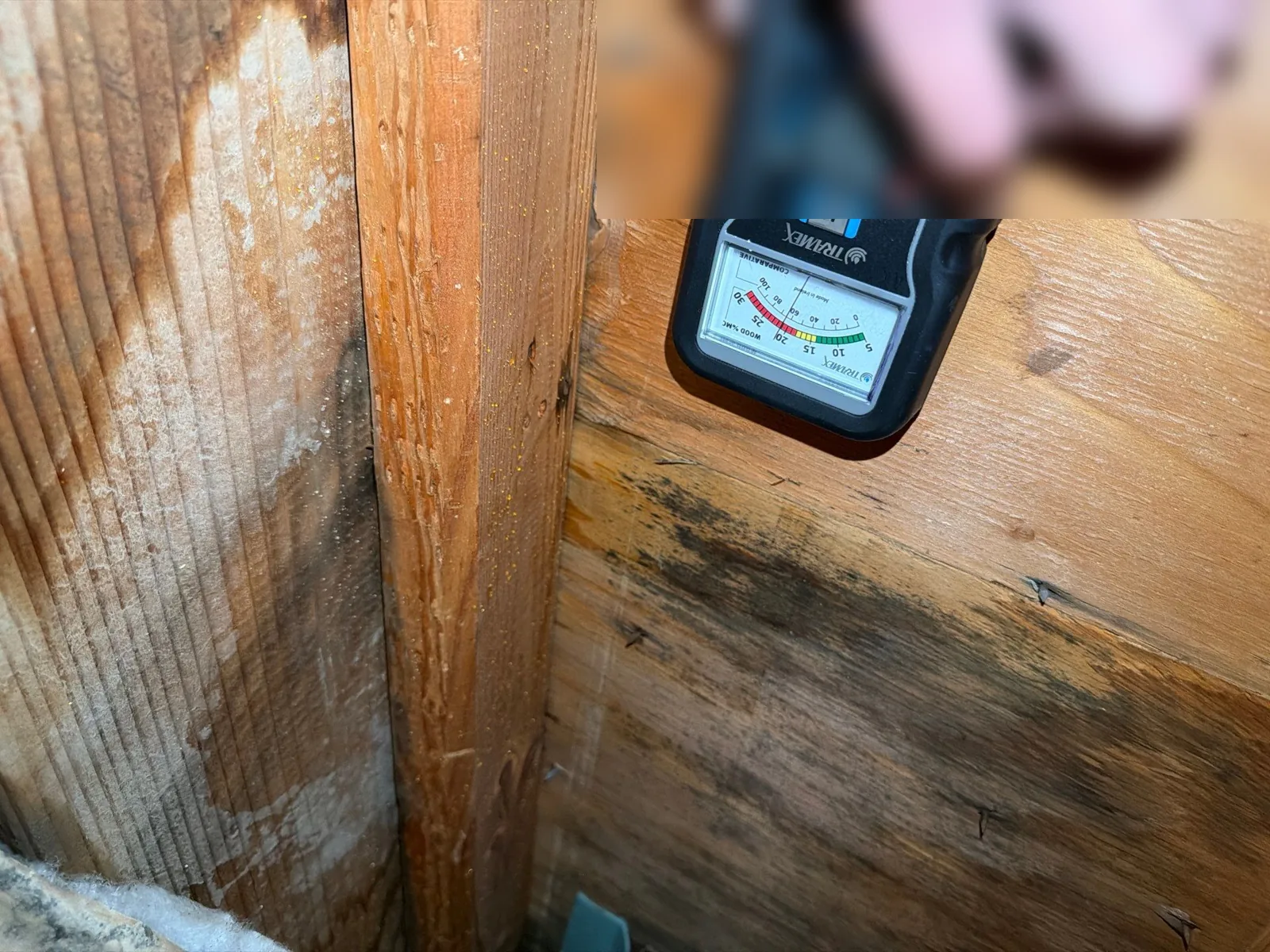
Staining tells you water has been there; the meter tells you whether it still is, and only the meter decides when drying is finished. Our Toms River water damage team covers Point Pleasant Beach and the Jersey Shore; see also the science of structural drying and our water damage restoration service.
What to install after a flood
If floodwater reached the insulation, the replacement choice is partly a code question. FEMA's NFIP Technical Bulletin 2, Flood Damage-Resistant Materials Requirements (January 2025) rates materials as Acceptable or Unacceptable. For insulation, Table 2 of the bulletin lists:
- Acceptable: sprayed polyurethane foam (SPUF) or closed-cell plastic foams
- Unacceptable: fiberglass and mineral wool (batts, blankets or blown), and all other types such as cellulose, cotton and open-cell plastic foams
The requirement applies to buildings in Special Flood Hazard Areas, below the base flood elevation, and state or local codes can be stricter. The bulletin also notes that how materials are combined matters: an assembly that traps water or can't dry can perform poorly even when each material is rated acceptable.
In practice: below flood level, use closed-cell spray foam or closed-cell plastic foam board, installed so water can't sit behind it. Above flood level, mineral wool tolerates incidental wetting better than fiberglass or cellulose, but it is not a flood damage-resistant material under TB-2, so it is not the answer for a basement that floods.
Removal cost and insurance
HomeAdvisor's national data puts routine attic insulation removal at $600–$1,200, with an average of about $900 and about $1–$2 per square foot (HomeAdvisor, updated June 2026; accessed October 2026). That is a baseline for dry, routine removal. Wet, moldy or sewage-affected insulation adds containment, HEPA cleanup and drying, and suspected vermiculite needs professional abatement. Opening the ceiling, drying, drywall and new insulation are typically separate line items.
Coverage depends on the policy and the cause; these are general patterns, not a promise:
- Many homeowners policies cover sudden and accidental water, such as a burst pipe, and exclude damage from a slow, long-running leak.
- Sewer or drain backup is usually excluded unless a water backup endorsement was added to the policy.
- Flood damage requires NFIP or private flood insurance. In a basement, NFIP building coverage is limited; FEMA's archived guidance on what flood insurance covers in a basement lists unpainted drywall and ceilings, including fiberglass insulation, as covered, but not basement improvements such as wall finishes, paint or floor coverings. FEMA notes coverage details can change, so confirm current terms with your flood insurer.
Photograph everything before removal, keep the moisture logs, and confirm details with your own policy and adjuster. Our guide to burst pipe insurance claims walks through the paperwork.
Frequently Asked Questions
How long does wet insulation take to dry?
Aim for dry within 24–48 hours, the window EPA gives for preventing mold, so drying should start the same day. Lightly damp, exposed fiberglass in an opened attic can get there with dehumidifiers and air movers. Insulation sealed behind drywall or a vapor retarder usually will not dry until the cavity is opened, and insulation still wet after about two days should generally be replaced. Dry means the framing and drywall around it read the same as unaffected material.
Will insulation be ruined if it gets wet?
Cellulose, open-cell foam, matted fiberglass and anything exposed to gray water, black water or mold should be treated as ruined. Clean-water fiberglass or mineral wool that dries fast in open air and returns to full thickness may be saved; the verdict table above breaks it down by material.
Will mold grow in wet insulation?
It can. Fiberglass and mineral wool are inorganic, but mold grows readily on kraft facing, on dust trapped in the fibers, and on the wood and drywall around them. Cellulose is paper and feeds mold directly. EPA advises drying within 24–48 hours to prevent it. Mold on facing or framing is handled through mold remediation under ANSI/IICRC S520, with containment for anything beyond a small area; here is the mold remediation process step by step.
Does a ceiling need to be replaced if it gets wet?
Not always. Drywall that is sagging, soft, crumbling or badly stained usually has to go, while a small, firm stain from a quickly stopped leak can sometimes be dried and sealed.
What should I do right away if my insulation gets wet?
Stop the water, cut power to wet fixtures, and keep everyone clear of any sagging ceiling. Then work through the first-steps list above and call (845) 294-8919 any time, day or night, if the ceiling is bulging or the water may be contaminated.
What insulation is best for areas that can get wet?
Below flood level, FEMA rates only closed-cell foams as flood damage-resistant. Above it, mineral wool tolerates incidental wetting better than fiberglass or cellulose. Details and code limits are in the section on what to install after a flood.
Categories
Need Restoration Services?
Our team is available 24/7 for emergency response. Call us today for a free phone consultation.


Questions About Restoration?
Our experts are ready to help. Contact us for a free consultation.