Emergency Temporary Power Solutions for Commercial Buildings
Elsa Boyer is a Regional Operations Manager for Advanced Disaster Recovery, based in Harrisburg, Pennsylvania, overseeing commercial and healthcare restoration projects. She holds a Bachelor of Arts from Valparaiso University and a deep certification portfolio, including ICRA Certified Healthcare Remediator Supervisor and multiple IICRC designations across commercial drying, structural drying, water, and fire & smoke restoration.
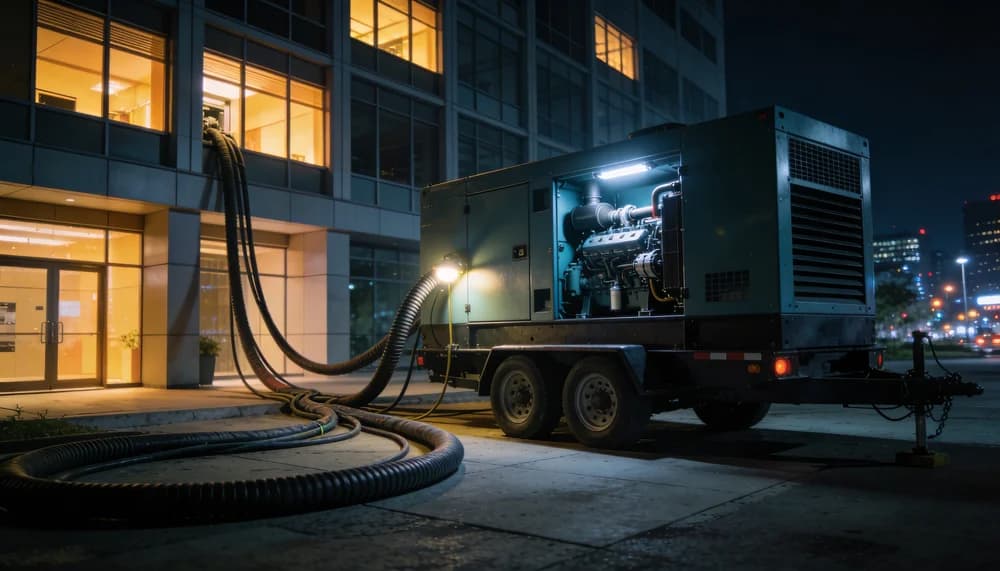
Protect your commercial property during power outages with emergency temporary power solutions from Advanced DRI. Serving NY, NJ, PA & CT 24/7.
When the Grid Goes Down, Your Building Stays at Risk
Commercial property owners and facility managers across New York, New Jersey, Pennsylvania, and Connecticut know that power outages are not just an inconvenience. They represent an active threat to the building itself, its contents, and ongoing business operations. Extended outages can cause tens of thousands of dollars in secondary damage that far exceeds the cost of the outage itself.
Advanced DRI provides emergency temporary power solutions that keep critical building systems operational during outages, preventing the cascade of damage that occurs when heating, cooling, sump pumps, and security systems lose power.
The Hidden Costs of Commercial Power Outages
Frozen Pipe Bursts
When heating systems lose power during winter, building temperatures can drop below freezing within hours. Water pipes in exterior walls, unheated spaces, and fire suppression systems are vulnerable to freezing and bursting. A single burst pipe in a commercial building can release hundreds of gallons of water per hour, causing catastrophic water damage to multiple floors, inventory, equipment, and finishes.
HVAC-Dependent Inventory Loss
Restaurants, grocery stores, pharmaceutical companies, and healthcare facilities depend on climate control to preserve perishable inventory and supplies. Without power, refrigeration and cold storage systems fail, potentially destroying thousands of dollars in inventory within hours.
Sump Pump Failure and Flooding
Many commercial buildings rely on sump pumps to manage groundwater infiltration. When power fails during storms, the very conditions most likely to cause an outage are also the conditions most likely to produce flooding. Without sump pump operation, basements and lower levels flood rapidly.
Security System Failure
Extended outages can exhaust backup batteries on security systems, access control, and surveillance equipment. This leaves commercial properties vulnerable to break-ins, vandalism, and unauthorized access during precisely the conditions when neighborhoods may be darkened and normal activity is disrupted.
Data and IT Infrastructure
Server rooms and data closets require consistent power and cooling. UPS systems provide only limited bridge power. Without extended backup power, servers overheat, data can be lost, and sensitive equipment can be damaged.
Advanced DRI's Emergency Power Services
Our emergency power team deploys, connects, and manages temporary power systems for commercial properties of all sizes. We understand that every hour without power increases the risk of secondary damage, which is why we maintain a fleet of generators and can respond rapidly across our four-state service area.
Generator Sizing and Selection
Proper generator sizing is critical. An undersized generator cannot support essential loads, while an oversized unit wastes fuel and increases costs unnecessarily. Our technicians assess your building's critical power needs and select the right equipment:
- Small portable generators (5-20 kW) for individual critical systems like sump pumps or server rooms
- Medium towable generators (20-100 kW) for small commercial buildings and essential building systems
- Large trailer-mounted generators (100-500+ kW) for full-building power in mid-size commercial properties
- Paralleled generator systems for large commercial facilities requiring redundant power
Professional Installation and Connection
Temporary generator connections must be made safely and in compliance with electrical codes. Improper connections can cause backfeed into utility lines (endangering line workers), damage building electrical systems, and create fire hazards. Our licensed technicians handle all connections using proper transfer switches and distribution equipment.
Fuel Management
Extended outages require reliable fuel supply. Advanced DRI coordinates fuel delivery schedules to keep generators running continuously. We monitor fuel levels and arrange resupply before tanks run low, ensuring uninterrupted power throughout the outage.
Monitoring and Maintenance
Our team monitors generator operation throughout the deployment. Regular checks ensure the equipment runs reliably, load levels remain appropriate, and any issues are addressed before they cause an interruption. For extended deployments, we perform scheduled maintenance including oil changes, filter replacements, and load bank testing.
Industries That Benefit Most from Emergency Power
- Healthcare facilities — Clinics, dental offices, assisted living facilities, and outpatient centers
- Food service and retail — Restaurants, grocery stores, convenience stores, and specialty food businesses
- Property management — Multi-tenant commercial buildings, apartment complexes, and condominiums
- Financial services — Banks, credit unions, and financial offices with critical data systems
- Manufacturing — Facilities with climate-sensitive processes or equipment
- Data centers — When UPS battery life is exhausted before utility restoration
Emergency Power During Restoration Projects
Temporary power is frequently needed during disaster restoration itself. After a fire, flood, or storm, utility power may be disconnected or unsafe. Advanced DRI's restoration teams often require significant electrical capacity to operate drying equipment, dehumidifiers, air scrubbers, and lighting during the restoration process. Our ability to provide our own temporary power means restoration can begin immediately without waiting for utility reconnection.
This integrated approach, combining water damage restoration, fire damage restoration, and emergency power under one company, eliminates delays and coordination problems that occur when multiple contractors are involved.
Planning for Power Resilience
While Advanced DRI is always ready for emergency deployments, proactive planning yields better outcomes. We recommend commercial property owners:
- Identify critical loads — Know which systems must remain operational during an outage
- Install transfer switches — Pre-installed transfer switches allow rapid generator connection
- Establish a relationship with a power provider — Having a provider on speed dial means faster response when an outage occurs
- Consider permanent standby generators — For facilities where any outage is unacceptable
- Test your plan — Verify that backup power plans work before you need them
If your commercial property is experiencing a power outage or you want to develop a power resilience plan, contact Advanced DRI today.
Frequently Asked Questions
How quickly can Advanced DRI deploy emergency power?
We maintain generators in our fleet ready for immediate deployment. In most cases, we can have a generator on-site and connected within hours of your call. Response times vary based on location, generator availability, and the complexity of the connection, but we prioritize speed because every hour without power increases the risk of secondary damage.
Can I connect a generator to my building myself?
We strongly advise against it. Improper generator connections can cause electrical backfeed that endangers utility workers, damages your building's electrical system, and creates fire hazards. Professional connection using proper transfer switches and distribution equipment is essential for safety and code compliance.
How much does emergency temporary power cost?
Costs depend on the generator size, duration of deployment, fuel consumption, and connection requirements. Emergency power is almost always far less expensive than the secondary damage it prevents, such as burst pipes, lost inventory, or flooded basements. Contact us for a rapid assessment and estimate.
Does insurance cover emergency generator costs?
In many cases, temporary power to prevent further damage is a covered expense under commercial property insurance policies. The cost of deploying a generator to prevent pipe freezing, for example, is typically far less than the resulting water damage claim. We can provide documentation to support your insurance claim.
What size generator does my building need?
Generator sizing depends on your critical load requirements. A small office may need only 20 kW to maintain heating, lighting, and IT systems, while a grocery store or restaurant may require 100 kW or more for refrigeration and HVAC. Our technicians assess your specific needs and recommend the right solution.
Categories
Need Restoration Services?
Our team is available 24/7 for emergency response. Call us today for a free phone consultation.

Questions About Restoration?
Our experts are ready to help. Contact us for a free consultation.