Water Damage Restoration
Dehumidification in Water Damage Restoration: Essential Drying Technology
January 24, 202610 min read
T
Tyler McClelland· Mitigation Manager, Hudson Valley Region (NY)
Tyler McClelland leads mitigation operations for Advanced DRI across New York's Hudson Valley, directing water, mold, and large-loss response in the field. He holds IICRC Water Restoration Technician (WRT) and Applied Microbial Remediation Technician (AMRT) certifications and a New York State Mold Supervisor certification, and is trained in IRCA hospital safe construction practices recognized by The Joint Commission.
IICRC Water Restoration Technician (WRT), IICRC Applied Microbial Remediation Technician (AMRT), NY State Mold Supervisor Certification, Lead RRP Certification, OSHA Bloodborne Pathogens Training, IRCA Hospital Safe Construction Practices (TJC), Large Loss Mastery Estimating CertifiedLinkedIn
Published January 24, 2026 · Updated October 10, 2026

Understand why dehumidification is essential for water damage restoration. Learn about professional equipment, drying processes, and why DIY isn't enough.
Why Dehumidification Is Essential After Water Damage
Water damage affects buildings through two mechanisms: direct water contact and elevated humidity. Extraction addresses direct water; dehumidification addresses the humidity that enables continued material absorption and prevents drying.The Physics of Drying
Wet building materials release moisture into surrounding air through evaporation. This moisture transfer continues until the material and air reach equilibrium—equal moisture levels. If air remains humid, materials stop releasing moisture and stay wet. Dehumidification maintains low air humidity, enabling continued evaporation until materials reach safe, dry conditions.Hidden Moisture Reservoirs
After extraction removes standing water, substantial moisture remains in materials:- Drywall absorbs water throughout its thickness
- Wood framing holds moisture deep in grain structure
- Concrete retains water in its porous matrix
- Insulation traps water between fibers
- Carpet pad absorbs multiple times its weight in water
Mold Prevention
Mold requires moisture to grow. Materials remaining above 60% relative humidity provide conditions for mold germination within 24-48 hours. Proper dehumidification maintains conditions below mold growth thresholds, preventing contamination that would require separate mold remediation services.Types of Dehumidification Equipment
Professional water damage restoration uses industrial dehumidification equipment far exceeding consumer-grade units in capacity and efficiency.Refrigerant Dehumidifiers
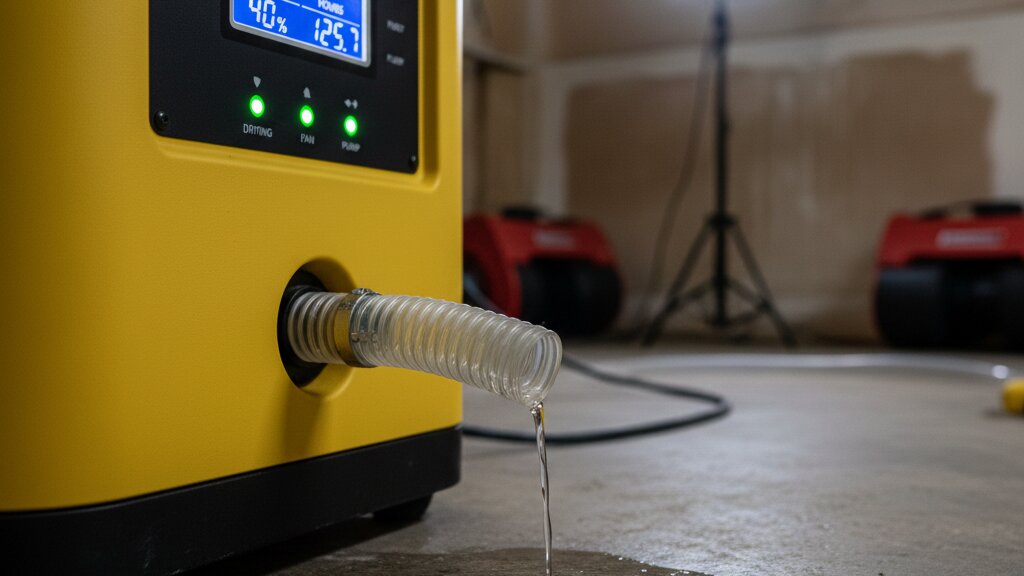
Refrigerant dehumidifiers work by cooling air below its dew point, causing moisture to condense on cold coils. This condensed water drains into collection systems or pumps directly to drains. These units work efficiently in typical indoor conditions (70-90°F, moderate to high humidity).| Refrigerant Dehumidifier Class | Typical Capacity | Best Applications |
|---|---|---|
| Conventional | 30-75 pints/day | Residential spaces, smaller affected areas |
| Low Grain Refrigerant (LGR) | 75-150 pints/day | Standard restoration, achieving lower humidity levels |
| High-capacity LGR | 150-250+ pints/day | Large spaces, heavy moisture loads, commercial restoration |
Desiccant Dehumidifiers
Desiccant dehumidifiers use moisture-absorbing materials (desiccants) to extract humidity from air. Incoming air passes through a desiccant wheel, releasing moisture. The wheel rotates through a regeneration zone where heat drives absorbed moisture to an exhaust stream. Desiccant Advantages:- Effective at lower temperatures where refrigerant units lose efficiency
- Can achieve very low humidity levels
- No condensate water to manage (moisture exhausts as vapor)
- Consistent performance across temperature ranges
- Cold environments (unheated spaces, winter conditions)
- Specialty drying requiring very low humidity
- Crawl spaces and other challenging environments
- Concrete and slab drying
Equipment Selection Factors
Restoration professionals select dehumidification equipment based on multiple factors:- Temperature conditions: Refrigerant units for moderate temperatures; desiccant for cold or variable conditions
- Target humidity levels: LGR or desiccant for achieving low humidity; conventional for moderate targets
- Space characteristics: Equipment capacity matched to volume and moisture load
- Power availability: Equipment electrical requirements matched to available circuits
- Logistics: Equipment size and weight appropriate for access and placement
How Dehumidification Integrates with Drying Systems
Dehumidification doesn't work alone—it functions as one component of integrated drying systems. Understanding this integration explains why professional restoration produces results that DIY approaches cannot match.Air Movement and Dehumidification
Air movers and dehumidifiers work synergistically: Air movers accelerate evaporation by directing airflow across wet surfaces. This airflow disrupts the boundary layer of saturated air that naturally forms above wet materials, enabling faster moisture release. Dehumidifiers remove this evaporated moisture from the air, maintaining low humidity that enables continued evaporation. Without dehumidification, air quickly saturates and evaporation stops regardless of airflow. Neither system works effectively alone. Air movement without dehumidification creates humid air that can't accept more moisture. Dehumidification without air movement leaves boundary layers intact, limiting evaporation rates.Temperature Management
Temperature affects drying rates significantly. Warmer air holds more moisture, enabling faster evaporation—but only with adequate dehumidification to remove that moisture. Professional restoration balances temperature and dehumidification for optimal drying without excessive heat that could damage materials.Equipment Ratios
Professional drying follows established ratios between air movers and dehumidifiers. Industry standards typically specify one dehumidifier for every 10-14 air movers, with adjustments based on specific conditions. These ratios ensure balanced systems that dry efficiently.The Dehumidification Process in Restoration
Professional dehumidification follows systematic protocols ensuring effective, complete drying.Initial Assessment
Before equipment deployment, assessment determines appropriate dehumidification approach:- Affected area measurements for capacity calculations
- Moisture levels in materials establishing baseline conditions
- Environmental readings (temperature, relative humidity, dew point)
- Building characteristics affecting equipment selection
- Power availability for equipment requirements
Equipment Placement
Strategic dehumidifier placement maximizes effectiveness:- Central positioning for air circulation coverage
- Airflow patterns directing humid air toward intake
- Condensate drainage or pump connections
- Integration with air mover positioning
- Access for monitoring and maintenance
Continuous Operation
Dehumidification must continue without interruption throughout the drying process. Equipment runs 24 hours daily until materials reach target moisture levels. Interruptions allow humidity to rise, absorbed moisture to redistribute, and drying progress to reverse.Monitoring and Adjustment
Daily monitoring tracks drying progress and identifies needed adjustments:- Environmental readings compared to targets
- Material moisture readings showing drying progress
- Equipment operation verification
- Condensate production indicating moisture removal
Completion Verification
Drying is complete when materials reach target moisture levels—not simply when surfaces feel dry. Professional verification uses moisture meters to confirm all affected materials have dried appropriately. Premature equipment removal leaves materials wet beneath apparently dry surfaces.Why Consumer Dehumidifiers Aren't Sufficient
Property owners sometimes attempt water damage drying with household dehumidifiers. While understandable, this approach typically produces inadequate results.Capacity Differences
Consumer dehumidifiers remove 20-50 pints daily under ideal conditions. Professional LGR units remove 100-250+ pints daily. Water damage introduces hundreds or thousands of pounds of water into building materials—consumer equipment simply cannot keep pace with moisture release.Performance Limitations
Consumer units are designed to maintain comfortable humidity in already-dry spaces, not to dry wet structures. They lack the grain depression capability to achieve conditions enabling deep structural drying.Runtime and Reliability
Consumer dehumidifiers aren't built for continuous operation under heavy moisture loads. They often cycle off when tanks fill, overheat during extended operation, or simply fail under restoration demands. Professional equipment is engineered for continuous, reliable operation throughout multi-day drying processes.System Integration
Effective drying requires integrated systems with appropriate equipment ratios, strategic placement, and coordinated operation. Consumer dehumidifiers used without proper air movement, containment, and monitoring cannot replicate professional results. Warning: Inadequate dehumidification creates conditions for hidden mold growth. Materials that feel dry on surfaces may remain wet inside, supporting mold contamination that isn't discovered until it spreads extensively. Professional drying with proper dehumidification prevents this dangerous scenario.Special Dehumidification Scenarios
Certain situations require adapted dehumidification approaches addressing specific challenges.Concrete and Slab Drying
Concrete absorbs water slowly but releases it even more slowly. Slab drying may require weeks of dehumidification. Desiccant dehumidifiers often prove most effective for concrete, achieving the low humidity levels needed for deep concrete drying. Surface drying systems may supplement standard dehumidification.Hardwood Floor Drying
Hardwood floors require carefully controlled drying to prevent cupping, crowning, and permanent damage. Excessive dehumidification can dry floors too quickly, causing cracking and deformation. Professional hardwood drying uses specialized systems that control drying rates while dehumidification maintains appropriate environmental conditions.Cold Weather Drying
Refrigerant dehumidifiers lose efficiency as temperatures drop below 65°F and become ineffective below 55°F. Cold weather restoration relies on desiccant dehumidifiers or supplemental heating that raises temperatures into effective ranges for refrigerant equipment.Large Commercial Spaces
Large commercial areas require multiple dehumidifiers with total capacity matched to space volume and moisture load. Strategic placement creates overlapping coverage zones ensuring consistent conditions throughout. Commercial restoration often deploys trailer-mounted or ducted systems serving extensive areas.Frequently Asked Questions About Dehumidification
How long do dehumidifiers need to run after water damage?
+
Dehumidification typically continues for 3-5 days in standard residential water damage, though severe cases may require longer. Runtime depends on water volume, affected materials, and environmental conditions. Professional monitoring determines when materials reach target moisture levels—the only true indicator that drying is complete.
Can I use my household dehumidifier for water damage?
+
Household dehumidifiers cannot adequately address water damage. Their limited capacity cannot keep pace with moisture release from wet materials. Running a consumer unit might provide slight benefit but cannot achieve the conditions necessary for proper structural drying. Professional equipment is essential for complete restoration.
Why are dehumidifiers so loud during restoration?
+
Professional dehumidifiers generate noise from powerful compressors and fans needed for high-capacity moisture removal. While disruptive, this noise indicates equipment working effectively. Restoration companies try to minimize impact through equipment placement and scheduling, but some noise is unavoidable during active drying.
What humidity level should be achieved during drying?
+
Professional drying typically targets 40-50% relative humidity in the drying environment. This level creates sufficient vapor pressure differential for efficient moisture removal from materials. Target humidity may vary based on material types, starting conditions, and regional climate norms.
Do dehumidifiers increase electric bills significantly?
+
Professional dehumidifiers consume substantial electricity—typically 800-1500 watts depending on capacity. Running multiple units continuously does increase electricity costs during restoration. However, this cost is typically covered by insurance as part of restoration expenses and is far less than costs of mold remediation from inadequate drying.
Why do restoration companies monitor dehumidifiers daily?
+
Daily monitoring verifies equipment operation, tracks drying progress, and identifies needed adjustments. Equipment can malfunction, environmental conditions change, and hidden moisture reservoirs emerge during drying. Monitoring ensures continuous effective operation and enables adjustments that optimize drying outcomes.
Professional Dehumidification Services
Proper dehumidification makes the difference between complete restoration and ongoing problems from hidden moisture. Professional dehumidification equipment, strategic deployment, and expert monitoring ensure thorough drying that protects buildings from secondary damage. When water damage affects properties in Northern New Jersey, Pennsylvania's Capital Region, New York's Hudson Valley, Connecticut's Capital Region, or the South Jersey Shore, professional restoration teams deploy industrial dehumidification systems that thoroughly dry structures, preventing mold and preserving property integrity.Categories
Need Restoration Services?
Our team is available 24/7 for emergency response. Call us today for a free phone consultation.

Questions About Restoration?
Our experts are ready to help. Contact us for a free consultation.