
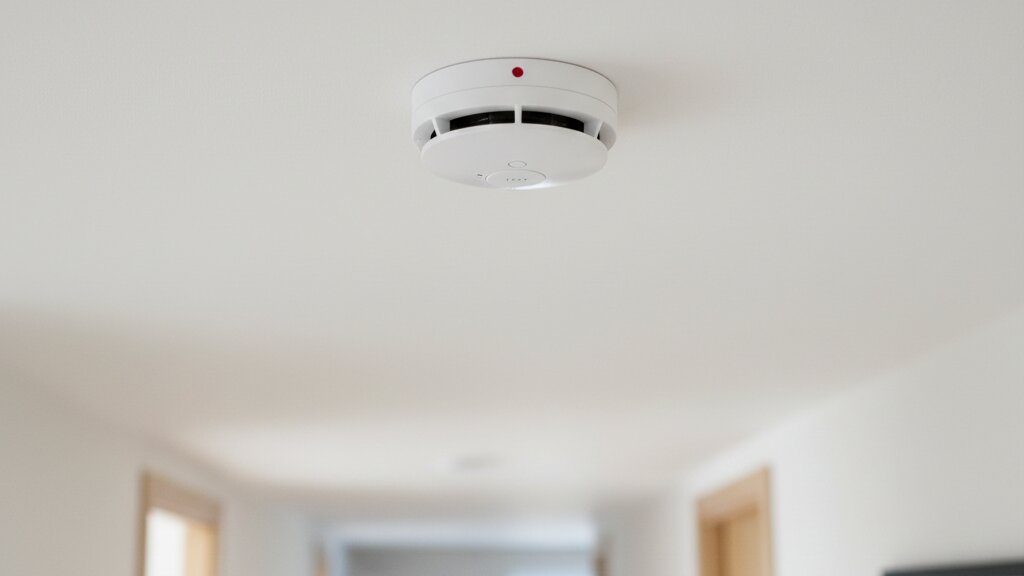
Understanding proper smoke detector placement and fire safety home systems protects lives and property. Correct smoke alarm installation ensures early fire detection when it matters most. Modern fire detection systems combine multiple technologies for comprehensive protection. Strategic smoke detector placement throughout homes provides the earliest possible warning, allowing time for safe evacuation and minimizing fire damage.
Understanding Smoke Detector Types
Two main smoke detector technologies work differently and excel in different situations within fire detection systems.
Ionization Smoke Detectors
Ionization detectors use a small amount of radioactive material to ionize air in a sensing chamber. Smoke particles disrupt this ionization, triggering the alarm.
- Best for: Fast-flaming fires with smaller particles
- Response time: Quick for flaming fires
- Limitations: Slower response to smoldering fires
- Common issue: More prone to false alarms from cooking
Photoelectric Smoke Detectors
Photoelectric detectors use a light beam and sensor. Smoke particles scatter the light beam onto the sensor, triggering the alarm.
- Best for: Smoldering fires that produce larger smoke particles
- Response time: Quick for smoldering fires
- Limitations: Slightly slower for fast-flaming fires
- Advantage: Fewer false alarms from cooking
Dual-Sensor Detectors
Dual-sensor (combination) detectors include both ionization and photoelectric technology, providing comprehensive detection regardless of fire type. These are increasingly recommended as the best protection option.
Smart Smoke Detectors
Connected smoke detectors offer additional features:
- Smartphone alerts when alarms activate
- Remote monitoring when away from home
- Self-testing and maintenance alerts
- Integration with home automation systems
Required Smoke Detector Locations
Building codes specify minimum requirements for smoke detector placement, though additional detectors enhance fire safety home protection.
Minimum Requirements (Most Jurisdictions)
- Every bedroom: Detectors inside each sleeping room
- Outside sleeping areas: Detectors in hallways or areas adjacent to bedrooms
- Every level: At least one detector on each floor, including basements
Recommended Additional Locations
- Living rooms and family rooms: Major living spaces where fires may start
- Near kitchens: Close enough to detect kitchen fires, far enough to avoid cooking false alarms
- Garage entry areas: Adjacent to attached garages
- Attic spaces: Where electrical fires may start undetected
- Utility rooms: Near water heaters and furnaces
| Location | Detector Type Recommendation | Placement Notes |
|---|---|---|
| Bedrooms | Photoelectric or Dual | On ceiling or high on wall |
| Hallways | Photoelectric or Dual | Central location, between bedrooms |
| Kitchen Area | Photoelectric | 10+ feet from cooking appliances |
| Living Rooms | Dual Sensor | Away from fireplaces and vents |
| Basement | Dual Sensor | Near stairway, away from furnace |
| Garage Adjacent | Photoelectric | Inside house near garage entry |
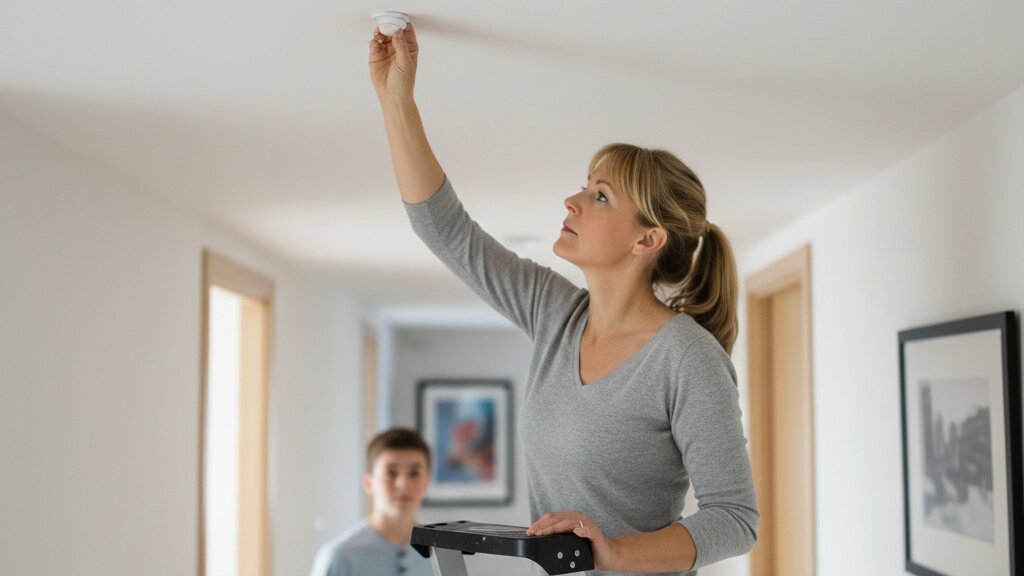
Proper Smoke Detector Mounting
Where and how you mount detectors affects their effectiveness. Proper smoke alarm installation techniques ensure optimal smoke detector placement.
Ceiling Mounting (Preferred)
- Mount on ceiling at least 4 inches from walls
- Center of room is ideal when practical
- Smoke rises—ceiling mounting detects fastest
Wall Mounting (Alternative)
- When ceiling mounting isn’t possible
- Mount 4-12 inches below ceiling
- Never more than 12 inches from ceiling
Locations to Avoid
- Near windows or doors: Drafts interfere with smoke reaching detector
- Near vents or fans: Air movement disperses smoke
- In dead air spaces: Corners where ceilings and walls meet
- In kitchens: Too close to cooking (within 10 feet) causes false alarms
- In bathrooms: Steam causes false alarms
- In garages: Temperature extremes and exhaust affect reliability
- Near fluorescent lights: Electrical interference possible
Pro Tip: In peaked or cathedral ceilings, mount detectors 3 feet from the peak. The apex may trap hot air that prevents smoke from reaching detectors mounted at the highest point.
Smoke Detector Maintenance
Detectors require regular maintenance to function properly when needed as part of comprehensive fire safety home systems.
Monthly Testing
- Press test button until alarm sounds
- Verify all household members can hear alarm
- Replace batteries if alarm doesn’t sound during test
Battery Replacement
- Replace batteries at least annually
- Some recommend changing with daylight saving time as a reminder
- Replace immediately if low-battery chirping begins
- Sealed battery units require replacement when batteries die (typically 10 years)
Cleaning
- Vacuum detector openings gently every 6 months
- Dust accumulation can affect sensitivity
- Never paint over detectors
Detector Replacement
- Replace detectors every 10 years
- Check manufacture date on the unit
- Sensitivity degrades over time
- Technology improvements make newer detectors more reliable
Carbon Monoxide Detection
Carbon monoxide (CO) detectors, while different from smoke detectors, are essential fire safety home companions.
CO Detector Placement
- Near sleeping areas (required by code in many jurisdictions)
- On every level with fuel-burning appliances
- Near attached garages
Combination Devices
Combination smoke/CO detectors simplify installation and maintenance while providing both critical protections.
Interconnected Detector Systems
Interconnected detectors provide enhanced protection—when one alarms, all alarm. These advanced fire detection systems offer superior safety.
Benefits
- Basement fire alerts entire house immediately
- Earlier warning throughout larger homes
- Especially important for sleeping areas
Options
- Hardwired: Connected through home wiring during construction or renovation
- Wireless: Communicate via radio signal—retrofittable to any home
Creating a Fire Safety Plan
Smoke detectors work alongside comprehensive fire safety home planning.
Escape Planning
- Two exit routes from every room
- Meeting place outside the home
- Practice drills at least twice yearly
- Special provisions for children, elderly, or disabled family members
Fire Extinguishers
- ABC-rated extinguishers for general home use
- Kitchen location readily accessible
- Know how to use them BEFORE emergencies
Frequently Asked Questions About Smoke Detectors
Why does my smoke detector keep going off while cooking?
+
The detector may be too close to the kitchen (within 10 feet of cooking appliances) or may be ionization type, which is more sensitive to cooking particles. Solutions include relocating the detector further from the kitchen for better smoke detector placement, switching to a photoelectric detector for that location, or using a detector with a “hush” feature for temporary silencing during cooking.
How often should I replace smoke detector batteries?
+
Replace standard batteries at least once per year—many people change them when clocks change for daylight saving time as a reminder. If the detector chirps indicating low battery, replace immediately. Some newer detectors have sealed 10-year batteries; replace the entire unit when these batteries die.
Do I really need smoke detectors in every bedroom?
+
Yes—current codes require detectors inside each bedroom. Proper smoke detector placement includes bedroom locations because closed bedroom doors (which are good for fire safety) prevent hallway detectors from alerting sleeping occupants quickly enough. Bedroom detectors provide the earliest possible warning for people at greatest risk during nighttime fires.
Are smart smoke detectors worth the extra cost?
+
Smart detectors offer valuable benefits: phone alerts when you’re away from home, self-testing features, and easy interconnection without wiring. For frequent travelers or larger homes, these features provide significant advantages. For basic protection, standard battery-powered detectors work well with proper maintenance and correct smoke alarm installation.
My smoke detector is 15 years old but still works. Should I replace it?
+
Yes, replace it immediately. Manufacturers recommend replacement every 10 years because detector sensitivity degrades over time. A 15-year-old detector may pass the test button check but fail to detect actual smoke quickly enough. The manufacture date is printed on the unit—check and replace detectors exceeding 10 years.
Which is better: ionization or photoelectric smoke detectors?
+
Neither is universally “better”—they detect different fire types faster. Ionization responds quicker to flaming fires; photoelectric responds quicker to smoldering fires. For comprehensive protection with optimal smoke detector placement, use dual-sensor detectors that include both technologies, or install both types throughout your home.
Fire Safety and Professional Restoration
Proper smoke detector placement and fire safety home planning help prevent fires and minimize damage when they occur. Correct smoke alarm installation enables faster response, quicker evacuation, and earlier fire department notification—all of which limit fire and smoke damage.
When fires do affect properties in Northern New Jersey, Pennsylvania’s Capital Region, New York’s Hudson Valley, Connecticut’s Capital Region, or the South Jersey Shore, 24-hour emergency restoration services respond quickly to begin cleanup and restoration, helping families recover from fire events.